

A dashcam can sometimes reduce your car insurance premium, but it is not automatic. Whether you qualify for a dashcam insurance discount depends on your insurer, the model you buy, how it is fitted, and whether you declare it correctly at quote stage.
Key caveats to know before you buy:
-
Not every insurer offers a discount. Some simply accept footage as evidence without reducing your premium.
-
Declaration is mandatory. You must tell your insurer you have a dashcam, usually at the point of quoting.
-
Model and installation conditions apply. Some insurers specify GPS, continuous recording, or cloud upload capability.
-
Footage must be available on request. Declaring a dashcam and then failing to supply footage can put your claim at risk.
Pro Tip: After any incident, press the manual lock button on your dashcam immediately to protect the clip from being overwritten. Copy the original file to a separate device before you do anything else.
Key takeaways
| Point | Details |
|---|---|
| Discounts are conditional | Not every insurer offers a reduction; declare at quote and confirm eligibility conditions before buying. |
| GPS and timestamp are essential | Footage without location and time data is far harder for insurers and police to act on. |
| Hardwiring requires disclosure | A hardwired installation may be treated as a modification; declare it to avoid cover being invalidated. |
| Preserve originals immediately | Lock the clip and copy the unedited file after any incident; automatic overwrite can destroy evidence. |
| Thatcham Trackers | Supplies S5, S5 Plus, and S7 certified trackers and 4G dashcams that meet common insurer acceptance criteria. |
Table of Contents
- What does a dashcam do, and why do insurers care?
- Do UK insurers offer a dashcam insurance discount?
- How does dashcam footage affect your claim and no-claims discount?
- How to qualify for a dashcam discount: the eligibility checklist
- UK legal and privacy rules for dashcam use
- What features do insurers prefer in a dashcam?
- Does hardwiring a dashcam affect your insurance?
- What does a dashcam cost, and what savings can you realistically expect?
- How to preserve and submit dashcam footage after an incident
- What should you do next?
- Thatcham-approved hardware that meets insurer requirements
- Sources
- FAQ
What does a dashcam do, and why do insurers care?
A dashcam is a compact camera mounted to the windscreen or dashboard that records continuously while you drive. Most models loop-record onto an SD card, overwriting older footage when storage is full.
Common types include:
- Single front-facing cameras covering the road ahead
- Dual front and rear units that record both directions simultaneously
- Internal driver cameras that capture the cabin as well as the road
- 4G/cloud models that upload footage remotely and allow live viewing
Insurers value dashcam footage because it establishes fault quickly, reduces fraudulent claims (including staged “crash-for-cash” collisions), and speeds up liability decisions. Footage with a clear GPS location stamp and accurate timestamp is far more useful to a claims handler than footage without. Image quality matters too: a camera that produces blurred or underexposed night footage may not be accepted as reliable evidence.
Do UK insurers offer a dashcam insurance discount?
Some insurers offer discounts for dashcams, but the practice is not universal across the UK market. The more consistent benefit is evidentiary: a dashcam that proves non-fault can protect your no-claims discount (NCD) and prevent an excess payment, which is often worth more than a modest premium reduction.
Reported typical discount ranges sit around 10–15%, with some specialist brokers advertising higher. Adrian Flux, for example, advertises up to 15% for listed in-car cameras. Vendor-partnered offers also exist: Nextbase runs insurance partnerships that advertise savings for customers who buy through their channel, though these are commercial arrangements rather than market-wide rules.
Market reality: Discounts are conditional and insurer-specific. Comparing quotes with and without a declared dashcam on sites such as MoneySuperMarket or CompareTheMarket is the most reliable way to see whether your insurer prices it in.
Discount figures are illustrative ranges reported in consumer guides; confirm current terms directly with each insurer.
How does dashcam footage affect your claim and no-claims discount?
Dashcam footage helps insurers determine fault and can accelerate liability decisions that would otherwise take weeks. The practical outcomes for drivers are significant:
- Preserved NCD: Footage that proves you were not at fault means the claim is recorded as non-fault, protecting your discount.
- Avoided excess: A clear non-fault determination can prevent you paying an excess you would otherwise lose.
- Faster settlement: Liability agreed early means repairs and hire cars are arranged sooner.
- Fraud protection: Footage showing a staged collision gives your insurer grounds to reject a fraudulent third-party claim.
Insurers may ask for footage during an investigation. Some provide a secure upload link; others request the original SD card file by email or post. Evidence handling is time-sensitive: dashcam systems overwrite storage automatically, so copying the original file immediately after an incident is not optional.
Pro Tip: Store a copy of incident footage in at least two places, such as a USB drive and a cloud folder, before you contact your insurer. Insurers and police prefer the unedited original export with full GPS metadata intact.
How to qualify for a dashcam discount: the eligibility checklist
Meeting insurer conditions is straightforward once you know what they are. The steps below cover the most common requirements.
Declare the dashcam at quote
When using a comparison site such as CompareTheMarket or MoneySuperMarket, look for the dashcam field in the quote form and select “yes.” If no field appears, call the insurer directly before binding cover.
Sample wording when speaking to an insurer:
Meet the model and feature requirements
Most insurers that offer car insurance dashcam savings specify one or more of the following:
- GPS location data embedded in footage
- Accurate timestamp on every frame
- Continuous loop recording (not event-only)
- Parking mode or cloud upload for unattended incidents
- Sufficient video resolution for number-plate legibility
Understand installation implications
Plug-in units (USB or 12V socket) are generally treated as accessories. Hardwired installations, where the camera is wired directly to the vehicle’s fuse box, may be classified as a modification. Failing to disclose a hardwired fitment can risk invalidating cover, so declare it explicitly. For guidance on compliant installation, the insurance approved tracker best practices guide covers plug-in versus hardwired setups in detail.
Keep footage available
- Retain footage for at least 30 days or until any incident is fully resolved.
- Do not edit, trim, or apply filters to original files.
- Back up incident clips immediately to a separate device.
Pro Tip: When you renew your policy, re-declare the dashcam even if nothing has changed. Insurers sometimes reset policy data at renewal, and an undeclared device at that point creates the same risk as never declaring it.
UK legal and privacy rules for dashcam use
Fitting and using a dashcam in the UK is legal, but a few rules apply.
Highway Code placement: The camera must not obstruct your view of the road. The accepted practice is to mount it within the 40mm wiper-cleared zone at the top of the windscreen, keeping it out of the driver’s direct line of sight. Mounting it low on the windscreen or in front of the steering wheel risks a “driving without due care” charge if it impairs visibility.
Data protection and GDPR: A dashcam records other road users, which means you are processing personal data. The lawful basis is legitimate interest (road safety and evidence). Practical obligations include:
- Not sharing footage publicly unless it is genuinely in the public interest
- Deleting footage you no longer need, typically after 30 days
- Providing footage to police when lawfully requested
Sharing footage: Uploading incident footage to social media before a claim is settled can complicate your case. Share footage only with your insurer, the police, or your legal representative until the matter is closed.
Most insurers and consumer guides recommend a 30-day retention period as standard practice, deleting older footage unless it relates to a specific incident.
What features do insurers prefer in a dashcam?
The features below are the ones most commonly referenced in insurer guidance and consumer comparisons when assessing whether footage will be accepted or a discount awarded.
- GPS and timestamp: The single most important feature. Footage without location and time data is far harder to use in a dispute.
- Continuous loop recording: Event-only cameras may miss the seconds before an incident. Continuous recording captures the full context.
- Night-vision sensor: Models using Sony STARVIS or equivalent low-light sensors produce usable footage in darkness. Poor night footage is frequently rejected as inconclusive.
- Parking mode: Records impacts or movement when the vehicle is unattended, useful for hit-and-run claims.
- Cloud or 4G upload: Allows footage to be retrieved remotely and reduces the risk of losing evidence if the camera is stolen or damaged.
- Tamper-evident export: Original files with intact metadata are harder to challenge as edited.
Pro Tip: Prefer models that allow easy export of the original file, not just a compressed app preview. Insurers and police request the original format, and some apps only share a lower-quality copy.
When it comes to insurance approved dash cams, the combination of GPS, continuous recording, and reliable night vision covers the majority of insurer requirements. Thatcham-approved trackers (S5, S5 Plus, S7) carry independent certification from Thatcham Research, the UK’s central automotive risk intelligence organisation, which insurers use directly when assessing device credibility.
Does hardwiring a dashcam affect your insurance?
Hardwiring connects the camera directly to the vehicle’s fuse box, providing a permanent power supply and enabling parking mode. The trade-off is that it alters the manufacturer’s original specification, which many insurers classify as a vehicle modification.
- Plug-in units (USB or 12V socket) are generally not treated as modifications and carry no disclosure risk beyond declaring the device itself.
- Hardwired units should be declared as a modification when taking a quote or updating a policy. The risk of non-disclosure is cover invalidation or a rejected claim.
Recommended steps for hardwired installations:
- Tell your insurer before or immediately after fitting.
- Ask the installer for a written note confirming the work, the parts used, and that the installation is reversible.
- Keep that documentation with your policy papers.
Hardwiring a dashcam may be treated as a vehicle modification that should be disclosed; the hardwired car tracker guide covers best practice for powered setups in detail.
Pro Tip: Ask your installer to supply a brief written installation note on headed paper. A single paragraph confirming the make, model, and method is usually sufficient for an insurer.
What does a dashcam cost, and what savings can you realistically expect?
Dashcam prices in the UK span a wide range depending on features.
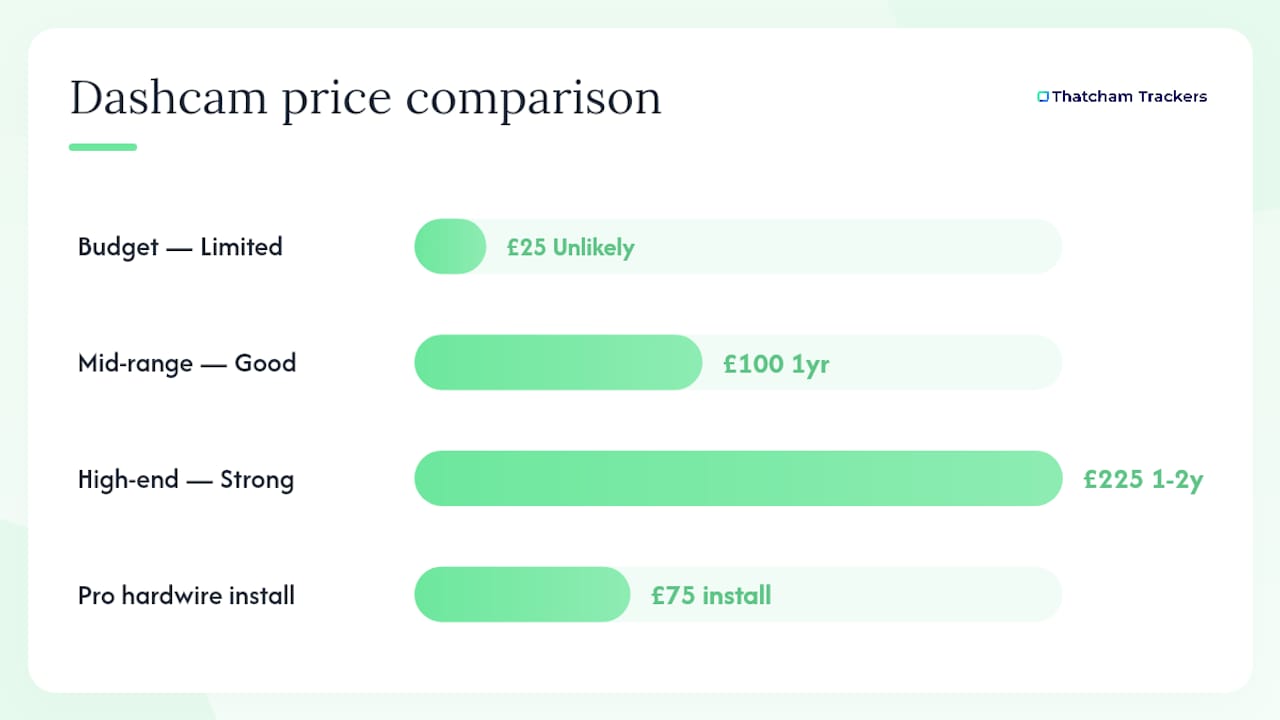
- Budget (under £50): Basic front-facing recording, limited night vision, no GPS. Unlikely to meet insurer GPS requirements for a discount.
- Mid-range (£50–£150): GPS, timestamp, decent low-light sensor, continuous loop. Covers most insurer eligibility conditions.
- High-end (£150–£300+): Dual front and rear, 4G/cloud upload, parking mode, Sony STARVIS sensor. Meets the most demanding insurer specifications.
Hardwiring installation by a professional typically costs £50–£100 on top of the camera price. Plug-in units require no installation cost.
Typical discount ranges sit around 10–15%, with illustrative average savings reported in the low hundreds of pounds annually where insurers offer them. A mid-range camera at £100, fitted plug-in, could pay for itself within the first policy year if your insurer prices in a discount. The more consistent financial benefit, however, is NCD protection: a preserved no-claims discount over several years is worth considerably more than a one-off premium reduction.
| Price band | Typical cost | Likely insurer acceptance | Estimated payback |
|---|---|---|---|
| Budget | Under £50 | Limited (no GPS) | Unlikely via discount alone |
| Mid-range | £50–£150 | Good (GPS + timestamp) | Within 1 policy year |
| High-end | £150–£300+ | Strong (GPS, cloud, parking) | Within 1–2 policy years |
How to preserve and submit dashcam footage after an incident
Acting quickly after an incident is the difference between usable evidence and a blank SD card.
- Lock the clip immediately. Press the manual incident lock button on the camera before you move the vehicle. This prevents the loop from overwriting the footage.
- Copy the original file. Remove the SD card and copy the full original file to a laptop, USB drive, or cloud folder. Do not edit, trim, or rename the file.
- Note the timestamp and GPS data. Confirm the camera’s time was accurate before the incident. If the clock was wrong, note the discrepancy.
- Document the scene. Take photos of vehicle positions, road markings, and any damage. Note witness details.
- Contact your insurer. Report the incident and state that you have dashcam footage available. Ask for their preferred submission method (secure upload link, email, or physical media).
- Submit the original file. Send the unedited export, not a screenshot or app preview. Include the GPS track file if your camera produces one separately.
Dashcam footage assists liability investigations but is time-sensitive; preserve and submit original files promptly to insurers or police.
Pro Tip: Name the file clearly before sending: “YYYY-MM-DD_incident_[your registration].mp4” makes it easy for claims handlers to locate and log. Include a brief covering note with the date, time, location, and a one-sentence description of the incident.
What should you do next?
A dashcam is worth fitting for the evidence benefit alone. The premium reduction, where it exists, is a bonus.
Three steps to act on now:
- Buy a mid-range or higher model with GPS, timestamp, and continuous loop recording. These features cover the majority of insurer eligibility conditions.
- Declare the dashcam at your next quote or renewal. Use comparison sites that include a dashcam field, and call your insurer directly if the field is absent.
- Preserve footage immediately after any incident. Lock the clip, copy the original file, and submit the unedited export to your insurer.
Compare policy wording carefully. The discount matters less than whether your insurer will accept footage and protect your NCD when it counts.
A note from Thatcham Trackers
Dashcams deliver real value, but the premium reduction is often overstated in marketing. The more reliable benefit is evidentiary: clear, timestamped footage that proves non-fault and protects a no-claims discount built up over years. Thatcham Trackers supplies Thatcham Research-certified hardware, including S5, S5 Plus, and S7 trackers, that insurers recognise directly. Pairing a certified tracker with a quality dashcam gives insurers two independent reasons to view a vehicle favourably at renewal.
Thatcham-approved hardware that meets insurer requirements
Drivers who want hardware insurers will accept without question have a straightforward option. Thatcham Trackers supplies Thatcham-approved trackers certified to S5, S5 Plus, and S7 standards, alongside 4G dashcams with remote live view, GPS tracking, and cloud upload built in.
The S7 certification is the highest level Thatcham Research awards, and many insurers require or reward it explicitly in their policy wording. The 4G dashcam with five years of tracking bundles continuous recording, GPS timestamp, and long-term tracking service into a single unit, covering the features most commonly cited in insurer eligibility conditions. Nationwide mobile installation is available, with professional fitting documentation supplied as standard.
Browse the Thatcham-approved tracker range or view the S7 collection to find the certified option that matches your insurer’s requirements.
Sources
- Does a dash cam reduce car insurance? | MoneySuperMarket
- Confused
- Can a car dash cam help with insurance claims? - Aviva
- Dash Cam Car Insurance | Safe Driver Discount - Nextbase
This article is general information, not a substitute for advice from a qualified financial advisor. Consult a qualified financial professional about your own circumstances before acting on anything here.
FAQ
How much does a dashcam reduce insurance in the UK?
Typical reported discounts sit around 10–15% where an insurer offers one, though not all do. The financial benefit also includes NCD protection, which can be worth more than the premium reduction over several years.
Do I need to tell my insurer if I fit a dashcam?
Yes. You should declare a dashcam at quote or policy update so eligible insurers can apply any available discount. Failing to declare a hardwired unit in particular can risk invalidating your cover.
Can dashcam footage protect my no-claims discount?
Clear timestamped footage that proves you were not at fault can secure a non-fault outcome, which preserves your NCD and may prevent you paying an excess. Aviva confirms that footage is increasingly accepted for this purpose.
What happens if I declare a dashcam but cannot provide footage?
Failing to supply footage after declaring a dashcam may lead to a discount being reclaimed or a claim being challenged. Always back up incident footage immediately and keep it available until the matter is resolved.
Do learner drivers benefit from fitting a dashcam?
A dashcam provides the same evidentiary benefit for learners as for full licence holders. For more on insurance obligations for learners, UK insurance rules for learner drivers covers the key requirements.