

An agreed value insurance tracker is a security device mandated by insurers to protect your vehicle and uphold the terms of an agreed value policy, guaranteeing the fixed payout amount if your vehicle is stolen or written off. Unlike standard motor insurance, which pays out based on your car’s market value at the time of the claim, agreed value insurance locks in a specific sum at the start of the policy. For that guarantee to hold, insurers frequently require a compliant tracker as a binding condition. Understanding what is agreed value insurance tracker means understanding both the device and the contract behind it.
What is an agreed value insurance tracker and how does it work?
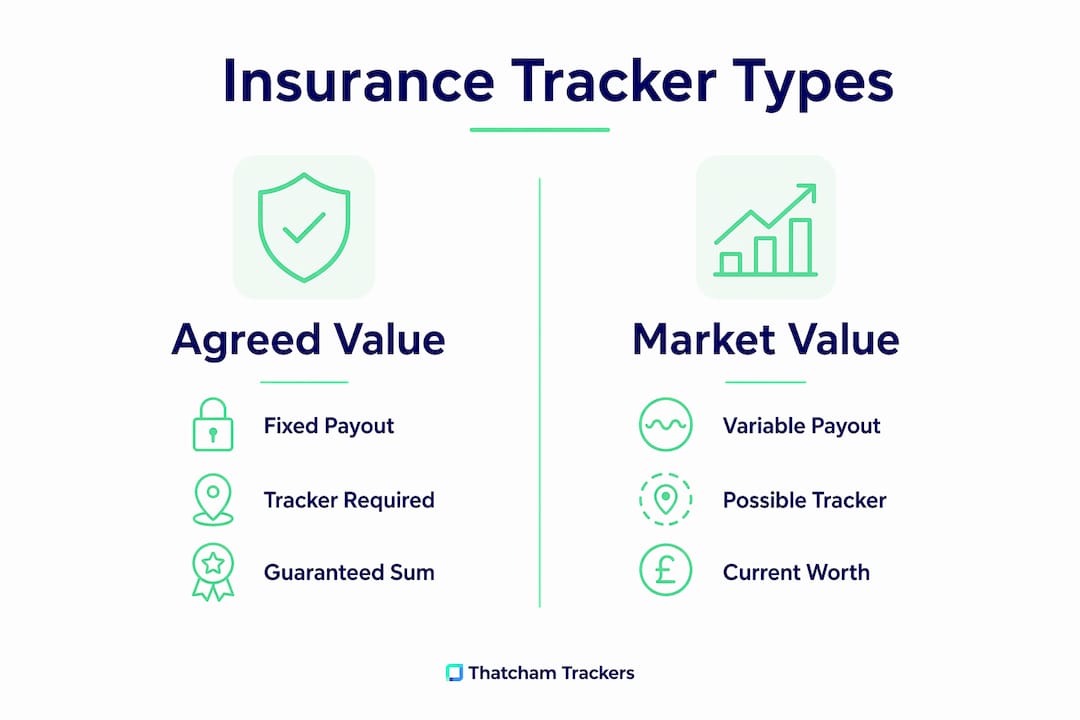
Agreed value insurance sets a fixed payout at policy inception, protecting owners from market depreciation and guaranteeing the agreed amount if the vehicle is lost. This differs fundamentally from standard market value policies, which pay based on what the car is worth on the day of the claim. For classic cars, modified vehicles, or appreciating models, that distinction is financially significant.
The tracker enters the picture as a condition of the insurer’s willingness to honour that fixed sum. Insurers take on greater financial exposure with agreed value policies. A tracker reduces that risk by enabling theft recovery, supporting underwriting decisions, and demonstrating that the owner has taken active steps to protect the vehicle. Without a tracker, the insurer’s risk calculation changes, and so does their willingness to pay the agreed figure.

At policy inception, the insurer and policyholder agree the vehicle’s value, often supported by a valuation certificate from an independent appraiser. That certificate formalises the fixed payout and supports the policy declaration. The tracker requirement is then written into the policy schedule as a condition of cover, not a suggestion.
Key functions a tracker performs within these policies include:
- Theft recovery support: GPS location data helps police and recovery services locate the vehicle quickly after theft.
- Risk reduction for insurers: Active monitoring reduces the insurer’s exposure on high-value agreed sum policies.
- Proof of security compliance: A fitted and active tracker demonstrates the owner has met their contractual obligations.
- Premium influence: Tracker technologies including GPS tracking and immobilisation can help insurers offer reduced premiums in some cases.
Pro Tip: Always confirm with your insurer before purchasing a tracker that the specific device and category meet their policy conditions. Not every tracker on the market satisfies every insurer’s requirements.
What are the legal and contractual implications of tracker conditions?
Trackers specified in insurance policies are often legally binding security conditions, not mere recommendations. Policy schedules list tracker requirements as conditions precedent to theft claims. A condition precedent means the insurer has no obligation to pay if that condition is not met at the time of loss.
The distinction between a policy endorsement and a brochure recommendation matters enormously. A brochure may suggest a tracker improves security. An endorsement written into your policy schedule makes the tracker a contractual requirement. If your policy contains an endorsement requiring a Thatcham-approved device and your tracker subscription has lapsed, the insurer can lawfully reduce or reject your claim.
Insurers treat tracker absence, inactivity, or subscription expiry as equivalent to having no tracker fitted at all. The financial consequences for owners can be severe, particularly on high agreed value policies where the gap between the agreed sum and any reduced payout is substantial.
Common reasons theft claims fail due to tracker issues include:
- The tracker was fitted but the monitoring subscription had expired at the time of theft.
- The device was inactive or had lost power due to a wiring fault.
- The tracker was not of the category specified in the policy endorsement.
- The owner could not provide proof of installation by an approved fitter.
- The tracker was removed during a modification and not reinstated.
Failure to meet tracker conditions is one of the most common reasons insurers reject theft claims and reduce payouts. Reading your policy schedule carefully, specifically the endorsements section, is the single most important step you can take before assuming your agreed value cover is intact. You can find further detail on why policies list trackers and what those conditions mean in practice.
How do you choose and maintain a compliant tracker?
Thatcham Research is the UK’s central automotive risk intelligence organisation. It independently tests and certifies vehicle security systems. Insurers use Thatcham’s ratings to assess theft risk, and the two categories most relevant to agreed value policies are S5 and S7.
S5 vs S7: what the categories mean
S5 devices are advanced tracking systems with active monitoring, professional installation, and a 24-hour control centre. They are the higher-specification category and are required by many insurers on high-value agreed value policies. S7 devices are asset location systems, typically used for lower-risk vehicles or as a secondary layer of security. Both categories meet strict criteria for installation, monitoring, and performance.
When selecting a tracker, insurers typically look for:
- Thatcham approval at the correct category (S5 or S7 as specified in your endorsement).
- Professional installation by an approved fitter, with a certificate of installation provided.
- Active monitoring subscription maintained without lapse for the full policy period.
- 24-hour control centre support for S5-category devices, enabling rapid theft response.
- Proof of compliance retained by the owner, including installation records and subscription receipts.
Pro Tip: Keep a dedicated folder, physical or digital, containing your tracker installation certificate, subscription confirmation, and any correspondence with your insurer about the device. If a claim arises, this documentation is your first line of defence.
The most common pitfall owners encounter is subscription lapse. Tracker devices must be active, monitored, and have subscriptions up to date at the time of loss to maintain full theft coverage. A lapsed subscription is treated as if no tracker was fitted. Set a calendar reminder at least 30 days before your subscription renewal date.
Thatcham Trackers provides a range of insurance-approved tracker options covering S5, S5 Plus, and S7 categories, with guidance on matching the right device to your policy conditions.
Agreed value vs market value: how do trackers affect claim outcomes?
Classic and high-value vehicles often benefit from agreed value policies because their worth can appreciate or remain stable while standard policies would pay a depreciated market figure. Trackers support the insurer’s risk management on these policies and help justify the fixed payout agreement.
| Feature | Agreed value insurance | Market value insurance |
|---|---|---|
| Payout basis | Fixed sum agreed at inception | Vehicle’s market value at claim date |
| Tracker requirement | Frequently a binding condition | Sometimes recommended, rarely mandatory |
| Risk of undervaluation | None, if policy conditions are met | High for appreciating or modified vehicles |
| Best suited to | Classic, modified, and high-value vehicles | Standard everyday vehicles |
| Claim certainty | High, subject to compliance | Variable, subject to depreciation |
Specialist insurance brokers tailor agreed value policies with tracker requirements specifically for rare or appreciating vehicles, enhancing both security and payout certainty. For vehicle enthusiasts with modified or collectible cars, this combination of fixed valuation and tracker compliance is the most reliable path to full financial protection.
The tracker’s role differs between policy types. Under a market value policy, a tracker may reduce your premium but rarely determines whether a claim is paid. Under an agreed value policy, the tracker is frequently a condition precedent. Its absence can void the fixed payout entirely, leaving you with a depreciated settlement or nothing at all. Understanding the role of a tracker in an insurance claim is therefore more critical for agreed value policyholders than for standard motor insurance customers.
Key takeaways
An agreed value insurance tracker is a binding contractual requirement in most agreed value policies, and non-compliance at the time of loss can void the fixed payout entirely.
| Point | Details |
|---|---|
| Fixed payout guarantee | Agreed value insurance locks in a sum at inception, protecting owners from depreciation at claim time. |
| Tracker as a legal condition | Policy endorsements make trackers a condition precedent, not a recommendation, for theft cover. |
| Subscription compliance | Tracker subscriptions must remain active throughout the policy period to maintain valid cover. |
| Thatcham S5 and S7 standards | Insurers specify Thatcham-approved categories; fitting the wrong category can invalidate a claim. |
| Documentation is critical | Retain installation certificates and subscription records to prove compliance if a claim arises. |
Thatcham Trackers’ view on agreed value tracker compliance
Owners consistently underestimate how binding tracker conditions are until a claim is rejected. The financial gap on a high agreed value policy, between the fixed sum and a reduced or denied payout, can run to tens of thousands of pounds. That is not a theoretical risk. It is a documented pattern in how insurers handle non-compliant claims.
The most overlooked benefit of a compliant tracker is not the theft recovery capability, though that matters. It is the documented proof of compliance that protects the agreed value payout. Insurers are not looking for reasons to pay. They are assessing whether every condition of the policy was met. A tracker that is fitted, active, and subscribed gives them no grounds to reduce the settlement.
Proactive communication with your insurer about tracker status is underused. If your subscription is approaching renewal, notify your insurer. If you change vehicles or modify your car, confirm the tracker conditions still apply. Industry standards evolve, and what satisfied an insurer in 2023 may not satisfy the same insurer’s 2026 policy schedule. Future-proofing your cover means staying ahead of those changes, not reacting to them after a loss.
— Thatcham Trackers
Thatcham-approved trackers for agreed value insurance
Agreed value insurance is only as secure as the tracker conditions behind it. Thatcham Trackers offers a full range of Thatcham-approved devices covering S5, S5 Plus, and S7 categories, all meeting the security standards insurers require as binding policy conditions.
Whether your vehicle is a classic car, a modified performance model, or a high-value everyday driver, the right tracker protects both the vehicle and the agreed payout. Thatcham Trackers also stocks S5 Plus category systems for owners whose policy endorsements require the highest available standard. Every device in the range is independently certified by Thatcham Research, giving insurers and owners confidence that the security condition is genuinely met.
FAQ
What is an agreed value insurance tracker?
An agreed value insurance tracker is a Thatcham-approved security device required by insurers as a binding condition of agreed value policies, enabling theft recovery and validating the fixed payout agreement.
Does agreed value insurance always require a tracker?
Not always, but many agreed value policies, particularly for classic, modified, or high-value vehicles, include a tracker as a condition precedent written into the policy endorsement.
What happens if my tracker subscription lapses?
Inactivity or subscription lapse is treated by insurers as if no tracker was fitted, which can result in a reduced payout or outright claim rejection under theft cover.
What Thatcham tracker category do I need for agreed value insurance?
Most agreed value insurers specify Thatcham S5 or S7 category devices. Check your policy endorsement for the exact category required, as fitting the wrong category can invalidate your cover.
Can a tracker reduce my agreed value insurance premium?
Tracker technologies including GPS tracking and immobilisation can help insurers offer reduced premiums in some cases, though the primary function in agreed value policies is to satisfy the security condition and protect the fixed payout.