

A car tracker with a driver identity tag is defined as a vehicle security device that uses Automatic Driver Recognition (ADR) to verify who is driving before the vehicle moves. The car tracker driver identity tag benefits are clear: proactive theft prevention, faster vehicle recovery, and potential insurance premium reductions of up to 20%. Thatcham Research, the UK’s central automotive risk intelligence organisation, certifies these systems under categories S5 and S5+. Insurance companies use these Thatcham ratings to assess theft risk and set premiums. Understanding how these systems work helps you choose the right tracker and avoid paying more than you need to.
1. How car tracker driver identity tags work
A driver identity tag is a small physical fob or card that communicates with your vehicle’s tracker. When you start the car with the tag present, the system recognises you as an authorised driver and operates normally. Without the tag, the tracker registers an unauthorised start.
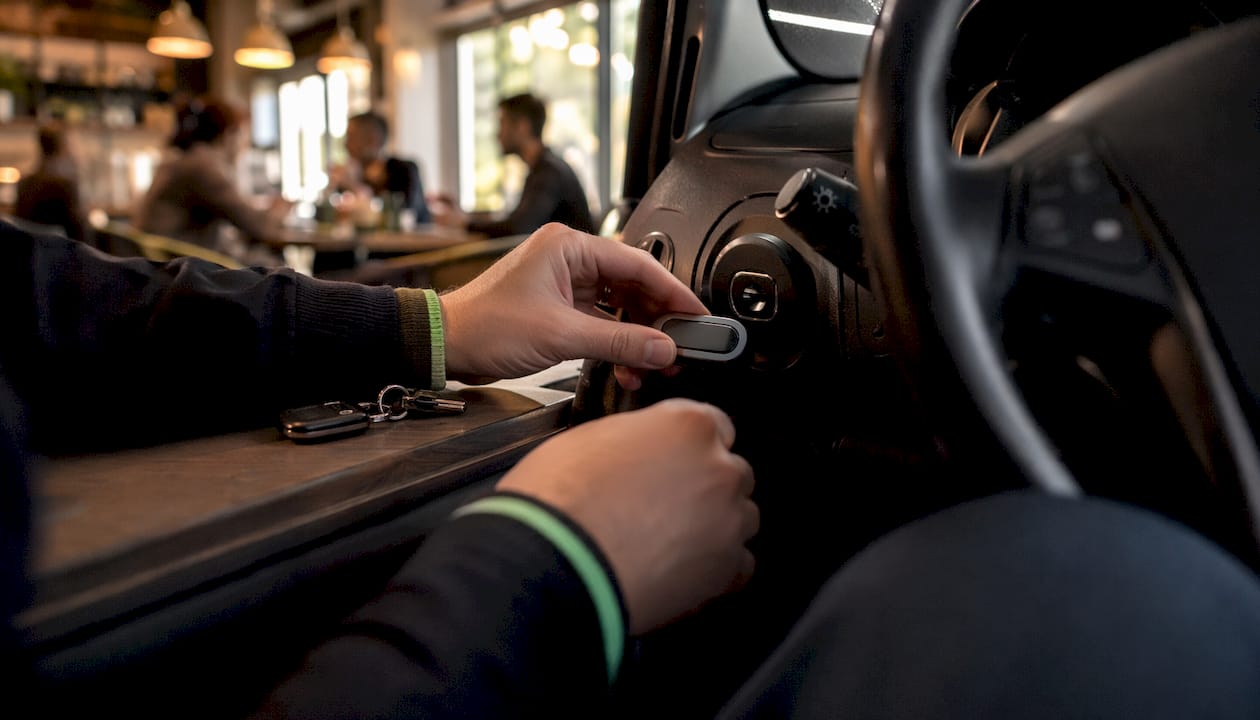
S5 category trackers use ADR to trigger an immediate silent alarm the moment a vehicle moves without a registered tag. The monitoring centre receives an alert instantly, often before the owner has any idea the car has been taken. This proactive response is the defining difference between S5 and lower-category systems.
The key components of an ADR-based system are:
- The identity tag or fob. Carried by the authorised driver, it broadcasts a unique signal to the tracker.
- The in-vehicle tracker unit. Reads the tag signal and confirms authorised use on every journey.
- The monitoring centre. Receives silent alerts and contacts the owner or police when no tag is detected.
- GPS location reporting. Transmits the vehicle’s position in real time once an alert is triggered.
Pro Tip: Keep a spare identity tag registered to your system and stored securely at home. If your primary tag is lost, you can switch to the spare immediately without losing monitoring coverage.
2. Proactive theft prevention
S5 trackers with driver identity tags prevent theft rather than simply recording it. S7 trackers lack driver identification and only begin reactive tracking after a theft is reported. By that point, the vehicle may already be stripped, exported, or hidden.
With ADR, the silent alarm fires the moment an unauthorised person moves the car. The monitoring centre can notify police while the vehicle is still nearby. Recovery on or near the premises becomes a realistic outcome rather than a remote possibility.
This matters most for high-value vehicles, which are disproportionately targeted by organised theft rings. A system that acts before the owner notices is far more effective than one that waits for a phone call.
3. Defence against relay attacks
Driver identity tags help prevent relay attacks, a method thieves use to amplify keyless entry signals and start a car without the physical key. Relay attacks have become one of the most common methods used to steal modern vehicles in the UK.
Even if a thief successfully amplifies your key signal and opens the car, the tracker will not detect an authorised tag. The silent alarm triggers immediately. The tag requirement adds a second layer of verification that relay attack equipment cannot replicate.
This is a significant practical advantage that standard immobilisers and keyless entry systems do not provide on their own.
4. Faster vehicle recovery
Speed is the critical factor in vehicle recovery. The longer a stolen car remains undetected, the lower the chance of recovering it intact. S5 systems notify monitoring centres instantly, giving police a live GPS position from the moment of theft.
Reactive systems like S7 depend on the owner noticing the car is gone, reporting it, and then waiting for tracking to begin. That delay can be hours. S5 eliminates that gap entirely.
For owners of prestige or high-risk vehicles, faster recovery also reduces the likelihood of a total loss insurance claim, which keeps future premiums lower.
5. Insurance premium reductions
Fitting an insurance-approved tracker with driver identity tags can reduce annual premiums by up to 20%. Insurers pass on savings because ADR-equipped vehicles are statistically less likely to result in a total loss claim.
The discount scale varies by tracker category. S5 and S5+ devices attract the largest reductions because they combine proactive identification with real-time monitoring. S7 devices offer smaller discounts because they lack the driver identification layer.
The financial case is straightforward. A £150 annual premium reduction on a policy costing £800 pays back a mid-range tracker within two years, with ongoing savings every year after that.
6. Insurer requirements for high-value vehicles
Many insurers require a Thatcham-approved tracker with driver identity tags for vehicles valued above £40,000 or models classified as high theft risk. Fitting an uncertified device or a lower-category tracker may void your insurance cover entirely.
This is not a minor technicality. If your insurer specifies an S5 device and you fit an S7, a theft claim could be rejected. Checking your policy schedule before purchasing a tracker is a non-negotiable step.
Thatcham Research publishes certification categories that insurers reference directly. Choosing a device from the Thatcham-approved S5 range removes any ambiguity about compliance.
7. S5+ remote immobilisation
S5+ trackers add remote immobilisation to the full ADR feature set. Once theft is confirmed and the vehicle is located, the monitoring centre can disable the engine remotely. This is the highest protection level in Thatcham-certified trackers.
Remote immobilisation is particularly valuable when a vehicle has been driven to a location where police cannot immediately intercept it. The car can be stopped safely without a pursuit. This feature is available across the Thatcham-approved S5 Plus collection.
8. Driver-specific trip reports and accountability
Driver identity tags facilitate driver-specific trip reports, recording which registered tag was present for each journey. This reduces manual record-keeping and creates a clear log of vehicle use. Fleet owners and families sharing a vehicle both benefit from this feature.
For private car owners, the data provides evidence of authorised use in the event of a dispute. For small businesses, it replaces paper mileage logs with automatic, timestamped records. The administrative saving is a secondary benefit that compounds over time.
9. Practical considerations and limitations
Driver identity tag systems are highly effective, but they require consistent use to deliver full protection. The most common failure point is leaving the tag in the car. A thief who steals the tag alongside the keys defeats the ADR system entirely.
Additional practical points to keep in mind:
- Tag loss. A lost tag should be deregistered from the system immediately. Most monitoring services allow remote deregistration by phone.
- Multiple drivers. Most S5 systems support several registered tags. Each authorised driver should carry their own.
- Subscription monitoring. The silent alarm and recovery service depend on an active monitoring subscription. A lapsed subscription removes the proactive benefit.
- Professional installation. Professional installation ensures the tracker is correctly wired and positioned, which is required for insurer compliance and optimal performance.
Pro Tip: Register your tracker serial number and monitoring contact details with your insurer at the point of installation. This removes delays if you ever need to make a claim.
Key takeaways
Driver identity tags transform a vehicle tracker from a passive recording device into a proactive theft deterrent, with measurable benefits for security and insurance costs.
| Point | Details |
|---|---|
| ADR triggers silent alarms instantly | S5 trackers alert monitoring centres before the owner notices a theft. |
| Up to 20% premium reduction | Insurance-approved trackers with driver ID can cut annual premiums significantly. |
| S5+ adds remote immobilisation | The highest Thatcham category allows remote engine disable after confirmed theft. |
| Relay attack protection | Tag requirement makes keyless relay attacks ineffective against ADR systems. |
| Insurer compliance is mandatory | Vehicles over £40,000 may require an S5 device or risk voided cover. |
Why driver identity tags are worth taking seriously
From the perspective of Thatcham Trackers, the most underestimated aspect of driver identity tag systems is how often car owners only discover their value after a theft. The technology exists to prevent that outcome, not just respond to it.
The vehicles most at risk are not always the most expensive. High-theft-risk models, leisure vehicles, and cars parked in urban areas are all targeted regularly. An S5 or S5+ system with ADR changes the risk profile of any vehicle, regardless of its value.
The insurance argument is compelling on its own. A reduction of up to 20% on premiums, combined with mandatory compliance for high-value vehicles, means the financial case for driver identity tags is not speculative. It is documented and consistent.
The peace of mind is harder to quantify but equally real. Knowing that an unauthorised start triggers an immediate response, rather than waiting for a morning discovery, changes how you think about vehicle security. Thatcham Trackers recommends treating driver identity tag systems as a standard feature rather than an optional upgrade.
— Thatcham Trackers
Thatcham Trackers: approved S5 and S5+ systems with driver ID
Thatcham Trackers stocks a full range of Thatcham-certified trackers with Automatic Driver Recognition, covering S5 and S5+ categories for private cars, vans, and high-value vehicles.
Every device in the Thatcham-approved tracker collection meets insurer requirements and is available with professional installation. S5+ models include remote immobilisation for the highest available protection level. Whether you drive a prestige saloon or a working van, there is a certified system suited to your vehicle and insurer requirements. Contact Thatcham Trackers directly to confirm which category your insurer requires before purchasing.
FAQ
What is a driver identity tag in a car tracker?
A driver identity tag is a physical fob or card that communicates with your vehicle tracker to confirm an authorised driver is present. Without it, an S5 tracker triggers a silent alarm to the monitoring centre.
How much can a driver identity tag tracker reduce my insurance premium?
Fitting an insurance-approved tracker with driver identification can reduce annual premiums by up to 20%. The exact saving depends on your insurer, vehicle type, and tracker category.
What is the difference between S5 and S7 trackers?
S5 trackers include Automatic Driver Recognition and trigger proactive alerts when no authorised tag is detected. S7 trackers lack driver identification and only provide reactive tracking after a theft is reported.
Do I need an S5 tracker for my insurance?
Many insurers require an S5 or higher category device for vehicles valued above £40,000 or high-theft-risk models. Fitting a lower category tracker may void your cover, so always check your policy schedule first.
What happens if I lose my driver identity tag?
Contact your monitoring centre immediately to deregister the lost tag. Most S5 systems support multiple registered tags, so a spare can be activated while a replacement is arranged.