

A commercial vehicle tracker is defined as a device that combines GPS or GNSS positioning with data transmission and, in many cases, vehicle diagnostics to give fleet managers live operational insight. Understanding the commercial vehicle tracker difference matters because not all systems work the same way. A basic GPS tracker tells you where a vehicle is. A full telematics system tells you where it is, how it is being driven, what faults are developing, and how much fuel it is burning. Choosing the wrong type costs money and leaves gaps in your fleet’s security and efficiency.
What are the key technical differences between vehicle trackers?
The core difference between vehicle trackers lies in three axes: positioning method, reporting mode, and data enrichment. Confusing these three is the most common reason fleet managers end up with a system that does not meet their needs.
Positioning method refers to how the device calculates location. Most commercial systems use GNSS receivers, which includes GPS alongside other satellite networks such as GLONASS. Some lower-cost devices rely partly on cellular signal triangulation, which is less accurate in rural or low-coverage areas. GNSS-based systems are the standard for any serious commercial fleet tracking application.

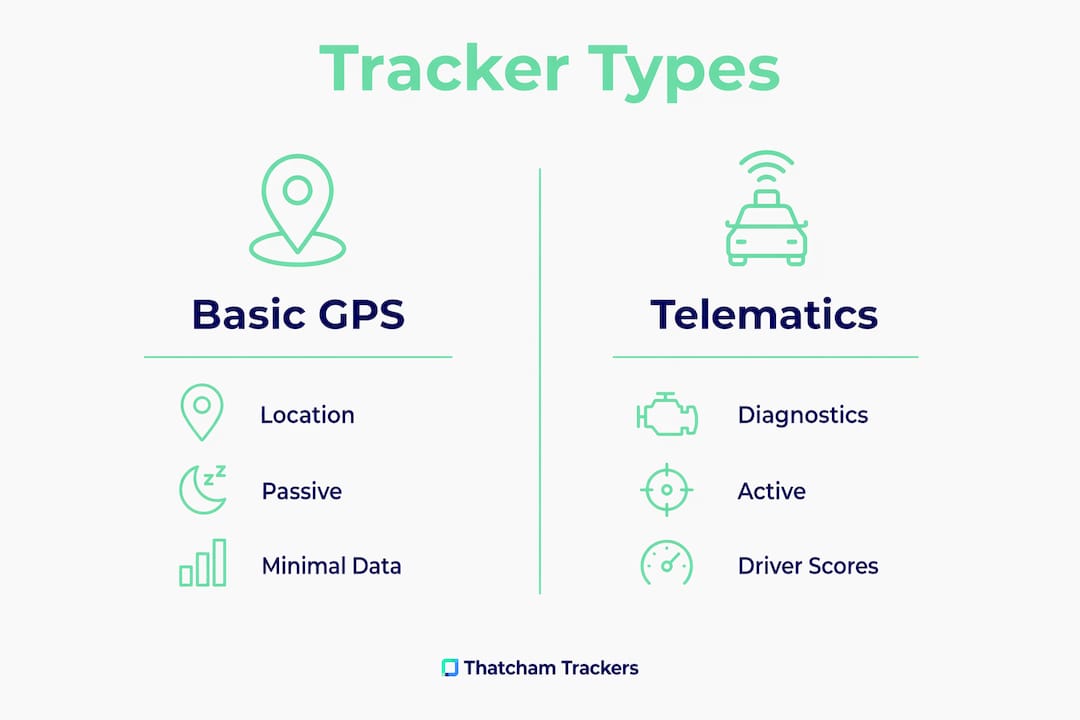
Reporting mode describes how the device sends data. Tracking data is transmitted via three distinct modes: passive systems log data internally for later download; active systems transmit in real time; hybrid systems buffer data in dead zones and backfill when connectivity returns. Each mode has a direct impact on how quickly you can respond to incidents.
Data enrichment is where the biggest capability gap appears. A basic GPS tracker reports location. A telematics device connects to the vehicle’s OBD-II or CAN-bus port and adds fuel consumption, fault codes, driver behaviour scores, and maintenance alerts. That additional layer of data is what separates a simple tracker from a full commercial vehicle tracking system.
| Device type | Positioning | Reporting mode | Data enrichment |
|---|---|---|---|
| Basic GPS tracker | GPS/GNSS | Passive or active | Location only |
| Active vehicle tracker | GPS/GNSS | Active, real-time | Location, speed, alerts |
| Telematics system | GPS/GNSS + cellular | Active or hybrid | Location, diagnostics, driver behaviour |
| AVL system | GNSS + wireless network | Active, near real-time | Location, dispatch integration |
Pro Tip: Ask any vendor which OBD-II or CAN-bus data fields their platform actually reads. Many systems connect to the port but only extract a fraction of the available diagnostic data.
How does data transmission mode affect fleet efficiency and security?
The transmission mode you choose directly determines how fast you can act on information. GPS tracking units either push data in real time or log it for later download. That distinction sounds simple, but the operational consequences are significant.
Passive systems store journey data on the device. You download it at the end of a shift or day. This works for basic mileage reporting but offers no live visibility. If a vehicle is stolen or a driver is involved in an incident, you have no real-time information to act on.
Active systems transmit continuously. Active AVL-style systems delivering continuous telemetry enable faster control room response than passive or driver-initiated logging systems. For theft recovery, this difference can determine whether a vehicle is recovered within hours or not at all.
Hybrid systems address the weak point of active tracking: cellular dead zones. They buffer data locally when signal is lost and backfill the server automatically when connectivity returns. This is the most practical choice for fleets operating in rural areas or across varied terrain.
Pros and cons of each transmission mode:
- Passive: Low cost, no ongoing data fees, simple to operate. No live visibility, no theft response capability, no real-time alerts.
- Active: Full live tracking, immediate alerts, supports theft recovery and incident management. Requires reliable cellular coverage, higher ongoing subscription cost.
- Hybrid: Combines live tracking with dead-zone resilience. Slightly higher hardware cost than passive, but far more reliable than active-only in patchy coverage areas.
Pro Tip: If your fleet operates in areas with inconsistent mobile coverage, a hybrid system is not optional. It is the only way to guarantee data continuity without gaps in your records.
Which features beyond location tracking differentiate commercial systems?
Telematics systems combine GPS location with vehicle diagnostics from OBD-II or CAN-bus interfaces, adding fuel use, fault codes, and driver behaviour data to positional tracking. That combination transforms a tracker from a security device into a fleet management tool.
Driver behaviour monitoring is one of the most operationally valuable features. The system scores drivers on harsh braking, rapid acceleration, cornering speed, and idling time. Fleet managers use these scores to identify drivers who need coaching, which reduces accident rates and lowers insurance premiums over time.
Predictive maintenance is another capability that basic trackers cannot provide. When a vehicle’s CAN-bus reports a fault code or flags that a service interval is approaching, the platform generates an alert before the vehicle breaks down. For a fleet running on tight schedules, avoiding unplanned downtime is worth more than the cost of the system itself.
Software platform quality varies considerably between vendors. Costs of tracking solutions are influenced more by downstream software capabilities and data normalisation across vehicle types than by hardware alone. A telematics device fitted to a mixed fleet of vans, HGVs, and cars will generate different diagnostic data formats. The platform must normalise that data into a consistent view. Not all systems do this well.
A practical workflow for a fleet manager using a full telematics system looks like this:
- Morning check: Review overnight alerts for fault codes, low fuel, or unauthorised movement.
- Dispatch: Assign jobs using live vehicle locations and estimated journey times.
- During shift: Monitor driver behaviour scores and receive speeding alerts in real time.
- End of day: Review trip reports, fuel consumption, and idling time by driver and vehicle.
- Weekly review: Use driver scoring data to identify coaching needs and flag vehicles approaching service intervals.
This workflow is only possible with an active or hybrid telematics system. A passive GPS tracker supports none of it.
What should fleet managers consider when choosing a commercial tracker?
A vehicle tracking system includes hardware, software, and connectivity. The right choice depends on matching all three to your operational requirements, not simply selecting the device with the most features.
Start by defining your primary use case. Security-focused fleets need active or hybrid systems with theft alerts and rapid response capability. Compliance-focused fleets need driver behaviour data and accurate mileage records. Maintenance-focused fleets need telematics with full OBD-II or CAN-bus integration. Many fleets need all three, which points toward a full telematics platform.
Key questions to ask any vendor before committing:
- What is the location update frequency? GPS trackers update location every 60 seconds or faster for live insight. Some basic trackers update far less frequently.
- Does the system buffer data in cellular dead zones, or does it simply lose those records?
- Which OBD-II or CAN-bus data fields does the platform read and display?
- How does the software handle mixed fleets with different vehicle types and diagnostic formats?
- What are the total costs, including hardware, installation, monthly data fees, and software licences?
Hidden costs are a real risk. Integration quality with vehicle diagnostics affects fleet insights and return on investment significantly. A low-cost hardware device paired with a weak software platform will deliver less value than a mid-range device on a well-built platform. Evaluate the software as carefully as the hardware.
Coverage is also worth testing before signing a contract. Ask vendors for coverage maps relevant to your operating area and request a trial period if possible. A system that drops signal on your most-used routes defeats its own purpose.
Key takeaways
Commercial vehicle tracking systems differ primarily in transmission mode and telematics depth, not simply in whether they use GPS.
| Point | Details |
|---|---|
| Three axes define the difference | Positioning method, reporting mode, and data enrichment determine system capability. |
| Transmission mode drives response speed | Active systems enable theft recovery and live dispatch; passive systems only support post-trip reporting. |
| Telematics adds operational depth | OBD-II and CAN-bus integration delivers driver scores, fault codes, and maintenance alerts beyond location. |
| Software quality determines value | Data normalisation and platform capability matter as much as the hardware device itself. |
| Match system to use case | Security, compliance, and maintenance needs each point toward different tracker types and feature sets. |
The real cost of choosing the wrong system
Fleet managers often focus on hardware price when comparing commercial vehicle tracking systems. That is the wrong starting point. The hardware is rarely where the value difference lies.
The systems that deliver the most operational benefit are the ones where the software platform is genuinely capable of normalising data across a mixed fleet and presenting it in a way that supports decisions. A van running a different CAN-bus protocol to an HGV will generate different data. If the platform cannot handle that, you end up with incomplete records and manual workarounds that cost more in staff time than you saved on the device.
Transmission mode is the second area where buyers consistently underestimate the impact. Passive systems look attractive on cost. They become expensive the moment a vehicle is stolen and there is no live location to give the police. Active and hybrid systems carry a higher monthly cost, but that cost is justified by a single theft recovery or a single avoided breakdown.
The terminology in this market is genuinely confusing. Vendors use “GPS tracker”, “vehicle tracker”, and “telematics system” interchangeably, even when the products are meaningfully different. The framework that cuts through the noise is simple: ask about update frequency, ask about dead-zone buffering, and ask exactly which diagnostic data the platform reads. Those three questions will tell you more than any marketing description.
— Thatcham Trackers
Thatcham Trackers: approved systems for commercial fleets
Thatcham Trackers supplies insurance-approved tracking devices independently tested and certified by Thatcham Research, the UK’s central automotive risk intelligence organisation. Every device in the range meets the standards that insurance companies use to assess theft risk, which means fitting one can reduce your fleet’s insurance premiums as well as improving security.
For commercial fleets, the Thatcham-approved tracker range includes active and hybrid systems with real-time monitoring, driver behaviour features, and full telematics capability. The VanGuard Series is built specifically for vans, combining GPS tracking with immobilisation for maximum security. Thatcham Trackers is rated 4.8 out of 5 on both Trustpilot and Google Reviews. Contact the team directly to discuss the right system for your fleet’s specific requirements.
FAQ
What is the difference between a GPS tracker and a commercial vehicle tracker?
A GPS tracker reports location using satellite positioning. A commercial vehicle tracker adds active data transmission, driver behaviour monitoring, and often vehicle diagnostics via OBD-II or CAN-bus, making it a full fleet management tool rather than a simple locator.
How do vehicle trackers work in areas with no mobile signal?
Hybrid systems buffer location and diagnostic data locally when cellular coverage is lost. The device backfills the server automatically once connectivity returns, preventing gaps in fleet records.
What does a telematics system add beyond basic tracking?
Telematics systems connect to a vehicle’s OBD-II or CAN-bus port and deliver fuel consumption data, fault codes, driver behaviour scores, and maintenance alerts alongside live location.
Why does update frequency matter for fleet management?
GPS trackers updating every 60 seconds or faster provide live fleet visibility for dispatch and incident response. Devices with longer update intervals create blind spots that reduce both security and operational control.
Do Thatcham-approved trackers count for insurance purposes?
Thatcham Research independently tests and certifies vehicle security devices. Insurance companies use these ratings to assess theft risk, and fitting a Thatcham-approved tracker often qualifies fleets for lower premiums.