

GPS trackers manage power during long-term storage by entering specialised low-power firmware states that reduce cellular modem consumption to just a few microamps, while motion sensors prevent unnecessary transmissions when the device is stationary. The tracker never fully powers off. Instead, it uses modes such as Power Saving Mode (PSM) and extended Discontinuous Reception (eDRX) to stay registered on the network without the power cost of repeated re-attachment. Understanding how tracker technology works in these conditions is the foundation for making the right decisions about configuration, storage environment, and device selection.
Key power-saving mechanisms active during storage:
- Motion detection: Accelerometers detect genuine asset movement and wake the device only when needed, ignoring vibrations from passing vehicles or environmental noise.
- Low-duty-cycle communication: The cellular modem transmits infrequently, spending the vast majority of time in a near-off state.
- Firmware efficiency: State machine logic coordinates GPS acquisition and transmission in a single brief session, then returns the device to sleep immediately.
- Battery self-discharge: Even without any transmissions, lithium batteries lose 1–5% charge per month through chemical reactions alone, making storage conditions a genuine factor in long-term performance.
Table of Contents
- What technical factors drive battery consumption in a GPS tracker?
- How to get the most from your tracker’s battery during storage
- How does the environment affect long-term tracker battery life?
- What battery life can you realistically expect from trackers in storage?
- Expert insight on long-term storage performance from Thatcham-approved specialists
- Thatcham Trackers: insurance-approved devices built for long-term reliability
- Key takeaways
What technical factors drive battery consumption in a GPS tracker?
Cellular transmission dominates power consumption by a factor of 10 to 100 times compared to GPS acquisition. A typical LTE-M transmission burst draws 200–500mA for several seconds, while a GPS chipset in acquisition mode pulls 20–30mA. Sleep current, by contrast, should measure in single-digit microamps on a well-designed device.
The split across a full duty cycle is telling. Cellular transmission, despite representing a tiny fraction of active time, accounts for roughly 60% of total battery capacity over a device’s lifetime. GPS acquisition takes another 25%. Sleep current, spread across years, accounts for the remaining 15%. Reducing transmission frequency is therefore the single most effective lever for extending battery life.
GPS starting state matters considerably. A cold start with no satellite almanac data can take 30–60 seconds at 25–30mA. A hot start, where the chipset retains satellite data, completes in 1–2 seconds at similar current. Assisted GPS (A-GPS) downloads satellite data over the cellular network, cutting acquisition time by 80% or more and reducing GPS power consumption proportionally.
Key technical factors affecting battery consumption:
- PSM (Power Saving Mode): Reduces modem current to 3–15 microamps compared to 5mA in legacy idle states, a reduction of 300–1,600 times.
- eDRX: Controls how often the modem checks for incoming messages, reducing listening frequency to save energy.
- Motion filtering algorithms: Firmware distinguishes genuine asset movement from irrelevant vibration, preventing false wake events.
- Adaptive reporting intervals: Devices reporting once daily transmit roughly 365 times per year versus 52,000 times at 10-minute intervals.
- Exponential backoff on retries: Sophisticated error handling avoids repeated transmission attempts against an unavailable network, which would otherwise drain the battery rapidly.
- A-GPS support: Dramatically reduces GPS fix duration and associated power draw.
- Microcontroller sleep current: An MCU drawing 500nA versus 5µA in deep sleep represents a 10-times difference in baseline consumption across years.
Pro Tip: Check whether a tracker supports over-the-air (OTA) firmware updates. Devices with active firmware development histories consistently improve power efficiency over time, whereas products that shipped once and were never updated often carry unresolved power management inefficiencies.
Firmware maturity is the invisible differentiator. Two trackers with identical hardware components can deliver vastly different battery life depending on how tightly the firmware manages state transitions. Efficient firmware wakes up, acquires GPS, transmits, and returns to sleep as quickly as possible. Every additional millisecond spent in a high-power state costs microamp-hours that compound over months and years.
How to get the most from your tracker’s battery during storage
Setting a tracker to motion-triggered or low-frequency reporting before placing a vehicle or asset into storage is the most direct way to extend battery life. A device configured for once-daily check-ins rather than 10-minute updates uses approximately 50 times less power over the same period, because each transmission cycle carries fixed overhead costs regardless of how much data is sent.
Charge the battery to 50–80% before storage. Storing at stable temperatures near 15°C minimises chemical self-discharge and maximises lifespan. A fully charged or fully depleted battery both accelerate degradation during extended inactivity.
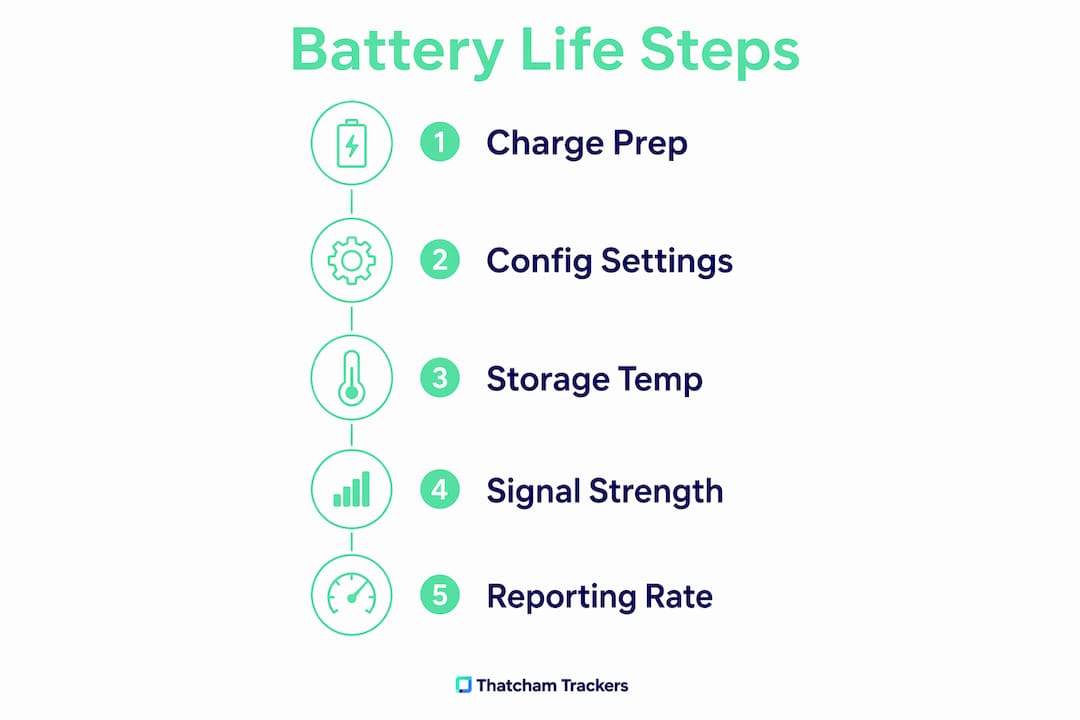
For OBD2 trackers fitted to vehicles that will sit unused for months, the practical answer is straightforward. Physically unplugging the OBD2 device takes seconds and removes any parasitic draw entirely. Hardwired trackers should be switched to Ultra Deep Sleep mode, where GPS and the cellular modem are fully powered down and the device wakes only on movement or ignition. You can read more about how motion alert technology underpins these wake decisions.
Practical tips for maximising battery life during storage:
- Enable Ultra Deep Sleep or equivalent: The lowest power tier available on the device, waking only on accelerometer-detected movement.
- Switch to motion-triggered reporting: Avoid fixed-interval transmissions when the asset is stationary for extended periods.
- Charge to 50–80% before storage: Neither full nor empty is optimal for lithium battery chemistry at rest.
- Store in a cool, dry location: Aim for around 15°C and low humidity.
- Keep firmware updated: OTA updates often include power management improvements that reduce consumption without any hardware change.
- Avoid high-temperature areas: Heat accelerates battery ageing and reduces overall capacity.
Pro Tip: Avoid leaving aggressive reporting settings active during storage. A tracker configured for 10-minute updates in a stationary vehicle will exhaust its battery in weeks rather than years. Check the reporting interval before storage, not after.
For vehicles stored long-term, also consider the insurance-approved tracker best practices that cover common configuration mistakes, including leaving high-frequency reporting enabled during periods of inactivity.
How does the environment affect long-term tracker battery life?
Temperature is the most significant environmental variable. Cold temperatures reduce the activity of battery electrolytes, lowering available capacity. Heat accelerates chemical ageing and permanently reduces how much charge the battery can hold. Daily temperature swings of 40°C to -10°C accelerate self-discharge by 2–3 times compared to a stable environment, which is a meaningful difference over a winter storage period.
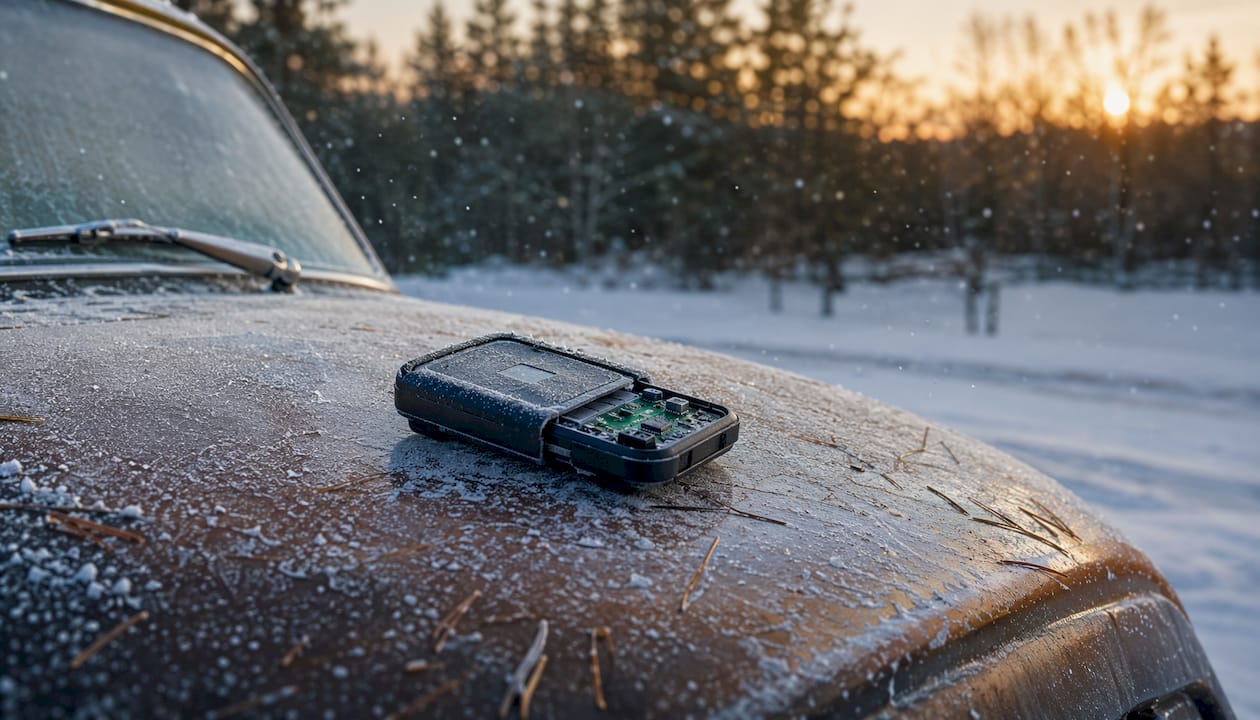
Poor network signal forces the cellular modem to increase its transmission power to maintain a connection. In weak coverage areas, the modem may also spend longer searching, attaching, and retrying, all of which consume battery at rates far above the normal sleep baseline. Metal-heavy environments and deep-indoor placements compound this effect.
Humidity and moisture exposure present a different risk. Moisture ingress can corrode internal components and accelerate battery degradation, particularly in devices not rated for outdoor or damp conditions. Storing a tracker in a boot space or garage with significant temperature variation and condensation risk shortens device lifespan over time.
Environmental variables affecting battery life during storage:
- Temperature stability: A consistent 15°C is the recommended storage temperature for lithium batteries.
- Temperature extremes: Cold reduces capacity; heat accelerates ageing. Both are damaging over months.
- Temperature cycling: Repeated swings between hot and cold accelerate discharge faster than either extreme alone.
- Signal strength: Weak network coverage forces higher modem power output and more frequent retry cycles.
- Humidity: Moisture exposure risks corrosion and battery degradation.
- Mounting location: Avoid areas near heat sources, exhaust systems, or direct sunlight.
For vehicles stored in unheated garages over winter, the combination of cold temperatures and self-discharge can result in 30–50% charge loss before spring deployment. That figure applies to the tracker battery independently of any vehicle battery considerations. Good battery care practices for stored vehicles apply equally to the tracker’s internal cell.
What battery life can you realistically expect from trackers in storage?
A 5-year battery life is genuinely achievable when component selection, firmware efficiency, and operational configuration align correctly. Miss any one of those three, and a large battery becomes a countdown clock to replacement rather than a long-term asset.
The reporting cadence is the dominant variable. Real-world deployments using PSM with once-daily reporting reach extended battery life on large lithium manganese dioxide cells. Increase reporting to hourly intervals significantly reduces battery life, and more frequent reporting shortens it further.
| Reporting cadence | Expected battery life (24Ah cell with PSM) |
|---|---|
| Once daily | up to 5 years |
| Every few hours | a couple of years |
| Hourly | 10–14 months |
| Every 15 minutes | 3–5 months |
Source: real-world deployment data from LTE Cat-1 PSM deployments.
Motion-triggered reporting changes the picture further. A vehicle lot where assets sit stationary for days at a time benefits most from once-daily check-ins, with five-year battery life achievable. A rental fleet with unpredictable movement patterns suits motion-triggered reporting, with realistic battery life of three to four years on a well-designed device. Construction equipment with regular work cycles and overnight inactivity typically achieves two to three years depending on utilisation.
Key battery life benchmarks:
- Vehicle lot monitoring (once-daily reporting): Up to five-year battery life achievable.
- Rental fleet (motion-triggered reporting): Three to four years realistic.
- Construction equipment (scheduled plus motion-triggered): Two to three years depending on use.
- Hourly reporting: 10–14 months on a 24Ah cell.
- 15-minute reporting: 3–5 months on the same cell.
Occasional wake events for emergency status or maintenance checks have a measurable but manageable impact. The motion intelligence that filters out irrelevant vibration and triggers transmissions only on genuine asset movement is what separates a tracker that delivers on its battery claims from one that does not. A device that wakes for every forklift bump or passing lorry will exhaust its budget long before the theoretical ceiling.
Expert insight on long-term storage performance from Thatcham-approved specialists
Thatcham Research is the UK’s central automotive risk intelligence organisation. It independently tests and certifies vehicle security systems, and its standards are the benchmark UK insurers use when assessing theft risk and setting premiums. Devices that carry Thatcham approval have been verified against rigorous criteria covering both security performance and operational reliability, including battery management under real-world conditions.
Thatcham-approved trackers are required to meet stringent standards for battery efficiency and operational robustness. Devices certified under the S5 and S7 categories must demonstrate reliable performance across extended deployment periods, including scenarios where vehicles are stored for weeks or months. Active firmware development is a core expectation: a device that cannot receive over-the-air updates cannot benefit from the power management improvements that accumulate through real-world feedback. For UK users, Thatcham certification is not just an insurance requirement. It is the clearest available signal that a tracker has been independently validated to perform as claimed.
The distinction between S5 and S7 certification is relevant here. Thatcham Approved S5 devices provide reliable tracking with solid power management, meeting the requirements most UK insurers specify. Thatcham Approved S7 represents the premium tier, with advanced power management features and enhanced operational robustness suited to longer storage periods and more demanding deployment environments.
The GPSBob VanGuard Series, available through Thatcham Trackers, is designed specifically for van security and tracking with power consumption optimised for extended storage periods. Its firmware supports the low-duty-cycle reporting modes and motion-triggered wake logic that deliver genuine long-term battery performance rather than theoretical figures based on ideal conditions.
Pro Tip: When evaluating any Thatcham-approved tracker, ask the supplier how many firmware versions have been released since the device launched and what power management improvements each delivered. A product with a documented update history is one where engineers have continued to refine efficiency based on field data.
Long-term tracker performance depends on the balance between battery longevity and responsiveness after storage. A device that has been in Ultra Deep Sleep for three months will exhibit a brief startup delay on first command. This is the power-saving design working correctly, not a fault. Thatcham-certified experts recommend informing vehicle owners of this expected behaviour rather than treating it as a device problem.
Thatcham Trackers: insurance-approved devices built for long-term reliability

Thatcham Trackers supplies Thatcham-approved trackers certified by Thatcham Research, covering S5, S7, and specialist van security options including the GPSBob VanGuard Series. Every device in the range has been independently tested against the standards UK insurers rely on, which means the battery management and storage performance claims are backed by certification rather than marketing copy.
For anyone storing a vehicle or asset for an extended period, the practical advantage of a Thatcham-approved device is configuration flexibility. The trackers available through Thatcham Trackers support Ultra Deep Sleep, motion-triggered reporting, and OTA firmware updates, giving you the tools to match the device’s behaviour to your actual storage scenario rather than accepting a fixed factory setting. The 5-year two-wire tracker is a direct example: designed from the ground up for long deployment periods with the firmware discipline to match.
Thatcham Trackers is rated 4.8 out of 5 on both Trustpilot and Google Reviews. To find the right device for your vehicle and storage requirements, visit the Thatcham-approved tracker collection or contact the team directly for guidance.
Key takeaways
A GPS tracker preserves battery during long-term storage through PSM and eDRX firmware states that reduce modem consumption to microamps, combined with motion-triggered reporting that prevents unnecessary transmissions while the asset is stationary.
| Point | Details |
|---|---|
| Cellular transmission dominates power use | Transmission accounts for roughly 60% of total battery capacity; reducing frequency is the most effective way to extend life. |
| PSM cuts modem draw by up to 1,600 times | PSM reduces cellular modem current to 3–15 microamps versus 5mA in legacy idle states. |
| Reporting cadence determines battery life | Once-daily reporting achieves up to 5 years on a 24Ah cell; hourly reporting cuts that to 10–14 months. |
| Storage conditions matter | Charge to 50–80% before storage, keep the device near 15°C, and avoid temperature swings to minimise self-discharge. |
| Thatcham Trackers | Supplies S5, S7, and GPSBob VanGuard Series devices independently certified by Thatcham Research for reliable long-term performance. |