

Vehicle tracker certification is the formal process by which an independent body verifies that a tracking device meets recognised security, technical, and operational standards. In the UK, this process is led by Thatcham Research, the country’s central automotive risk intelligence organisation. Understanding what is vehicle tracker certification matters directly to you if you own a high-value car, manage a fleet, or want to reduce your insurance premium. This guide covers how certification works, why Thatcham approval carries weight with insurers, and what to look for when choosing a certified device.
What is vehicle tracker certification and why does it matter?
Vehicle tracker certification is defined as official verification that a tracking device complies with specific security, safety, and communication standards set by a recognised authority. The certifying body tests the device independently, then publishes its findings so that insurers and consumers can rely on the result.
In the UK, Thatcham Research uses NVSA benchmarks to assess both physical and digital security. NVSA stands for the National Vehicle Security Assessment. It tests tamper resistance, encrypted communication, GPS accuracy, and the reliability of monitoring centre integration. A device that passes earns Thatcham approval, which UK insurers recognise as a credible measure of theft risk reduction.
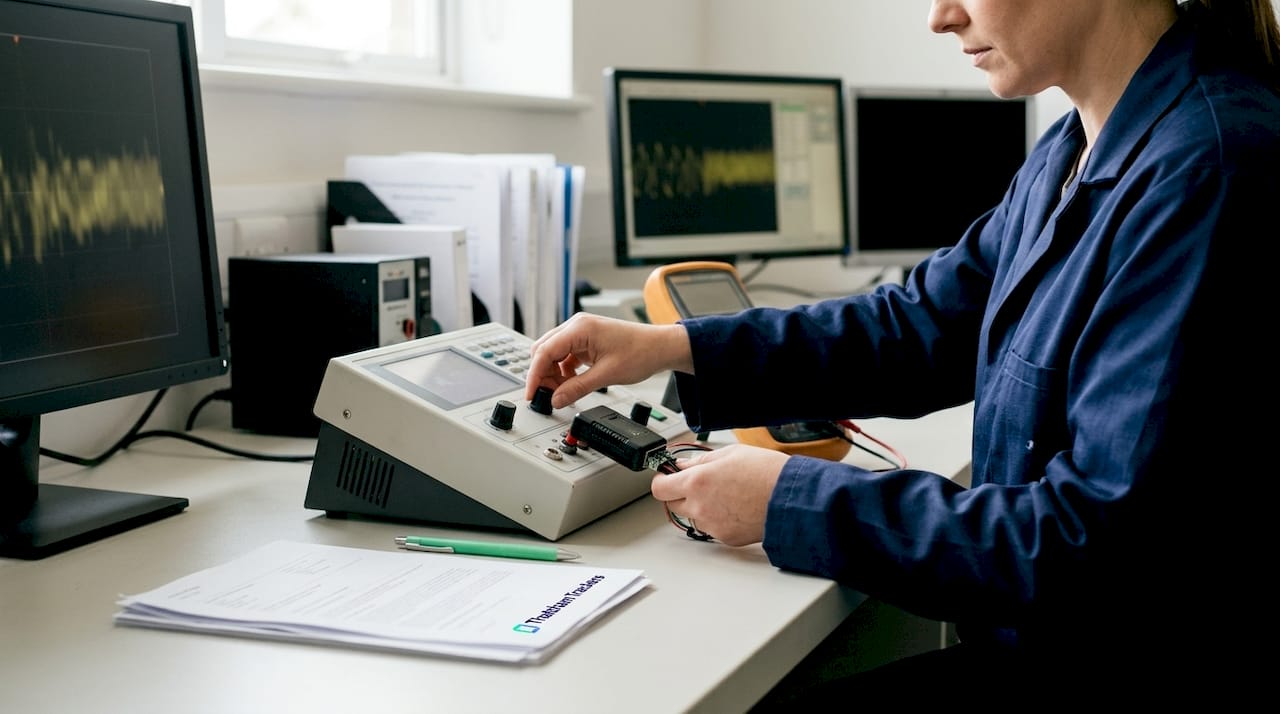
The importance of vehicle tracking certification extends beyond a label on a box. Certified devices are linked to fewer theft incidents and lower claims costs. That connection is why insurers treat Thatcham approval as a factor in risk assessment, and why some policies require it outright.
Pro Tip: Before buying any tracker, ask your insurer directly whether they require a specific Thatcham category. Some policies for prestige vehicles specify S5 or S7 approval as a condition of cover.
How does the vehicle tracker certification process work?
The vehicle tracker certification process varies by country, but it consistently involves multiple stages rather than a single test. Here is how it typically unfolds in the UK under Thatcham Research, compared with India’s AIS-140 scheme.
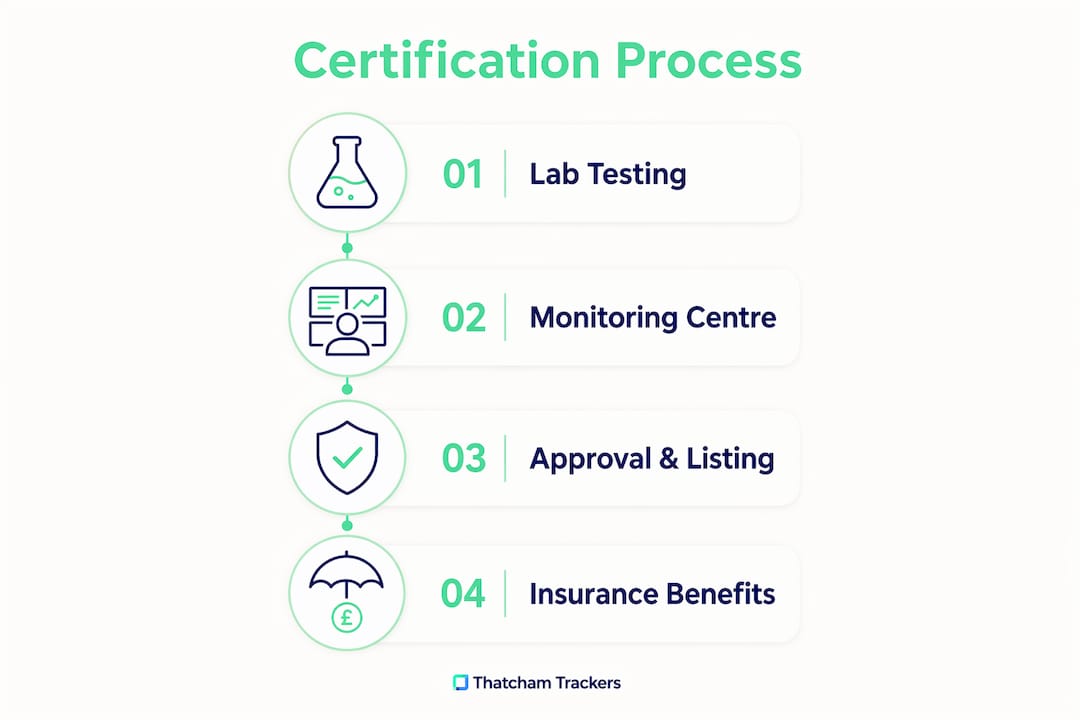
Stage 1: Laboratory Testing The manufacturer submits the device for independent lab evaluation. Thatcham Research tests physical resilience, tamper detection, GPS and GNSS accuracy, and the security of data transmission. The device must meet NVSA thresholds to proceed.
Stage 2: Monitoring Centre Integration Thatcham-approved trackers must connect to an approved monitoring centre that operates around the clock. The centre receives alerts, communicates with the vehicle owner, and liaises with police when theft is confirmed. This operational layer is tested as part of certification, not assumed.
Stage 3: Approval and Listing Devices that pass are listed on Thatcham Research’s approved products register. Insurers reference this register when assessing risk. The listing is what makes a tracker “insurance approved” in the UK market.
| Certification Step | UK (Thatcham Research) | India (AIS-140 via ARAI/ICAT) |
|---|---|---|
| Lab testing body | Thatcham Research | ARAI or ICAT |
| Standards applied | NVSA benchmarks | AIS-140 technical specification |
| Monitoring requirement | Approved 24/7 centre | Integration with government portal |
| Legal mandate | Insurer-driven | Mandatory for public service vehicles |
| Ongoing compliance | Product listing maintained | State transport authority registration |
India’s AIS-140 certification requires lab approval by ARAI or ICAT, followed by registration with state transport authorities and integration with national tracking portals. That two-phase structure makes it more complex than a single product test. Fleet managers operating across borders need to understand both frameworks.
Pro Tip: Check the Thatcham Research approved products register before purchasing. A tracker sold as “Thatcham compatible” is not the same as one that holds formal approval.
Why is thatcham approval important for UK vehicle owners?
Thatcham Research’s security certifications serve as a quantifiable measure that insurers use to reduce vehicle theft risk and claims costs. That is not a marketing claim. It is the basis on which UK insurers build their risk models.
Thatcham-approved trackers fall into distinct categories. The two most relevant for private owners and fleet operators are:
- S5 (Category 5): Provides GPS tracking combined with a driver recognition system. The vehicle cannot be driven without the owner’s unique tag or fob being present. This category is widely required for high-value and prestige vehicles.
- S7 (Category 7): Provides GPS tracking without the driver recognition element. It is suitable for vehicles where tracking and recovery are the primary goals rather than immobilisation.
- S5 Plus: An enhanced version of S5, offering additional layers of protection and monitoring capability.
Insurance companies offer premium reductions to owners who install Thatcham-approved devices. The reduction reflects the lower statistical risk of theft and the higher probability of recovery if theft does occur. Certification also simplifies claims handling, because the insurer already has confidence in the device’s performance standard.
For fleet operators, the benefits extend to liability management. A certified tracker provides documented evidence of vehicle location and driver behaviour, which supports both insurance claims and internal investigations. The importance of vehicle tracking certification for fleets is therefore both financial and operational.
Pro Tip: If your insurer lists specific approved tracker models, cross-reference those models against the Thatcham approved products register. The two lists should align. If they do not, contact your insurer for clarification before fitting a device.
How does certification affect leisure vehicles and fleets differently?
The leisure vehicle tracker certification benefits and the fleet certification requirements share a common foundation but diverge significantly in scope and complexity.
For private leisure vehicle owners, including motorhome and caravan owners, the primary driver is insurance. Many specialist leisure vehicle policies require or strongly incentivise Thatcham-approved devices. The benefits are direct:
- Lower annual premiums, reflecting reduced theft risk.
- Faster claims processing, because the insurer recognises the device’s standard.
- Higher probability of vehicle recovery if theft occurs, due to 24/7 monitoring centre support.
- Peace of mind during storage periods, when leisure vehicles are most vulnerable.
For commercial fleet operators, the picture is more involved. Certification involves registration and integration beyond initial device testing, requiring project management across manufacturers, installers, and regulatory authorities. In markets where AIS-140 applies, fleet managers must coordinate with state transport authorities and maintain ongoing compliance with government tracking portals.
AIS-140 certified GPS trackers go beyond basic location tracking. They include emergency buttons, two-way communication, and direct integration with national portals. These features are mandatory for public service vehicles in India and represent a higher operational standard than most private owner requirements.
The cost implications also differ. A private owner fits one device and benefits immediately. A fleet operator managing 50 or 500 vehicles faces a structured rollout, installer qualification checks, and ongoing compliance monitoring. Treating certification as a one-time purchase rather than an ongoing project is the most common mistake fleet managers make.
What should you look for when choosing a certified vehicle tracker?
Choosing a certified tracker requires more than confirming a logo on the packaging. The following comparison covers the key features that certification bodies assess, and what you should verify before committing.
| Feature | Why It Matters | What to Check |
|---|---|---|
| Thatcham category (S5, S7) | Determines insurer acceptance and cover terms | Match to your insurer’s stated requirement |
| GNSS support | Ensures accurate positioning across networks | Confirm multi-constellation support |
| Tamper detection | Alerts if device is removed or disabled | Check alert method and monitoring centre response |
| 24/7 monitoring centre | Required for Thatcham approval | Verify centre holds Thatcham accreditation |
| Driver recognition | Required for S5 category | Confirm fob or tag is included and registered |
GPS tracker certification includes electrical safety, wireless compatibility, and national regulatory approval. Certified devices are listed in public registries and must meet local safety and communication standards to be sold legally. A device not on the Thatcham approved products register cannot be described as Thatcham approved, regardless of what the seller claims.
When evaluating options, check the Thatcham Trackers guidance on selecting the right category for your vehicle type. The correct choice depends on your insurer’s requirements, your vehicle’s value, and whether you need immobilisation capability alongside tracking.
Pro Tip: Avoid trackers sold through unverified online marketplaces without a Thatcham listing reference. Counterfeit or uncertified devices are sold with misleading descriptions. Always verify the device model against the official Thatcham Research approved products register before purchase.
Dashcam technology follows a similar logic for fleet operators. Certified security devices including dashcams and trackers together reduce insurance costs more effectively than either device alone. Combining certified tracking with certified recording gives insurers a complete risk picture.
Key takeaways
Vehicle tracker certification is the single most reliable indicator that a tracking device will be accepted by UK insurers and perform effectively against theft.
| Point | Details |
|---|---|
| Certification body in the UK | Thatcham Research independently tests and approves trackers using NVSA benchmarks. |
| Insurance premium impact | Thatcham-approved devices reduce premiums by lowering the insurer’s assessed theft risk. |
| Tracker categories matter | S5 requires driver recognition; S7 provides tracking only. Match the category to your insurer’s requirement. |
| Fleet certification is ongoing | Fleet managers must treat certification as a project involving installers, manufacturers, and regulators. |
| Verify before you buy | Always cross-reference the device model against the Thatcham Research approved products register. |
The certification standard that actually protects you
At Thatcham Trackers, we have seen one pattern repeat itself consistently. A vehicle owner fits a tracker that was marketed as “insurance approved” and later discovers their insurer does not recognise it. The claim is rejected or the premium discount is refused. The device was not on the Thatcham approved products register. It was simply described in a way that implied approval without holding it.
The misconception we encounter most often is that any GPS tracker with decent reviews qualifies as certified. It does not. Certification is a specific, documented outcome from a specific testing process conducted by Thatcham Research. The NVSA benchmarks are not a general quality standard. They are a precise set of physical and digital security criteria that a device either passes or fails.
We have also seen fleet managers underestimate the ongoing nature of compliance. Fitting certified devices is the starting point. Maintaining approved monitoring centre contracts, keeping device firmware current, and verifying that new vehicle additions use listed models are all part of the commitment. Certification is not a one-time purchase decision. It is a standard you maintain.
The practical advice we give consistently is this: start with your insurer’s requirements, not with a product. Know which Thatcham category your policy demands, then select from the approved products register. That sequence avoids the most common and most costly errors.
— Thatcham Trackers
Find the right thatcham-approved tracker for your vehicle
Thatcham Trackers supplies a full range of insurance-approved tracking devices, each holding formal Thatcham Research certification. Whether you need an S5 approved tracker with driver recognition for a prestige vehicle, or an S7 approved tracker for straightforward GPS recovery, the range covers both private owners and fleet operators.
Every device listed on the Thatcham Trackers website appears on the Thatcham Research approved products register. That means your insurer will recognise it. Browse the full Thatcham-approved tracker collection to find the right fit for your vehicle, or contact the team directly for guidance on matching a device to your insurer’s specific requirements.
FAQ
What is vehicle tracker certification in the UK?
Vehicle tracker certification in the UK is the process by which Thatcham Research independently tests and approves a tracking device against NVSA security benchmarks. Insurers use this approval to assess theft risk and determine premium levels.
Who certifies vehicle trackers in the UK?
Thatcham Research is the primary certification body for vehicle trackers in the UK. It operates independently and publishes an approved products register that insurers reference directly.
What is the difference between s5 and s7 thatcham approval?
S5 approval requires a driver recognition system, meaning the vehicle cannot be started without an authorised tag or fob. S7 approval covers GPS tracking and recovery without the immobilisation element.
Does a thatcham-approved tracker reduce my insurance premium?
Yes. Insurance companies offer premium reductions to owners who install Thatcham-approved devices, reflecting the lower statistical risk of theft and improved recovery rates.
How do i verify a tracker holds genuine thatcham certification?
Cross-reference the exact device model against the Thatcham Research approved products register. A device described as “Thatcham compatible” or “insurance approved” without a listing reference does not hold formal certification.