

The direct equivalent of a Cat 5 tracker is Thatcham category S5, formally known as a Vehicle Tracking System. Thatcham Research retired the Cat 5 label on 1 January 2019 and replaced it with the S5 classification, which carries the same core requirement: Automatic Driver Recognition (ADR) via a driver tag or fob. Before assuming your existing device or a new purchase satisfies your policy, check your insurer’s wording directly — certification acceptance is their decision, not Thatcham’s.
Table of Contents
- What changed when Cat 5 became S5?
- What does S5 actually require?
- How do S5, S5 Plus, and S7 compare?
- What does S5 certification mean for your insurance?
- How to check whether your tracker is S5
- Which manufacturers offer S5-capable systems in the UK?
- Why Thatcham certification matters to owners and insurers
- Key takeaways
- A practical perspective from Thatcham Trackers
- Thatcham Trackers: S5 devices, installation, and paperwork
- Useful sources for confirming tracker approval
What changed when Cat 5 became S5?
The switch was a reclassification, not a product recall. From 1 January 2019, Thatcham retired the CAT 5, CAT 6, and CAT 7 TQA labels and introduced two new categories: S5 (Vehicle Tracking Systems with ADR) and S7 (Asset Location Systems without ADR). The underlying technical standards were consolidated and clarified, but devices certified under the old Cat 5 rules were not instantly invalidated.
In practical terms, most insurers treat a previously certified Cat 5 device as S5-equivalent, provided the model meets S5 criteria. The Thatcham national product listing continues to carry S5 entries as of June 2026, confirming the category remains active and maintained. The key action for owners of older Cat 5 devices is to verify the specific model appears in the current Thatcham database and to confirm acceptance with their insurer in writing.
What does S5 actually require?
S5 is a demanding standard. The published Thatcham checklist specifies the following requirements for a compliant system:
- 24/7 monitoring to BS 8591 Category 1 or equivalent
- Automatic Driver Recognition (ADR) via a driver identification device (tag or fob)
- GPS positioning
- Roaming SIM for network coverage across regions
- Bi-directional data transmission
- Vehicle motion detection
- Data logging
- Health check programme (regular system self-tests)
- Battery backup
- Resistance to attack for a minimum of two minutes
ADR is the feature that sets S5 apart from simpler tracking categories. When a driver starts the vehicle without presenting the registered tag, the monitoring centre receives an alert. This directly addresses relay attacks and key-cloning theft, where criminals bypass the ignition without needing the physical key. The tag essentially acts as a second layer of identity verification every time the vehicle moves.
Pro Tip: Ask your installer about spare tag policy before fitting. Most S5 systems allow two or more registered tags, and losing the only one can cause monitoring alerts or require a costly re-registration. Get a spare tag at installation and keep the Thatcham reference number with it.
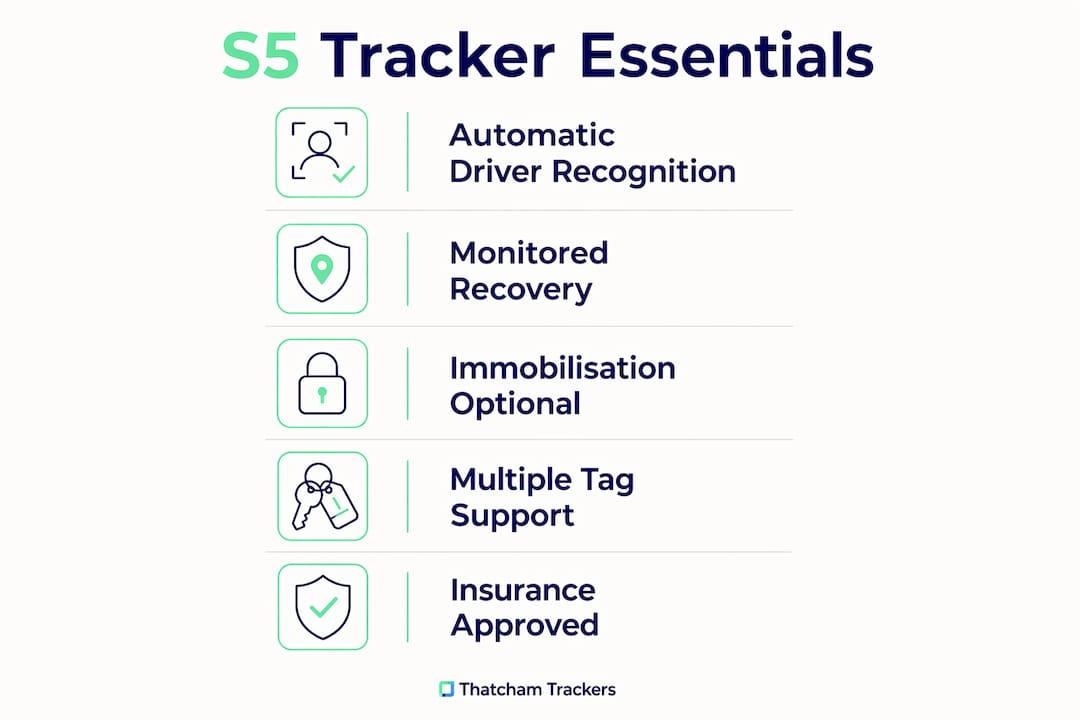
S5 focuses on tracking and monitored recovery. Immobilisation is not a mandatory S5 requirement, though some systems include it. That distinction matters when comparing S5 to S5 Plus.
How do S5, S5 Plus, and S7 compare?
| Category | Replaces | ADR required | Immobilisation | Monitored recovery | Typical use |
|---|---|---|---|---|---|
| S5 | Cat 5 / Cat 6 | Yes | Optional | Yes | Standard to high-value vehicles |
| S5 Plus | Cat 5 (enhanced) | Yes | Yes | Yes | Prestige, high-risk, or insurer-specified vehicles |
| S7 | Cat 7 | No | No | Yes | Asset tracking, fleet, lower-risk vehicles |
S5 Plus adds mandatory immobilisation to the S5 feature set. For owners of prestige or high-value vehicles, some insurers specifically require S5 Plus rather than standard S5, particularly where the vehicle is on a specialist or agreed-value policy. S7, by contrast, is an asset location system with no ADR requirement — it suits fleet operators or owners whose insurer does not mandate driver recognition.
Typical use-cases by category:
- High-value, prestige, or theft-targeted vehicles: S5 or S5 Plus
- Insurer-mandated immobilisation: S5 Plus
- Fleet assets, vans, or lower-risk vehicles where ADR is not required: S7
- Owners upgrading from S7 to S5: additional wiring and tag registration required
What does S5 certification mean for your insurance?
Thatcham Research is clear on this point: certification is an objective evaluation of a product’s functionality and resistance performance. It is not an automatic insurance guarantee. Insurers decide independently how much weight to place on Thatcham certification when pricing or accepting a policy.
That means two things for owners. First, a Thatcham S5 certificate does not guarantee a premium reduction — it makes one more likely, but the insurer sets the terms. Second, if your policy wording still references “Category 5”, an installed S5 device is widely accepted as compliant, but you should not assume this without written confirmation. Some underwriters continue to use legacy terminology in policy documents.
Steps to protect your cover:
- Check your policy schedule for the exact tracker category required (Cat 5, S5, or S5 Plus)
- Obtain the installed unit’s model name, serial number, and installer paperwork
- Ask your insurer to confirm in writing that the installed device satisfies their requirement
- If your policy names “Cat 5”, request written confirmation that S5 is accepted as the equivalent
- For insurance-approved tracker best practices, retain all documentation and the Thatcham certificate reference
How to check whether your tracker is S5
Follow these steps to confirm compliance or identify whether an upgrade is needed.
- Find the model and serial number. Check the device itself (often a sticker on the unit), the installer’s job sheet, or any paperwork supplied at fitting.
- Search the Thatcham certification database. Use the model name to confirm the category listed. The database is publicly searchable and updated regularly.
- Contact the manufacturer or installer. Request the Thatcham certificate reference and a PDF copy of the certificate. This is the document insurers most commonly ask to see.
- Confirm insurer acceptance in writing. Send the certificate reference to your insurer and ask them to confirm the device satisfies their policy requirement. Keep the reply.
- Arrange an upgrade if needed. If the model is not listed or is listed only as S7, contact a Thatcham-approved installer. A straightforward S5 swap typically takes a few hours; systems requiring immobilisation wiring for S5 Plus take longer and should be quoted in advance.
For a broader guide on verifying tracker certification, Thatcham Trackers has published a UK owner’s reference covering the full verification process.
Which manufacturers offer S5-capable systems in the UK?
The brands below are examples of manufacturers with S5-capable product lines commonly referenced across UK vehicle security pages. This is not a ranked list or an endorsement of any specific model — always verify the individual model’s Thatcham listing before purchase.
SmarTrack offers a range of Thatcham-approved tracking systems including S5-certified options with ADR, widely fitted by approved installers across the UK.
Trackstar produces S5 and S5 Plus systems, with some models specifically designed for high-value and prestige vehicles requiring monitored recovery and immobilisation.

Vodafone Automotive (formerly Cobra) supplies S5-certified trackers through its dealer network, with products covering standard and enhanced monitoring tiers.
ScorpionTrack manufactures S5 and S5 Plus devices with ADR, and its systems are regularly cited by insurers as accepted options for specialist and performance vehicles.
British Tracking Systems provides Thatcham-approved S5 solutions, typically installed through a network of approved fitting centres.
Meta Trak offers S5-certified systems with ADR and 24/7 monitoring, with models available for both standard and high-value vehicle applications.
Pairing any S5 tracker with complementary anti-theft measures — such as number plate cloning protection — adds a further layer of security that ADR alone does not address.
Why Thatcham certification matters to owners and insurers
Thatcham Research operates as the UK’s central automotive risk intelligence organisation, independently testing and certifying vehicle security systems. Its certification programme evaluates both the software and communication requirements of a device (roaming SIM, bi-directional comms, health checks) and its physical resilience (resistance to attack, battery backup). That combination gives insurers a consistent, independently verified benchmark rather than relying on manufacturer claims.
Thatcham’s own position is that certification provides objective assurance around functionality, design, and performance. Insurers then decide how to apply that evidence. Some require a specific category as a policy condition; others offer premium reductions for certified devices without making them mandatory. The practical implication is that certification is a strong signal, not a guarantee.
Pro Tip: Keep your installer’s job sheet, the device’s model and serial number, and the Thatcham certificate reference in a single document. When speaking to insurers, having all three to hand avoids delays and removes any ambiguity about which device is fitted.

Key takeaways
Thatcham category S5 is the direct replacement for Cat 5, with Automatic Driver Recognition as its defining requirement — and insurer confirmation in writing remains the only reliable way to protect your cover.
| Point | Details |
|---|---|
| Cat 5 → S5 equivalence | Thatcham replaced Cat 5 with S5 from 1 January 2019; most insurers treat them as equivalent. |
| ADR is the defining feature | S5 requires a driver identification tag; S7 does not — this is the key technical distinction. |
| Certification ≠ insurance guarantee | Thatcham certifies functionality; insurers independently decide acceptance and premium effects. |
| Verify model and insurer | Check the specific model in the Thatcham database and get insurer confirmation in writing. |
| Thatcham Trackers for S5 devices | Thatcham Trackers stocks Thatcham-approved S5 trackers with installation and certification paperwork. |
A practical perspective from Thatcham Trackers
The most common mistake owners make is assuming that because a tracker was fitted and certified years ago, everything is still in order. Labels change, insurers update their policy wording, and older devices occasionally drop off active certification lists. The sensible course is to check the Thatcham database for the specific model, get the certificate reference from the installer, and send it to the insurer for written confirmation. That process takes less than a day and removes any ambiguity.
Retaining the original installation paperwork is equally important. If a claim arises and the insurer asks for proof of the fitted device, a PDF certificate with the Thatcham reference is the clearest evidence available. Ask the installer for this at the point of fitting, not months later when paperwork may be harder to retrieve.
Thatcham Trackers: S5 devices, installation, and paperwork
For owners who need a confirmed S5-compliant system, Thatcham Trackers supplies a range of Thatcham-approved trackers with professional installation and full certification documentation. Every device comes with the Thatcham reference details needed to satisfy insurer requirements, and the team can advise on whether S5 or S5 Plus is the right fit for your vehicle and policy.
Before purchasing, confirm with your insurer which category your policy requires. Thatcham Trackers can supply the certificate reference and model documentation to support that conversation. View the S5 tracker collection or contact Thatcham Trackers directly to arrange installation and obtain the paperwork your insurer needs.
This article is general information for UK vehicle owners and does not constitute insurance or legal advice. Confirm your specific policy requirements with your insurer or a qualified professional.
Useful sources for confirming tracker approval
The Thatcham Research database is the primary place to verify any model’s current certification status. The table below lists the main authoritative sources to use.
| Source | What it contains | Why to use it |
|---|---|---|
| Thatcham Security Certifications database | Searchable list of all certified products by category | Confirm whether a specific model holds current S5 certification |
| Thatcham Vehicle Security National Listing | Full product listing updated to June 2026 | Cross-reference model entries and check category designations |
| Thatcham Product Definitions Guidelines | Official S5 and S7 technical requirements | Understand exactly what a compliant device must include |
| Thatcham Trackers — choose the right tracker | Practical guidance on selecting a certified device | Match vehicle risk and insurer requirements to the correct category |
Always retain installer paperwork and the Thatcham certificate reference. These two documents are the practical proof insurers request when verifying that a fitted device meets their policy conditions.
Recommended
- Car tracker insurance requirement proof: UK guide 2026 – Thatcham Trackers
- Car tracker subscription setup guide for UK drivers – Thatcham Trackers
- Insurer tracker requirements: S5 and S7 explained for UK drivers – Thatcham Trackers
- Insurance approved tracker best practices: 2026 guide – Thatcham Trackers