

A tracker tamper alert is an immediate notification triggered when a GPS tracking device is physically interfered with or removed. The alert fires the moment a sensor detects an unauthorised interaction, whether that is someone cutting the power supply, prising open the device casing, or pulling the unit from its mounting point. The purpose is straightforward: give the owner or a monitoring centre enough warning to act before the vehicle or asset is moved beyond recovery range.
These alerts rely on several sensor types working in combination:
- Accelerometers detect sudden movement or vibration consistent with removal attempts
- Light sensors trigger when a sealed enclosure is opened and exposed to ambient light
- Power disconnection detectors fire when the device’s wired connection is severed
- Magnetic field sensors register when a magnetically mounted unit is displaced
Alert delivery typically takes one of three forms: a push notification to a smartphone app, an SMS to a registered number, or an alert routed directly to a 24/7 monitoring centre. In vehicle security applications, the monitoring centre route is the most effective, since it removes the dependency on the owner being available to respond. Thatcham Research recognises tamper detection as a standard component of certified stolen vehicle recovery (SVR) systems in the UK.
Table of Contents
- How tamper alerts make vehicle security more effective
- How tamper alerts compare with other anti-tamper technologies
- UK standards and best practices for tamper alerts
- Thatcham Trackers: insurance-approved devices with certified tamper detection
- Key takeaways
How tamper alerts make vehicle security more effective
Real-time notification is what separates a tamper alert from passive security. The moment the sensor fires, the clock starts. Owners or monitoring staff can verify the alert, contact the police, and begin tracking the vehicle’s position while it is still close to its original location. Without that early warning, a theft may not be discovered until hours later, by which point recovery becomes significantly harder.
Tamper alerts do not operate in isolation. They sit within a broader tracker alert system that typically includes several complementary features:
- Motion alerts trigger when a vehicle moves without authorisation, covering scenarios where the tracker itself has not been touched
- Ignition alerts notify when the engine is started outside expected hours or without the key, useful for detecting relay attacks
- Geofence alerts fire when a vehicle crosses a defined boundary, adding a geographic layer of protection
The combination matters. A thief who manages to disconnect a tracker without triggering a tamper alert may still activate a motion or geofence alert. Each layer compensates for the gaps in the others.
From an insurance perspective, tamper detection is a recognised feature within Thatcham-approved trackers. Insurers use Thatcham Research ratings to assess theft risk, and vehicles fitted with certified devices often qualify for reduced premiums. The tamper alert contributes directly to that rating by demonstrating that the device cannot be silently removed.

| Alert type | Detection method | Alert triggers | Effectiveness against theft | Typical use scenario |
|---|---|---|---|---|
| Tamper alert | Physical sensor (accelerometer, light, power) | Device removal, enclosure opening, power cut | High for early-stage intervention | Hardwired vehicle trackers, asset trackers |
| Motion alert | Accelerometer / GPS movement | Unauthorised vehicle movement | High for in-progress theft | All tracker types |
| Ignition alert | OBD or wired ignition feed | Engine start outside schedule | Moderate; bypassed by towing | Hardwired vehicle systems |
| Geofence alert | GPS boundary crossing | Vehicle exits defined zone | Moderate; delayed trigger | Fleet management, high-value vehicles |

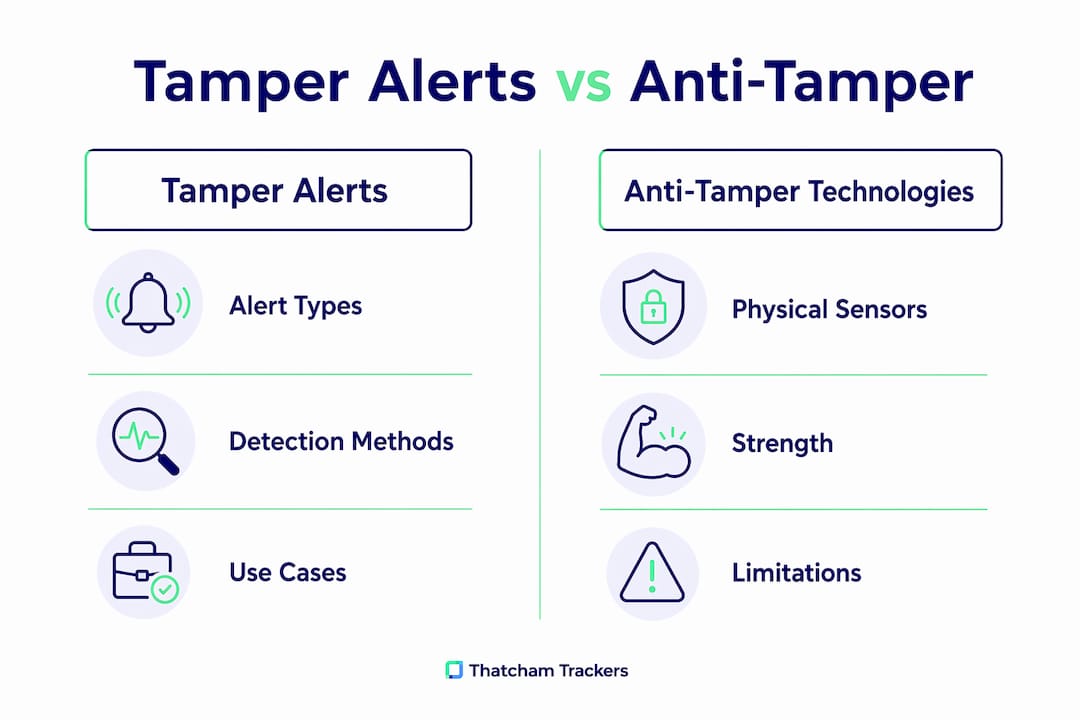
How tamper alerts compare with other anti-tamper technologies
Not all anti-tamper features work the same way, and understanding the differences helps in choosing the right configuration.
| Technology | Detection method | Alert trigger | Strength | Limitation |
|---|---|---|---|---|
| Physical tamper sensor | Accelerometer, light, power disconnect | Device touched, opened, or disconnected | Detects interference before theft begins | Can produce false alarms from vibration or maintenance |
| Motion detection | GPS or accelerometer | Vehicle or asset moves | Catches theft in progress | Does not detect pre-theft device tampering |
| Ignition monitoring | Wired ignition circuit | Engine started | Effective for key-based theft | Bypassed by towing or relay attack |
| Geofencing | GPS boundary | Asset leaves defined area | Geographic coverage | Delayed; theft may already be in progress |
Physical tamper sensors are the only technology that detects interference with the tracking device itself, before the vehicle moves. That is their specific advantage. GPS trackers are designed to be discreet, and tamper detection is what maintains that covert protection if someone locates the unit. Motion detection, ignition monitoring, and geofencing all address what happens after the vehicle is already being moved.
The limitation of tamper alerts is that they do not stop theft. As research confirms, tamper and motion alerts function as the preventative security layer, while the tracker itself primarily supports post-theft recovery. An alert without a response protocol is of limited value.
False alarms are a genuine operational concern. Poor installation or incorrect sensitivity settings are the most common causes, with routine maintenance such as battery disconnection frequently triggering nuisance alerts. The practical consequences are alert fatigue and reduced trust in the system.
Pro Tip: Have the tracker installed by a qualified engineer and request a sensitivity calibration during commissioning. A correctly tuned accelerometer threshold will distinguish between a deliberate removal attempt and normal road vibration or a workshop visit. See the hidden car tracker installation guide for practical placement advice.
Use case suitability also varies by device type. Magnetic asset trackers, which are battery-powered and portable, rely heavily on tamper and motion alerts because they have no wired power connection to monitor. Hardwired vehicle systems can monitor the ignition circuit and power supply simultaneously, giving a richer set of triggers and fewer gaps.
UK standards and best practices for tamper alerts
Thatcham Research sets the benchmark for vehicle security certification in the UK. Its Vehicle Security National Listing defines the requirements that GPS trackers must meet to receive insurance-recognised approval, and tamper detection is a specified element within those standards. A device that can be silently removed without alerting anyone does not meet the criteria for a certified SVR system.
The key best practices for tamper alert systems in the UK context are:
- Professional installation by a qualified engineer, ensuring sensors are correctly positioned and wired
- Sensitivity calibration during commissioning to reduce false alarms without compromising detection
- Integration with 24/7 monitoring so alerts are acted upon even when the owner is unavailable
- Police notification protocols established in advance, so monitoring staff can contact the relevant force immediately upon confirmed alert
- User education covering what triggers legitimate alerts versus nuisance events, reducing unnecessary call-outs
Thatcham Research endorses a layered SVR approach in which tamper alerts are one component, not the whole solution. Individual unmonitored tamper alerts frequently fail to prevent organised vehicle theft. Professional thieves work quickly and methodically; without a monitoring centre ready to act, the alert window closes before any intervention is possible.
The insurance requirements for Thatcham trackers reflect this. Insurers do not simply require a device with tamper detection; they require a certified system that includes monitoring and police liaison capability. The tamper alert is the trigger; the monitoring infrastructure is what converts that trigger into a meaningful response.
Key figure: Best practice guidance from Thatcham Research states that owners should respond promptly to alerts to verify and take action before a vehicle or asset is moved beyond recovery range, underlining that alert speed and response speed are equally critical.
When an alert fires, the recommended response protocol is clear. Verify the alert through the monitoring platform or app. If the vehicle’s location is moving or the alert cannot be explained by routine activity, contact the monitoring centre immediately. Do not attempt to intercept the vehicle personally. The monitoring centre will coordinate with police, who have the authority and resources to act.
Thatcham Trackers: insurance-approved devices with certified tamper detection

For drivers and fleet operators who need a tracker that meets UK insurance requirements, Thatcham Trackers supplies a range of Thatcham-approved devices with certified tamper detection built in. Every device in the range has been independently tested and certified by Thatcham Research, meaning insurers recognise them for premium reductions and compliance purposes.
The S5 range covers the majority of private and commercial vehicle applications, with hardwired installation, power disconnect detection, and 24/7 monitoring compatibility. For higher-risk vehicles or those where insurers specify a more advanced category, the S5 Plus and S7 range provide additional layers of tamper detection and monitoring integration.
All devices are supplied with professional installation and configured to the correct sensitivity thresholds from day one, removing the false alarm risk that comes with self-fitted units. To find the right certified tracker for your vehicle, browse the full collection at Thatcham Trackers.
Key takeaways
A tracker tamper alert is the first line of defence in a certified SVR system, detecting physical interference with the GPS device before a vehicle is moved, and its effectiveness depends entirely on the speed and quality of the response it triggers.
| Point | Details |
|---|---|
| What tamper alerts detect | Physical interference with the GPS device: removal, enclosure opening, or power disconnection. |
| How alerts are delivered | Via push notification, SMS, or directly to a 24/7 monitoring centre for fastest response. |
| Tamper alerts vs other features | Tamper sensors detect pre-theft device interference; motion, ignition, and geofence alerts cover in-progress theft. |
| UK standards requirement | Thatcham Research requires tamper detection as part of a certified SVR system, not as a standalone feature. |
| Thatcham Trackers | Supplies Thatcham-approved S5, S5 Plus, and S7 trackers with certified tamper detection and professional installation. |