

A Thatcham-approved tracker is a vehicle security device independently tested and certified to UK standards by Thatcham Research, the country’s central automotive risk intelligence organisation, which insurance companies require to reduce theft risk and lower claims costs through verified vehicle recovery. Understanding why insurance requires a Thatcham tracker is not simply a matter of compliance. It directly affects your premium, your cover, and whether your insurer will pay out if your car or motorhome is stolen. Categories S5 and S7 represent the two primary certification levels, each carrying different insurance implications. Fitting an approved device can reduce your annual premium by up to 20%, making it one of the most financially sound security decisions a vehicle owner can make.
Why do insurers require Thatcham-approved trackers?
Insurance companies require Thatcham-approved trackers because they need an objective, independently verified benchmark for vehicle security performance. A basic consumer GPS device carries no standardised testing, no tamper-proof requirements, and no guaranteed monitoring capability. Thatcham Research fills that gap by independently testing security systems and producing ratings that insurers can trust without question.
The financial logic is straightforward. When a vehicle is stolen and recovered quickly, the insurer avoids a total loss claim. When recovery fails, the insurer pays out the full vehicle value. Thatcham-approved trackers improve stolen-vehicle recovery outcomes, which directly reduces the frequency and severity of total loss claims. For insurers managing thousands of policies, that difference is significant.
Thatcham Research’s assessments go beyond simple location tracking. They cover:
- Physical anti-theft resistance and tamper-proof installation standards
- Digital resilience against relay attacks and keyless entry exploitation
- 24/7 monitoring centre requirements and police cooperation protocols
- Ongoing subscription obligations to maintain active protection
“A tracker is not just a GPS device. Insurers insist on Thatcham approval because they need proof of digital resilience and tamper-proof features.” — Thatcham Research
This is why the Thatcham tracker necessity extends beyond theft deterrence. Insurers are assessing whether a device can survive modern theft methods, not just track a vehicle after the fact. Relay attacks, key cloning, and signal jamming are now common tactics. A certified device must demonstrate resilience against all of them to earn and retain its rating.
What is the difference between S5 and S7 trackers?
The distinction between S5 and S7 is the most important technical detail for any vehicle owner navigating insurance requirements. Both categories replaced older Thatcham classifications in 2019, but they serve different security purposes and attract different insurer responses.
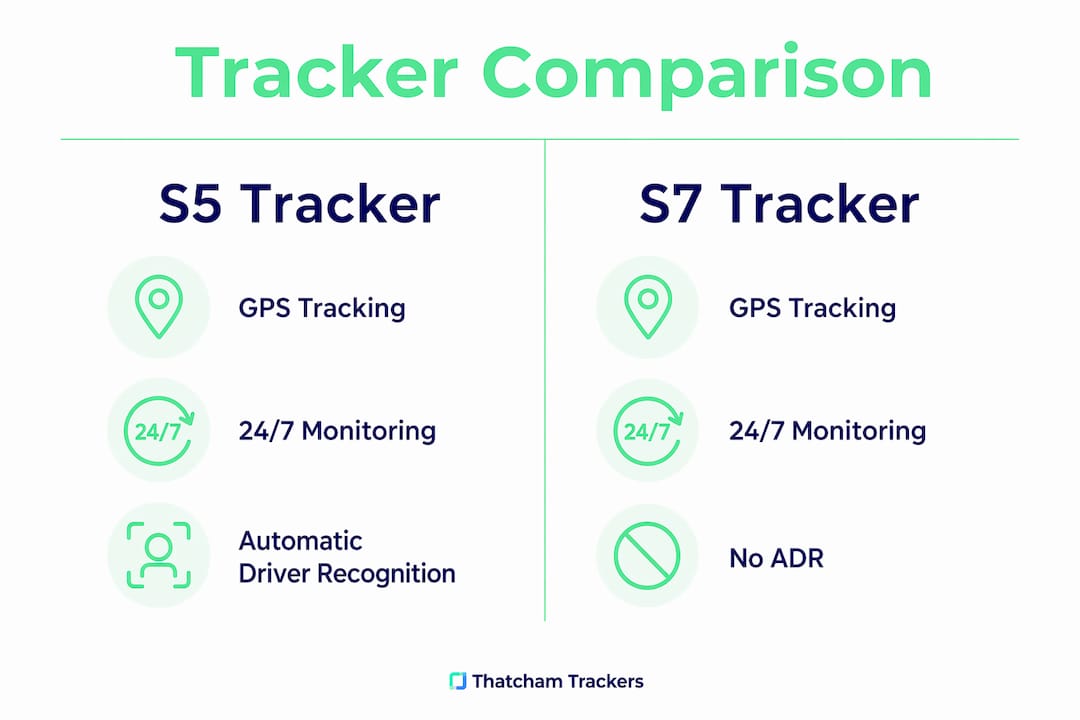
Thatcham S7 trackers provide GPS and GSM location tracking with continuous 24/7 monitoring. Their primary function is vehicle recovery after theft has occurred. S7 is suitable for standard vehicles with moderate insurance requirements, making it the baseline choice for most privately owned cars and motorhomes without keyless entry systems.
Thatcham S5 trackers include everything S7 offers, plus Automatic Driver Recognition (ADR). ADR detects unauthorised use before the vehicle leaves the owner’s possession, triggering an alert the moment an unrecognised driver operates the vehicle. This earlier detection capability is what sets S5 apart in insurer underwriting decisions.
| Feature | S5 tracker | S7 tracker |
|---|---|---|
| GPS and GSM tracking | Yes | Yes |
| 24/7 monitoring centre | Yes | Yes |
| Automatic Driver Recognition | Yes | No |
| Keyless entry resilience | Enhanced | Standard |
| Typical vehicle suitability | Luxury, keyless, high-value | Standard, moderate-risk |
| Insurance premium impact | Greater reduction potential | Standard reduction |
Keyless entry vehicles and high-value cars typically require S5 category trackers because ADR directly counters relay attacks and key cloning. If your insurer specifies S5 and you fit an S7, your policy conditions are not met, regardless of whether the S7 device is otherwise fully functional. The choice between S5 and S7 aligns with insurer underwriting strategies that balance cost, vehicle value, and risk profile.
Pro Tip: Before purchasing any tracker, request written confirmation from your insurer specifying the exact Thatcham category required. Some insurers specify S5 for vehicles above a certain value threshold, and fitting the wrong category will not satisfy your policy conditions.
S5 trackers carry a higher purchase price and installation cost than S7 devices. However, for owners of keyless entry vehicles, the additional premium reduction and the genuine security benefit of ADR make the investment worthwhile over a standard policy term.
How does professional installation affect insurance acceptance?
Professional installation is not optional. DIY installations void tracker approval and risk invalidating your insurance coverage entirely. Insurers require that Thatcham-approved trackers are fitted by accredited technicians, and this requirement exists for several concrete reasons.
Accredited engineers place trackers in discreet, secure vehicle locations using standard wiring methods that prevent tampering and preserve the vehicle’s existing warranty. An improperly fitted tracker can be located and disabled by a thief in minutes. A professionally installed device is concealed, hardwired, and integrated with the monitoring centre’s systems from the moment of fitting.
The practical requirements of accredited installation include:
- Fitting by a technician registered with the tracker manufacturer’s approved installer network
- Secure, hidden placement that does not compromise vehicle wiring or warranty
- Activation of the monitoring subscription at the point of installation
- Provision of a certificate of installation for the insurer’s records
Most insurers require an active monitoring subscription to keep tracker protection valid and enable police cooperation. Without an active subscription, the monitoring centre cannot alert authorities when the device triggers. This means a lapsed subscription effectively renders the tracker non-compliant with your policy conditions, even if the hardware is fully functional.
Pro Tip: Keep your installation certificate and monitoring subscription renewal confirmation in the same place as your insurance documents. If you make a claim, your insurer may request both as proof of compliance.
Selecting an installation service is straightforward. The tracker manufacturer’s website lists approved installers by postcode. Avoid any service that cannot provide a manufacturer-issued installation certificate, as this document is the only evidence your insurer will accept as proof of compliant fitting. For further guidance on compliant fitting, the 2026 best practices guide covers current standards in detail.
What are the financial benefits of a Thatcham-approved tracker?
The financial case for fitting a Thatcham-approved tracker is direct. Insurance companies offer up to 20% premium reduction for vehicles fitted with approved trackers. That figure represents a meaningful annual saving for most car and motorhome owners, and it compounds over successive policy years.
The premium reduction reflects a genuine shift in risk. Faster and more reliable vehicle recovery reduces total loss claims, which are the most expensive outcome for an insurer. When a stolen vehicle is recovered intact, the insurer’s liability is limited to repair costs rather than full replacement value. Trackers make that outcome significantly more likely.
Beyond the premium saving, the Thatcham tracker benefits for owners include:
- Reduced likelihood of a total loss settlement, which protects no-claims discount
- Faster police response due to real-time location data from the monitoring centre
- Potential requirement satisfaction for leased vehicles, where insurers and leasing companies may mandate approved trackers as a condition of the agreement
- Improved resale value for vehicles with documented, certified security installations
For motorhome owners, the financial benefit is particularly pronounced. Motorhomes carry high replacement values and are increasingly targeted by organised theft groups. An S5 or S7 tracker, combined with professional installation and an active monitoring subscription, addresses the specific risk profile that makes motorhome insurance expensive. Owners of leased vehicles should also note that lease car insurance requirements in the UK frequently specify Thatcham-approved devices as a condition of cover.
The ongoing cost of a monitoring subscription, typically between £12 and £20 per month depending on the provider, is almost always offset by the premium reduction within the first policy year. The net financial position is positive from year one for the majority of vehicle owners.
Key takeaways
Insurance companies require Thatcham-approved trackers because Thatcham Research independently certifies that these devices meet verified security standards, reducing theft risk, improving recovery rates, and lowering insurer claims costs in measurable terms.
| Point | Details |
|---|---|
| Insurer rationale | Thatcham approval provides an objective, independently tested security benchmark insurers trust over generic GPS devices. |
| S5 vs S7 distinction | S5 includes Automatic Driver Recognition for earlier theft detection; S7 focuses on post-theft recovery. |
| Installation compliance | Professional fitting by an accredited technician is mandatory; DIY installation voids certification and insurance cover. |
| Premium reduction | Approved trackers can reduce insurance premiums by up to 20%, often offsetting monitoring subscription costs within one year. |
| Monitoring subscription | An active subscription is required to maintain policy compliance and enable police cooperation through the monitoring centre. |
The case for treating tracker compliance as a priority, not an afterthought
From the perspective of Thatcham Trackers, the most common mistake vehicle owners make is treating tracker installation as a box-ticking exercise rather than a genuine security decision. Owners frequently purchase a tracker without confirming the exact category their insurer requires, fit it through an unaccredited service to save money, and then discover at the point of a claim that their cover is invalid.
The second most common error is allowing the monitoring subscription to lapse. The hardware does not protect you without an active subscription. The monitoring centre is the link between the tracker and the police. Without it, the device is a passive GPS unit with no insurance value.
Theft tactics have changed significantly. Relay attacks on keyless vehicles now account for a substantial proportion of car theft in the UK. An S7 tracker fitted to a keyless vehicle may not satisfy your insurer’s requirements precisely because S7 does not include ADR. Checking your policy wording carefully before purchasing is not optional. It is the only way to be certain your investment delivers the cover you are paying for.
Proactive security planning means selecting the right category for your vehicle, using an accredited installer, maintaining your subscription, and keeping documentation current. These four steps are the difference between a tracker that satisfies your insurer and one that creates a false sense of security.
— Thatcham Trackers
Find the right Thatcham-approved tracker for your vehicle
Thatcham Trackers supplies a full range of insurance-approved devices covering both S5 and S7 categories, each independently certified by Thatcham Research to meet current UK insurer requirements.
Whether you drive a standard car, a high-value keyless vehicle, or a motorhome, the right tracker is available with professional installation included. Every device in the range carries full Thatcham certification, and installation is carried out by accredited engineers who provide the documentation your insurer requires. Browse the complete range of Thatcham-approved trackers to find the device that matches your vehicle type and insurance conditions. For premium vehicles and keyless entry cars, the S5 tracker range delivers the ADR capability most insurers now specify. For further detail on how a tracker affects your premium, the insurance premium benefits guide sets out the figures clearly.
FAQ
Why do insurance companies require a Thatcham tracker?
Insurers require Thatcham-approved trackers because Thatcham Research independently tests and certifies these devices to verified UK security standards, giving insurers an objective measure of theft risk reduction and improved vehicle recovery outcomes.
Is Thatcham tracking mandatory for all vehicles?
Thatcham tracking is not universally mandatory, but many insurers require it as a policy condition for high-value, keyless entry, or motorhome vehicles, and some will not offer cover without it.
What happens if I fit a tracker without professional installation?
DIY installation voids the tracker’s Thatcham certification and risks invalidating your insurance policy. Insurers require fitting by an accredited technician and a valid installation certificate as proof of compliance.
What is the difference between an S5 and S7 tracker for insurance purposes?
An S5 tracker includes Automatic Driver Recognition, which detects unauthorised use before the vehicle is driven away, making it the required category for keyless and high-value vehicles. An S7 tracker focuses on post-theft recovery and is accepted for standard vehicles with moderate insurance requirements.
How much can a Thatcham tracker reduce my insurance premium?
Insurance companies commonly offer up to 20% reduction on premiums for vehicles fitted with Thatcham-approved trackers, with the exact saving depending on the insurer, vehicle type, and tracker category fitted.