

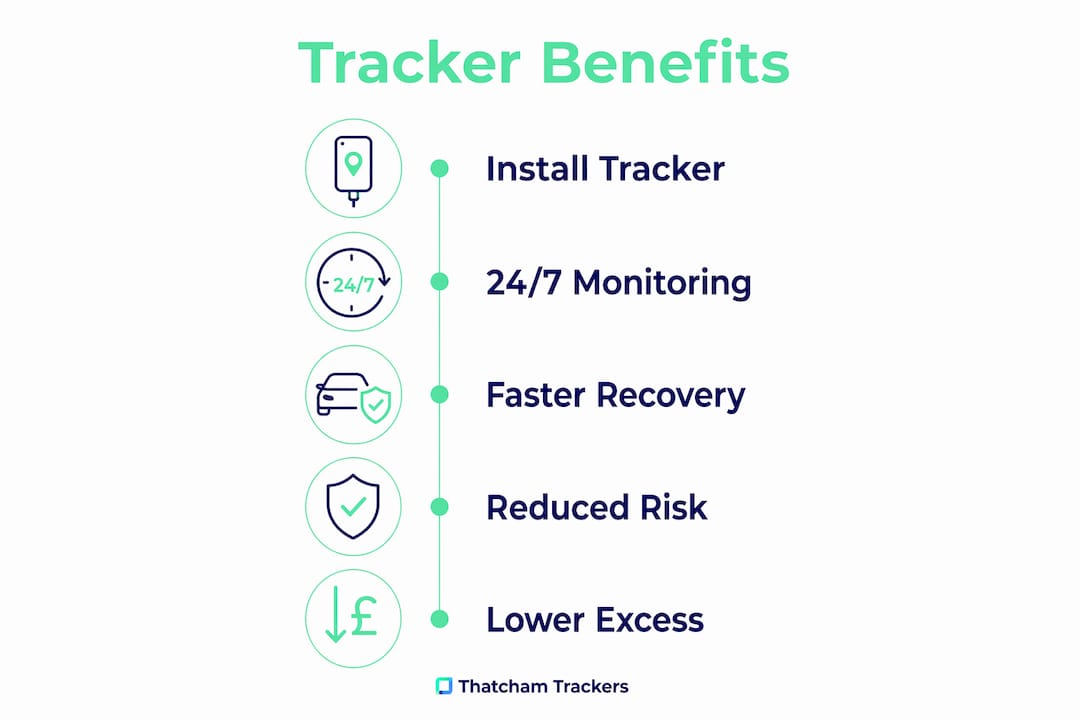
Fitting a Thatcham-approved tracker directly reduces your insurance excess by lowering the risk your insurer carries on every policy. When a vehicle is fitted with a certified tracking device, insurers treat it as a lower theft risk. That reduced risk translates into a lower excess, and often a lower annual premium too. Thatcham Research, the UK’s central automotive risk intelligence organisation, independently tests and certifies these devices. Insurers then use those certifications to price policies more accurately. For UK car and motorhome owners, understanding this connection is the clearest route to reducing insurance costs with trackers.
Why do trackers reduce insurance excess?
Insurance excess is the amount you pay towards any claim before your insurer covers the rest. Theft excess, specifically, applies when a vehicle is stolen and not recovered. Insurers set this figure based on how likely they think a theft claim will be, and how costly it will expect to be.
A Thatcham-approved tracker changes both of those calculations. Trackers cut insurer exposure by locating stolen vehicles faster, which reduces the total payout on a claim. A vehicle recovered within hours costs far less to settle than one written off as a total loss. That lower expected cost is what drives the excess down.

Thatcham Research certifies trackers across three main categories: S7, S5, and S5+. Each category represents a different level of monitoring capability and police response. Insurers use these categories to decide how much risk reduction a tracker actually delivers. The higher the category, the greater the confidence an insurer places in the device, and the more willing they are to reduce your excess and premium.
How do Thatcham-approved vehicle trackers work to lower insurance excess?
The mechanism is straightforward. A certified tracker monitors your vehicle’s location continuously and alerts a monitoring centre the moment it detects unauthorised movement. That centre then contacts you and, if needed, coordinates directly with the police.
The three Thatcham categories work as follows:
- S7: The entry-level standard. Provides GPS tracking and 24/7 monitoring. Qualifies for basic insurance discounts and is accepted by most mainstream insurers.
- S5: Adds driver identification technology. The tracker can detect whether the authorised driver is present, reducing false alarms and improving police response confidence.
- S5+: The highest standard. S5+ combines remote immobilisation with 24/7 monitoring and driver ID, representing the top tier of insurance-quality tracking. Insurers treat this category as the strongest available security measure.
Insurers prefer 24/7 monitored trackers with Level 1 police response, which is the highest priority response available to civilian vehicles. That police involvement means stolen vehicles are recovered faster. Faster recovery means smaller claims. Smaller claims mean lower excess and lower premiums.
Pro Tip: Ask your insurer which Thatcham category they require before purchasing. Some will only reduce your excess for S5 or above, so confirming this first avoids paying for a device that delivers less benefit than expected.
What evidence supports insurance discounts and excess reductions with trackers?
The financial case for fitting a tracker is well established. Premium discounts of 5%–20% are available depending on the insurer and the vehicle’s value. That range reflects how differently insurers price risk, and why it pays to shop around with a certified device already fitted.
Beyond the premium itself, trackers affect how insurers classify your vehicle. Vehicles with Thatcham-approved trackers often qualify for the security suffix ‘E’ in their insurance group rating. This suffix signals enhanced security to underwriters and can shift a vehicle into a lower risk band, which directly reduces the base premium before any tracker discount is applied.
Fitting a Thatcham-approved tracker does more than reduce your annual premium. It preserves your No Claims Bonus by enabling quicker vehicle recovery, and it protects you from a total loss claim denial that could leave you without cover entirely.
For motorhome owners, the stakes are higher still. Leisure vehicles are high-value targets, and many insurers now mandate trackers as a policy condition to qualify for theft cover at all. Without a compliant device, a theft claim can be denied outright. That is not a reduced excess. That is no payout at all.
| Scenario | Impact of Thatcham-approved tracker |
|---|---|
| Standard car policy | 5%–20% premium discount; lower theft excess |
| High-value vehicle | Often mandatory for theft cover; prevents claim denial |
| Motorhome or leisure vehicle | Frequently a policy condition; secures theft cover eligibility |
| Insurance group rating | Security suffix ‘E’ applied; vehicle moves to lower risk band |
| No Claims Bonus | Preserved through faster recovery and smaller claim payouts |
The financial benefit of trackers extends well beyond the annual discount figure. Avoiding a single total loss claim can save thousands of pounds and protect years of accumulated No Claims Bonus.
What are the practical steps for choosing and installing a tracker?
Selecting the right tracker requires matching the device category to your insurer’s requirements and your vehicle’s risk profile. Follow these steps to get the most from your investment.
-
Confirm your insurer’s requirements. Contact your insurer and ask which Thatcham category they accept. Some require S5 as a minimum for high-value vehicles. Others accept S7 for standard cars. Get the answer in writing before purchasing.
-
Choose the correct category. S7 suits most standard vehicles and delivers solid premium savings. S5 adds driver ID and suits vehicles at higher theft risk. S5+ suits high-value cars, motorhomes, and any vehicle where your insurer demands the highest standard. Thatcham Trackers offers certified options across all three categories.
-
Use a certified installer. Professional installation by Thatcham-certified technicians is not optional. Insurers will not recognise a self-installed device for discount or excess reduction purposes. The installation standard is part of the certification.
-
Factor in subscription costs. Most Thatcham-approved trackers require an ongoing monitoring subscription. Subscription costs are outweighed by the combined savings on premiums, excess reductions, and the avoided cost of a total loss claim. Calculate the net saving over a three-year period to see the true value.
-
Notify your insurer after installation. Provide your insurer with the installation certificate and the device’s Thatcham category. This is the step that triggers the excess reduction and any applicable premium discount. Without formal notification, the benefit does not apply.
-
Consider combining with immobilisation. Pairing a tracker with a ghost immobiliser adds a second layer of security. Some insurers reward this combination with additional discounts. Thatcham Trackers offers immobilisation products designed to work alongside tracking devices.
Pro Tip: Keep a copy of your installation certificate with your vehicle documents. If you ever need to make a claim, your insurer will ask for proof of the tracker’s category and installation standard before processing any theft-related payout.
Are there nuances or limitations to consider?
Trackers are not a complete solution to vehicle theft. Understanding their limits helps you set realistic expectations and avoid gaps in cover.
- Trackers do not prevent theft. A tracker cannot stop a determined thief from taking your vehicle. What it does is enable faster recovery. Recovery rates above 90% are achievable with monitored systems, but no tracking device guarantees your vehicle will not be stolen.
- Not all insurers offer the same benefits. The 5%–20% discount range reflects genuine variation across the market. Some insurers offer minimal reductions for S7 devices. Others apply significant excess reductions only for S5+ installations. Always confirm the specific benefit before committing.
- Low-value vehicles see less impact. If your vehicle is worth less than a few thousand pounds, the excess reduction may be modest. The financial case for a tracker is strongest on vehicles worth £15,000 or more, where claim costs are highest.
- Certification must remain current. An out-of-date or lapsed monitoring subscription can invalidate your tracker’s Thatcham certification for insurance purposes. Check your subscription renewal dates and keep your tracker compliance up to date.
- Motorhome and luxury car policies vary significantly. Some specialist insurers apply their own tracker requirements that go beyond standard Thatcham categories. Always read the policy conditions carefully and confirm compliance before assuming cover applies.
- Policy wording matters. A tracker listed as a policy condition is not the same as one listed as a discount qualifier. If your policy states a tracker is required, failing to maintain it can void your theft cover entirely, not just reduce your discount.
Key takeaways
Thatcham-approved trackers reduce insurance excess by lowering insurer risk through faster vehicle recovery, certified monitoring standards, and improved insurance group ratings.
| Point | Details |
|---|---|
| Excess reduction mechanism | Faster recovery lowers claim costs, which directly reduces the theft excess insurers apply. |
| Discount range | Fitting a certified tracker delivers premium savings of 5%–20% depending on insurer and vehicle value. |
| Category matters | S5+ delivers the greatest insurance benefit; S7 is the accepted baseline for most standard vehicles. |
| Motorhome owners | Trackers are often a mandatory policy condition, not just a discount option, for leisure vehicles. |
| Installation and compliance | Professional installation and an active monitoring subscription are both required for insurer recognition. |
Thatcham Trackers’ view on tracker value
The conversation around trackers tends to focus on the annual premium saving. That number is real, but it understates the full picture. The more significant protection is what a tracker does to your No Claims Bonus and your ability to make a successful theft claim at all.
Owners of high-value vehicles and motorhomes sometimes discover, only after a theft, that their insurer required a specific tracker category as a policy condition. Without it, the claim is denied. That outcome is entirely avoidable, and it is one of the clearest arguments for checking your policy wording before assuming you are covered.
Insurer requirements are also moving in one direction. More policies now list trackers as conditions rather than recommendations, particularly for vehicles above a certain value threshold. Fitting a certified device now positions you ahead of that trend rather than behind it.
The upfront cost of a quality tracker, including professional installation and a monitoring subscription, is recoverable within a reasonable period through premium savings alone. The avoided cost of a denied claim or a lost No Claims Bonus is harder to quantify, but it is real and it is significant.
— Thatcham Trackers
Thatcham-approved trackers for UK car and motorhome owners
Thatcham Trackers supplies insurance-approved tracking devices across all three Thatcham categories, with certified professional installation included.
Every device in the Thatcham-approved tracker range meets the standards insurers require to reduce your excess and apply premium discounts. S7 devices suit most standard vehicles. S5 and S5+ trackers are available for high-value cars, motorhomes, and any vehicle where your insurer demands the highest certification level. All installations are carried out by certified technicians and come with the documentation your insurer needs to process your discount. Purchasing from a verified source means your device is compliant from day one.
FAQ
Does fitting a tracker always reduce my insurance excess?
Fitting a Thatcham-approved tracker reduces your theft excess in most cases, but the extent depends on your insurer and the tracker category installed. Always confirm the specific reduction with your insurer before purchasing.
Which Thatcham tracker category gives the best insurance benefit?
S5+ delivers the greatest insurance benefit, combining remote immobilisation, 24/7 monitoring, and driver identification. Most insurers apply their largest excess reductions and premium discounts to this category.
Do I need a tracker for my motorhome insurance?
Many motorhome insurers require a Thatcham-approved tracker as a condition of theft cover, not simply as a discount qualifier. Without a compliant device, a theft claim can be denied entirely.
Will a tracker protect my No Claims Bonus?
A tracker improves the chance of fast vehicle recovery, which reduces the size of any theft claim. Smaller claims are less likely to affect your No Claims Bonus, and a recovered vehicle may not result in a claim at all.
Does the tracker need professional installation to count for insurance?
Professional installation by a Thatcham-certified technician is required for the device to be recognised by your insurer. Self-installation does not meet the standard and will not qualify for excess reductions or premium discounts.