

Fleet tracker compliance in the UK means fitting an approved S7 or S5 tracker, professionally installed with an active monitored subscription and a Certificate of Installation your insurer accepts. Older Cat 5, 6 and 7 labels still circulate in policy wording, but they correspond to the current S5 and S7 categories. Before buying anything, contact your insurer and get the required S‑category confirmed in writing.
- Confirm with your insurer in writing whether S5 or S7 trackers are required, especially regarding automatic driver recognition or immobilisation features.
- Ensure the tracker is professionally installed by an accredited engineer and that you retain the Certificate of Installation, monitoring contract, and category confirmation for compliance proof.
- Use S5 trackers only if your vehicle has keyless entry or if ADR is explicitly mandated by the policy; otherwise, S7 may suffice for standard fleet vehicles.
- Keep central records of all compliance documents, including installation certificates, monitoring references, and ADR tag details, to simplify insurer audits.
- Avoid using consumer-grade GPS trackers marketed as insurance approved; only certified Thatcham devices fitted by approved installers meet the required standards.
Table of Contents
- What do S7 and S5 trackers actually require?
- How do I confirm my insurer’s tracker requirement?
- Installation, monitoring and your ongoing obligations
- When does a fleet actually need S5 over S7?
- Compliance checklist for fleet managers
- What fleet managers get wrong about tracker compliance
- Sorting compliance without juggling three suppliers
- Sources
- FAQ
What do S7 and S5 trackers actually require?
Thatcham’s certification framework treats a tracker as a complete system, not a box bolted under the dashboard. The Thatcham Security Certification database tests the device, the monitoring centre, and the fitting standard together, which is why a self‑installed unit bought online rarely satisfies an insurer even if the hardware itself is sound.
S7 is the asset‑location baseline. It covers:
- GPS positioning reported to a 24/7 Secure Operating Centre, monitored to a standard equivalent to BS 8591
- Tamper and battery‑disconnect alerts that flag interference in real time
- Internal battery backup so the device keeps reporting if the vehicle battery is cut
- A roaming SIM for continuous connectivity
- Professional fitting by an accredited engineer, evidenced by a Certificate of Installation
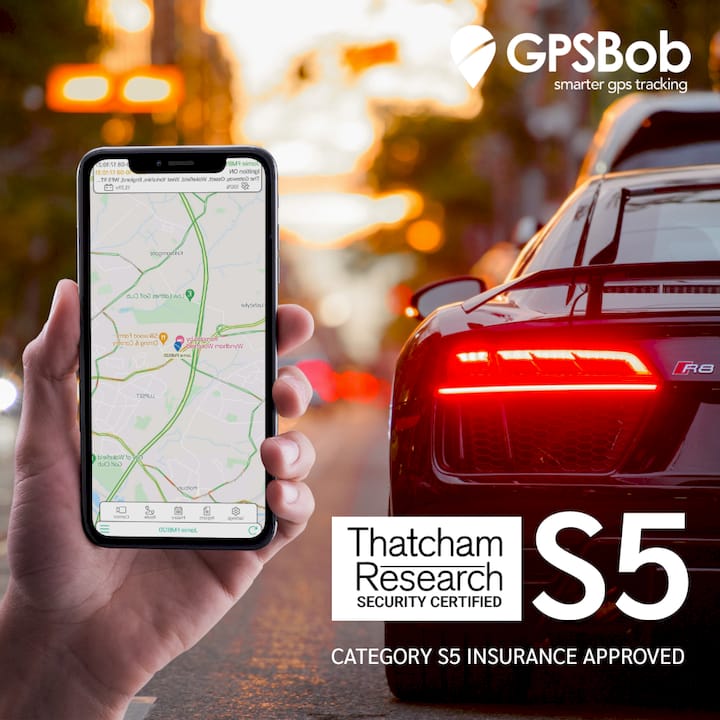
S5 builds on all of that and adds Automatic Driver Recognition (ADR). Authorised drivers carry a tag, and if the vehicle moves without one, the Thatcham vehicle security product definitions document confirms the system triggers an alert to the monitoring centre before the car has even left the street. S5+ variants extend this further with automatic immobilisation, cutting the engine remotely once theft is confirmed.
Pro Tip: Check whether your policy names a “tracking device” generically or specifically demands ADR. That single word changes whether S7 is enough or you need S5.
How do I confirm my insurer’s tracker requirement?
Insurers rarely volunteer the exact wording you need. You have to ask, and you have to get the answer in a form you can produce later.
- Call your insurer and ask directly: “Which Thatcham S‑category does my policy require, S5 or S7?”
- Ask whether older Cat 5, 6 or 7 references in your documents still apply, since Thatcham confirms these labels were retired on 1 January 2019 and now map to S5 and S7.
- Ask specifically whether ADR or immobilisation is mandatory, not just “a tracker”.
- Request written confirmation by email or as a policy schedule amendment, not a verbal note from a call handler.
- Keep that confirmation with your Certificate of Installation, monitoring reference and device serial number in one file.
Independent guidance from KeepClose makes the same point: policy wording varies between insurers, and Thatcham certification alone does not guarantee an insurer will accept a particular device. A claim can be delayed, or refused, simply because nobody confirmed the category before installation. Getting it in writing costs five minutes and prevents that entirely.
Installation, monitoring and your ongoing obligations
Certification is not just about the box. It is about who fits it and how the fit is proven. Thatcham’s product definitions require devices to be installed by an accredited engineer, and the engineer’s paperwork is what turns a piece of hardware into evidence your insurer can act on.
A properly issued Certificate of Installation should show:
- The fitter’s name and accreditation reference
- The device’s unique certificate or serial number
- The vehicle’s VIN and registration
- The date of fitting
- The monitoring supplier and subscription reference
Fitting the device is the easy part. Keeping the system compliant afterwards takes more discipline, particularly across a fleet:
- Keep the monitoring subscription active. A lapsed subscription can invalidate cover even if the hardware still works.
- Manage ADR tags properly. Lost or unissued tags undermine the entire point of S5, since the alert only fires correctly when tag allocation is current.
- Log every device’s certificate number and vehicle pairing centrally, not on individual drivers’ paperwork.
- Schedule periodic health checks so a failed SIM or a dead backup battery doesn’t sit unnoticed for months.
When does a fleet actually need S5 over S7?
Not every vehicle needs the same tier, and buying S5 across an entire fleet when your insurer only asks for S7 wastes money on tag administration you don’t need. The decision usually comes down to vehicle value, theft risk, and what your insurer has actually put in writing.
S5 tends to be necessary when:
- The vehicle has keyless entry, which remains a common relay‑theft target
- It’s a high‑value or prestige model sitting on a high‑theft list
- Your insurer explicitly names ADR as a policy condition, not just “an approved tracker”
S7 is typically sufficient when:
- Vehicles are standard fleet cars or vans below your insurer’s value threshold for enhanced security
- Your policy wording says “approved tracker” or “S7 or above” without naming ADR
The trade‑off is operational as much as financial. As KeepClose notes, ADR brings tag issuance, lost‑tag procedures and driver turnover into the mix, which is a real administrative cost across a mixed fleet.
Pro Tip: If your fleet mixes vehicle values, don’t default everything to S5 “to be safe”. Match the category to what each vehicle’s insurer condition actually states, then document the rationale per vehicle.
Compliance checklist for fleet managers
A working compliance process follows the same sequence every time, regardless of fleet size.
- Contact the insurer and get the required S‑category confirmed in writing.
- Select S7, S5 or S5+ per vehicle based on that confirmation and the vehicle’s risk profile.
- Book installation with an accredited engineer, not a general auto electrician.
- Collect the Certificate of Installation and the monitoring contract reference on the day of fitting.
- Allocate ADR tags where relevant and record them against the driver and vehicle.
- Update central fleet records before the vehicle goes back into service.
Booking windows for accredited fitters typically run to a few days’ notice, with the fit itself usually completed within a short period of time per vehicle. One person in the fleet operation should own compliance records, not each depot individually.
| Record | Where it’s held | Why it matters |
|---|---|---|
| Certificate of Installation | Central compliance file | Insurer proof of accredited fitting |
| Monitoring subscription reference | Central compliance file | Confirms 24/7 SOC coverage is live |
| Insurer’s written S‑category confirmation | Central compliance file | Prevents claim disputes over category mismatch |
| ADR tag register | Fleet operations | Tracks issuance and lost‑tag replacements |
What fleet managers get wrong about tracker compliance
The mistake we see most often is a fleet buying a consumer GPS tracker off a general marketplace, fitting it themselves, and assuming it satisfies a Thatcham condition because the listing says “insurance approved”. It doesn’t, unless the certificate, the monitoring, and the fitting all meet Thatcham’s own standard together.
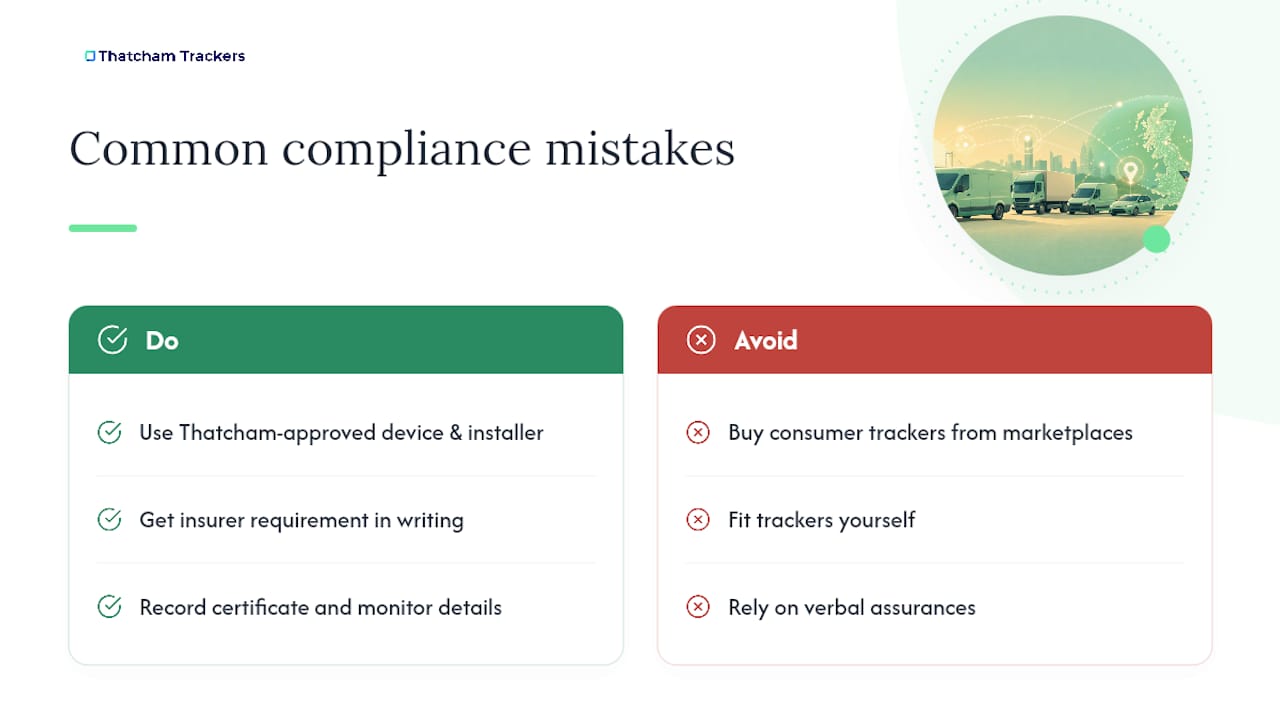
The second mistake is never putting the insurer’s requirement in writing. A verbal assurance from a call centre agent is worth nothing when a claim is being assessed months later.
Using a properly Thatcham‑approved device with accredited installation removes both risks at once: it evidences compliance instantly and gives police a verified system to work with if a vehicle is stolen. Fleets handling driver data through ADR tags should also check our vehicle tracking GDPR guidance to keep that side of the operation lawful.
Sorting compliance without juggling three suppliers
Thatcham Trackers supplies Thatcham‑approved S7, S5 and S5+ devices with nationwide accredited installation, monitoring options and a Certificate of Installation issued as part of the fit, not as an afterthought you have to chase.
For a fleet manager, that means one supplier holds the hardware, the fitting record and the monitoring reference together, so producing evidence for an insurer is a single request rather than three separate ones to different companies. If your insurer has confirmed an S5 requirement, the Thatcham S5: insurer‑approved 4G GPS tracker page covers ADR functionality and fitting options. If S7 meets your policy condition, browse the Thatcham‑approved trackers range to compare devices and book installation directly.
Sources
- Thatcham Security Certifications - Thatcham Research
- Thatcham approved trackers explained and what your insurer wants (KeepClose)
FAQ
Does Thatcham certification guarantee my insurer accepts the tracker?
No. Certification confirms the device meets Thatcham’s technical standard, but insurer acceptance is a separate commercial decision, so you must still confirm the category with your insurer.
Are Cat 5, 6 and 7 trackers still valid?
Yes, if the monitoring subscription remains active. Thatcham confirms these older category labels were retired on 1 January 2019 and now correspond to S5 and S7.
What’s the real difference between S5 and S7?
S7 focuses on post‑theft recovery through 24/7 monitored GPS tracking, while S5 adds Automatic Driver Recognition, which can flag unauthorised movement before the vehicle leaves the area.
What documents should I keep for an insurer audit?
Keep the Certificate of Installation, your insurer’s written S‑category confirmation, the monitoring subscription reference, and the device’s serial number in one central file.
Can I install a Thatcham‑approved tracker myself?
No. Certification depends on professional fitting by an accredited engineer, and self‑installation typically invalidates the Certificate of Installation insurers rely on.