

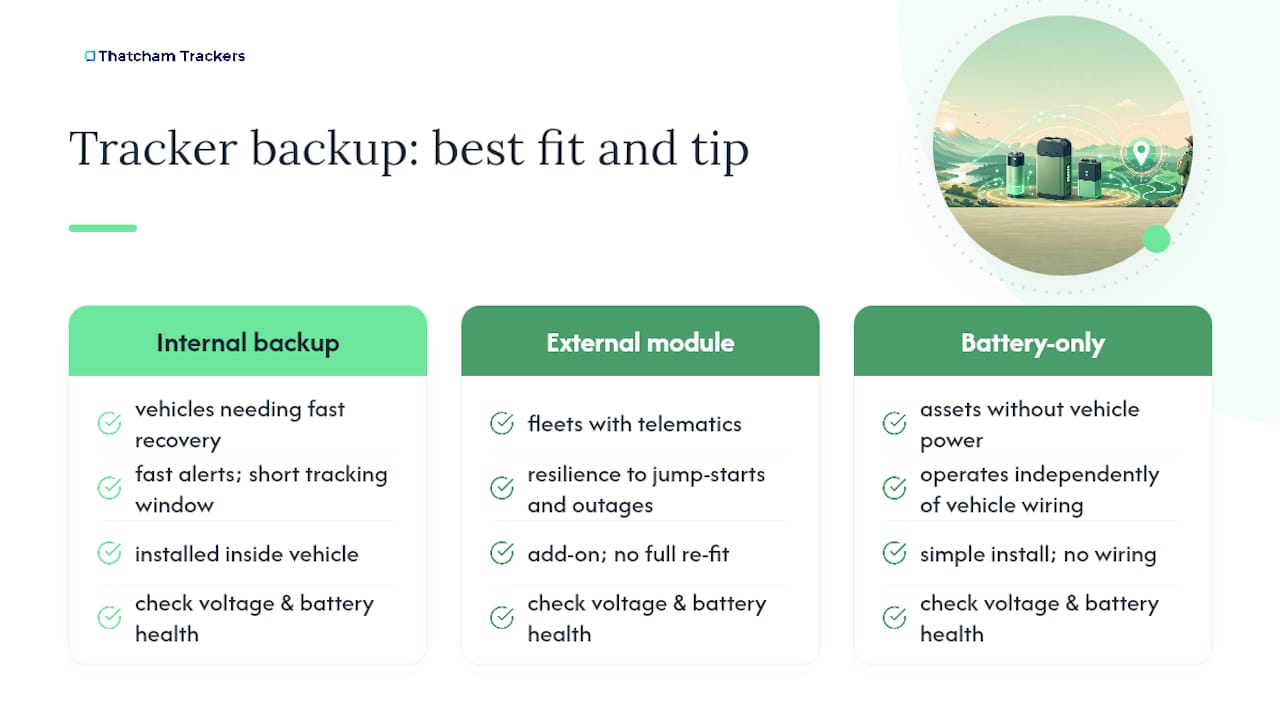
The best tracker backup battery is a built-in, internal battery inside a hardwired unit connected to a 24/7 monitored centre. That combination keeps location data flowing when a thief cuts the power supply, and it satisfies the Thatcham S5, S5+, and S7 battery back-up requirements that most UK insurers look for.
External backup modules, the IOX-style plug-in packs, suit fleet vehicles that already run telematics and just need short-term resilience during a jump-start or battery swap. Standalone battery-powered trackers work best on unpowered assets such as trailers, plant machinery, or shipping containers, where there’s no vehicle electrical system to tap into at all.
- Best all-round choice: a Thatcham-approved hardwired tracker with an internal backup battery, wired to a monitored centre meeting BS 8591.
- Best for fleet vehicles with existing telematics: an external IOX-style backup module, typically good for up to four hours of live tracking or up to four days of heartbeat pings.
- Best for unpowered assets: a standalone battery tracker, with runtimes stretching from months to several years depending on reporting frequency.
Table of Contents
- What is a tracker backup battery and why does it matter?
- How long does a tracker battery actually last?
- Installation types and how backup batteries trigger tamper alerts
- How do you choose the right backup battery for your tracker?
- Which Thatcham Trackers products cover these backup battery needs?
- Why does Thatcham approval matter for backup batteries?
- Ready to fit a backup battery that actually protects your vehicle?
- Sources
- FAQ
What is a tracker backup battery and why does it matter?
A tracker backup battery is the internal power cell inside a GPS or asset tracking device that keeps it transmitting after the main power supply is removed. Cut the wires to a vehicle’s battery, and a quality tracker doesn’t go dark. It switches to its backup cell, fires off a power-cut alert, and often carries on reporting location at a reduced frequency to conserve charge.
That last part matters more than most buyers realise. A backup battery doesn’t just keep the lights on. It’s the component that turns a power interruption into an alarm event, notifying a secure operating centre that something’s wrong the moment a thief starts working on the wiring loom.
Three broad categories cover almost every backup-power approach on the market, and knowing which one your asset needs saves you from buying the wrong device.
Built-in internal backup batteries
These live inside hardwired trackers, wired directly into the vehicle’s electrical system. When main power drops, the internal cell takes over immediately, usually giving you a window of continued tracking measured in hours rather than days. That’s by design: the priority is sending the alert and locating the vehicle fast, not running indefinitely on a coin-sized cell.
External dockable backup modules (IOX-style)
These plug into an existing telematics device rather than sitting inside it. Geotab’s IOX-BATTERY is the clearest example: it can power a device for up to four hours of live transmission while the vehicle is driving, then drops to a heartbeat every 30 minutes for the first 96 hours if the vehicle is stationary, before stretching that out further until the module depletes. External modules also tend to support daisy-chaining and pass-through power, so fleets can add resilience without replacing the whole unit.
Standalone battery-powered trackers
These carry no dependency on a host vehicle’s power supply at all. Battery-only trackers are the natural choice for trailers, generators, plant equipment, and containers, where standby life can run from a few months to several years depending on how aggressively the device reports its position.
Pro Tip: Match the reporting mode to the battery type before you buy. A standalone tracker set to report every five minutes will burn through a “two year” battery in weeks. Always check the manufacturer’s runtime figures against your intended reporting interval, not the headline number on the box.
How long does a tracker battery actually last?
Runtime depends almost entirely on two things: how much capacity the battery holds, and how often the device wakes up to report its position. A tracker pinging its location every 30 seconds during active movement will drain far faster than one that only reports on a scheduled heartbeat.
Wired trackers with internal backup batteries are built for short, sharp bursts of resilience rather than long-term standalone operation. Most carry one to two hours of internal battery dedicated to sending a final alert and holding a tracking window open long enough for recovery teams to act. Wireless and standalone devices work the opposite way: they trade reporting frequency for longevity, and their capacity is the whole story.
| Device type | Typical capacity / mode | Expected runtime |
|---|---|---|
| Hardwired tracker, internal backup | Small internal cell, alert + short tracking mode | 1–2 hours of continued transmission |
| External IOX-style module | Dockable pack, live vs heartbeat modes | Up to 4 hours live transmission driving; up to 4 days heartbeat parked |
| Standalone battery tracker, low-frequency reporting | Larger internal battery, scheduled heartbeat | Months to several years |
| Standalone battery tracker, high-frequency reporting | Same battery, motion-triggered updates | Days to weeks |
The IOX-BATTERY example illustrates the trade-off well. Geotab’s module gives four hours of live tracking while driving, then switches to a heartbeat every half hour for four days once the vehicle is stationary, before dropping to roughly one ping every 23 hours until the battery is exhausted. That staged approach, rich data first, then rationed pings, is how most well-designed backup systems stretch a finite power source across an unpredictable recovery window.
Battery-only asset trackers behave differently again. Manufacturers regularly quote standby times running into years for devices left in low-power sleep between scheduled check-ins, provided the reporting interval stays conservative.
Installation types and how backup batteries trigger tamper alerts
Installation complexity varies sharply depending on which backup approach you choose, and it directly affects how covert and tamper-resistant the final setup is.
- Plug-in / OBD trackers are the simplest to fit but the easiest to spot and unplug, which limits their usefulness for serious theft protection.
- Hardwired two-wire installs with internal backup take longer to fit, usually by a professional, but are far harder to locate and disable, and they integrate cleanly with a vehicle’s own wiring.
- External module installs sit between the two: quicker than a full hardwired job, but the module itself needs a secure, hidden mounting point to avoid tampering.
A loss of vehicle power is itself an alarm trigger on a well-built system. The moment someone disconnects the battery or cuts the feed wire, the backup cell kicks in, sends an immediate power-cut notification to the monitoring centre, and can switch into a “tow mode” that increases reporting frequency temporarily to help recovery teams pin down the vehicle’s movement.
Mounting location matters more than most owners think. A backup battery buried near an engine bay faces heat cycling and vibration that shortens its working life, while one tucked into a dry, low-vibration cavity holds charge and function far longer. Damp footwells and boot cavities near exposed metalwork are common failure points for corrosion on connectors, which is a bigger real-world cause of “battery” problems than the cell itself degrading.
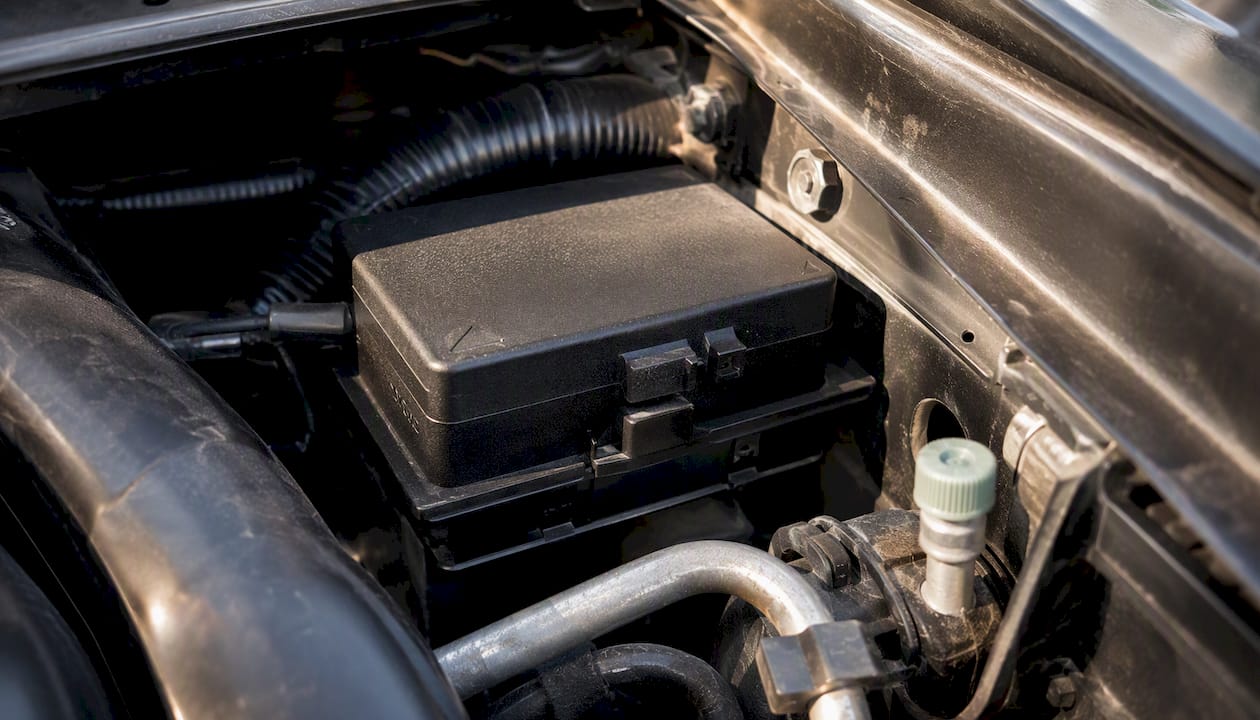
Pro Tip: Once your tracker is installed, ask your installer to configure both tamper and low-voltage alerts separately. A tamper alert flags physical interference, but a low-voltage alert warns you the backup battery is degrading before it fails during an actual theft attempt.
How do you choose the right backup battery for your tracker?
Start with three questions about the asset itself before looking at any product spec sheet.
- Is the asset powered or unpowered? A car, van, or motorhome has a vehicle electrical system to draw from; a trailer, container, or piece of plant machinery does not.
- How urgently do you need recovery data after a power cut? Vehicle theft recovery usually needs the richest possible data in the first hours after an incident, favouring hardwired systems with monitored alerting.
- What are your installation constraints? A fleet with existing telematics hardware may prefer an external module; a private car owner chasing insurer discounts almost always needs a proper hardwired, Thatcham-approved install.
Match those answers against three broad recommendations: a Thatcham-approved hardwired tracker with internal backup for theft-recovery vehicles, an external IOX-style module for fleets extending existing hardware, or a standalone battery tracker for anything with no power supply of its own.
When comparing specific products, weigh these criteria:
- Battery capacity and runtime under both active movement and heartbeat modes.
- Physical size and how easily the unit and its backup cell can be mounted out of sight.
- Thatcham or equivalent insurance approval, and compatibility with a 24/7 monitored centre.
- Warranty length and total price, including any installation fee.
Costs vary by category. Hardwired, Thatcham-approved trackers with professional installation typically sit at the higher end of the market because of the certification, monitoring subscription, and fitting labour involved. External modules cost less upfront but rely on an existing telematics device to plug into. Standalone battery trackers are often the cheapest entry point, though premium multi-year warranty models command a higher price for the extended battery life and ruggedised housing.
Which Thatcham Trackers products cover these backup battery needs?
Thatcham Trackers builds its range around exactly the three backup-power categories covered above, so matching your asset profile to a product is straightforward.
- For standard vehicle theft recovery with a built-in backup battery and monitored alerting, the Thatcham Approved S5 covers the core requirement: internal battery back-up, compatibility with 24/7 monitoring, and the certification most insurers ask for.
- Where immobilisation matters as much as recovery, the Thatcham Approved S5 Plus adds Ghost Immobilisation on top of the same backup battery and monitoring foundation, so a stolen vehicle can be tracked and disabled remotely.
- For higher-value cars, motorhomes, or anyone wanting the strongest resistance-to-attack rating available, the Thatcham Approved S7 sits at the top of the range.
- For owners who want long-term backup reliability without thinking about replacement for years, the 5 Year Two Wire GPS Vehicle Tracker pairs a hardwired install with an extended warranty period, reducing the chance of an ageing backup cell letting you down unnoticed.
Every one of these devices is built to work with a 24/7 monitored centre and its internal backup battery behaves the way Thatcham’s own product definitions require: immediate alerting on power loss, sustained transmission during the critical recovery window, and a design robust enough to resist tampering. Warranty terms and installation are handled as part of the purchase, so buyers aren’t left sourcing a fitter separately.
Why does Thatcham approval matter for backup batteries?
Thatcham Research doesn’t just check that a tracker has a battery inside it. Its S5, S5+, and S7 definitions specify a battery back-up power supply combined with 24/7 monitored reception meeting BS 8591 Category 1, along with resistance-to-attack testing and pursuit-locating performance benchmarks. A backup battery on its own, without a monitored centre picking up its alerts, is only half the system.
The value of a backup battery isn’t just that it keeps a device powered. It’s that it turns a power-cut event into an immediate, actionable alert at a monitored centre, which is precisely what BS 8591 compliance is designed to guarantee.
That distinction has real consequences for insurance eligibility. Removing or bypassing a monitored service, or fitting a tracker without genuine battery back-up, can undermine the very approval that earns a policyholder a premium discount in the first place. Buyers should treat the backup battery and the monitoring subscription as one package, not two optional extras.
- Thatcham S5, S5+, and S7 all require battery back-up as a baseline specification, not an upgrade.
- BS 8591 Category 1 monitoring defines how fast and how reliably a monitored centre responds to a power-cut alert.
- Choosing an approved system protects insurer discount eligibility and supports faster recovery outcomes after a theft attempt.
A practical view on risk, cost, and maintenance
Internal backup batteries earn their keep on any vehicle where theft recovery speed matters, because the alert and short tracking window they provide is exactly what a monitored centre needs to act. External modules make more sense as an add-on for fleets already running telematics, buying resilience against jump-starts and short outages without a full re-fit. Battery-only trackers are the right call the moment an asset has no vehicle electrical system to lean on, and trying to force a hardwired solution onto a trailer or container is usually the wrong instinct. The habit that saves owners the most grief isn’t picking the perfect device. It’s checking voltage and battery health alerts periodically, rather than assuming a backup cell fitted years ago is still doing its job.
Ready to fit a backup battery that actually protects your vehicle?
A tracker is only as reliable as the power source keeping it alive after the wires get cut. Thatcham Trackers builds every S5, S5 Plus, and S7 device around that principle: a genuine internal backup battery, wired to a monitored centre, installed by a professional fitter rather than left to a plug-in unit that a thief can simply pull out.
If your asset is a standard car or motorhome facing theft risk, start with the Thatcham Approved S5 for core backup and monitoring, or step up to the Thatcham Approved S5 Plus if you also want Ghost Immobilisation. Owners chasing the longest warranty on a hardwired backup battery should look at the 5 Year Two Wire GPS Vehicle Tracker. Choose your product, book nationwide mobile installation, and ask your fitter to configure tamper and low-voltage alerts before you drive away.
Sources
- VEHICLE SECURITY PRODUCT DEFINITIONS GUIDELINES
- IOX-BATTERY documentation (Geotab support)
- GPS Tracker Battery Backup – Why It Matters and How to Choose (EcoCosmo GPS)
- GPS tracker battery drain: myths vs facts (Fleetmate)
FAQ
How long will a tracker battery last?
Runtime depends on the device type and reporting frequency: hardwired internal backup batteries typically last one to two hours after a power cut, while standalone battery trackers can run from months to several years on a conservative reporting schedule.
Does a tracker drain the vehicle’s battery?
Properly configured trackers in sleep mode draw only a few milliamps and won’t normally flatten a healthy vehicle battery; most reported drain issues trace back to incorrect configuration or a vehicle battery that was already weak.
What battery does a tracker use?
Hardwired trackers use a small internal backup cell for short-term alerting, external modules like IOX-style packs use dockable battery units, and standalone trackers rely on larger internal batteries sized for long-term standby.
How does reporting mode affect battery life on a tracker?
Live, continuous reporting drains a battery within hours, while heartbeat or motion-triggered modes can stretch the same battery’s life to days, months, or years depending on the interval chosen.
Why does a Thatcham-approved tracker need a backup battery?
Thatcham’s S5, S5+, and S7 definitions require battery back-up alongside 24/7 monitored reception, because the backup battery is what powers the power-cut alert that notifies the monitoring centre during a theft attempt.