

Deliberately using a GPS or tracker jamming device in the UK is already a criminal offence under section 68 of the Wireless Telegraphy Act 2006, punishable on indictment by up to two years’ imprisonment and an unlimited fine. Ofcom and the police enforce this today, and government proposals now aim to go further by criminalising mere possession. If you own a vehicle or fleet, the practical advice is simple: never buy, use, or import a jammer, and report any suspected interference to Ofcom and the police straight away.
TL;DR:
- Possessing a GPS jammer is not yet a criminal offence in the UK, but legislation proposals could make ownership punishable even without proof of use.
- The current law criminalizes using devices to interfere with wireless signals, with penalties of up to two years in prison and unlimited fines on conviction.
- Enforcement relies on technical detection and seizure of devices, but proving active jamming remains difficult since jammers are portable and used briefly.
- Regulation also applies to sellers and importers of non-compliant jamming equipment, with future laws expected to tighten restrictions further.
- Protecting vehicle tracking systems through Thatcham-approved, anti-jamming devices can significantly reduce theft risks, with certification offering added recovery assurance.
Table of Contents
- What does UK jamming law actually cover?
- Why is the government proposing a possession ban?
- What penalties apply for jamming offences?
- How is jamming actually detected and prosecuted?
- Are there rules for selling or importing jammers?
- Are any jamming activities actually legal?
- What should vehicle owners and businesses actually do?
- Why certified anti-jamming technology matters
- Get insurer-approved protection that resists interference
- Sources
- FAQ
What does UK jamming law actually cover?
Section 68 of the Wireless Telegraphy Act 2006 makes it an offence to use apparatus for the purpose of interfering with wireless telegraphy. In plain terms, that covers any device deliberately deployed to block, disrupt, or degrade a radio signal, including the GPS and GSM signals a vehicle tracker relies on. The offence turns on intent to interfere, which is why proving it in court has never been straightforward.
Ofcom regulates the airwaves and confirms it does not issue licences for jammers under any circumstances, because their entire function is to cause harmful interference. Its guidance on radio equipment sets out enforcement powers that include seizing equipment and referring cases for prosecution. Two further layers of regulation matter here:
- The EMC Regulations and Radio Equipment Regulations require any radio equipment sold in the UK to meet compliance standards.
- Jammers typically fail to meet the definition of legitimate “radio equipment” at all, which puts them outside the compliance regime entirely rather than exempting them from it.
- Making a non-compliant device available on the UK market, whether through sale, import, or distribution, is itself a criminal offence Ofcom can pursue.
Why is the government proposing a possession ban?
The current law has a gap: owning a jammer is not, by itself, a crime. Only using it to interfere with a signal is an offence, and proving that use took place has proven difficult in practice. The Department for Science, Innovation and Technology has run a call for evidence on jammer possession specifically to close that gap.
Two developments are shaping where the law is heading:
- The Crime and Policing Bill includes measures that would make simply possessing certain devices linked to vehicle theft an offence, shifting the burden away from proving active interference.
- Ministers have framed jammers as tools of organised crime that threaten critical infrastructure, which is the stated rationale behind the proposed ownership ban.
If these proposals pass, owning a jammer with no legitimate purpose could become prosecutable on its own, regardless of whether use can be proven.
What penalties apply for jamming offences?
Under section 68, a conviction on indictment carries up to two years’ imprisonment and an unlimited fine; summary conviction carries lower maximum penalties in a magistrates’ court. Suppliers and importers of non-compliant equipment face separate criminal exposure under the EMC Regulations, enforced by Ofcom.
Statistic callout: Government announcements on the vehicle theft equipment ban cite maximum sentences of up to five years for possession or distribution of devices used to commit vehicle theft, a sharper penalty than the current two-year maximum under the 2006 Act.
Key points to weigh:
- Using a jammer: up to 2 years’ imprisonment and an unlimited fine on indictment.
- Supplying or importing non-compliant jamming equipment: separate offences under EMC Regulations, with Ofcom empowered to seize stock and prosecute.
- Possession or distribution tied to vehicle theft: proposed maximum of 5 years under new government measures.
Sentencing in practice depends heavily on context. Courts treat organised, repeated, or commercially motivated jamming far more seriously than an isolated incident, and the direction of travel is clearly towards tougher penalties rather than lighter ones.
How is jamming actually detected and prosecuted?
Ofcom, the police, and Trading Standards all play a part, but their roles differ. Ofcom handles technical detection and spectrum enforcement, police pursue criminal investigations, and Trading Standards focuses on unsafe or non-compliant products entering the market.
- Ofcom can trace interference technically and seize devices once located.
- Police investigate reported incidents, particularly where jamming coincides with a vehicle theft.
- Trading Standards targets sellers placing non-compliant equipment on the market.
The real obstacle has always been proving active use. Jammers are portable, used briefly, and rarely left at a crime scene, so investigators often rely on correlating incidents, such as a tracker losing its GPS fix, with device seizures and technical forensic analysis rather than catching a jammer mid-transmission. This evidential gap is precisely why the proposed possession offence matters so much to enforcement agencies.
Pro Tip: If your tracker suddenly loses signal in a location where reception has always been reliable, note the exact time and place immediately. That detail becomes useful evidence if you later need to report suspected jamming to the police or Ofcom.
Are there rules for selling or importing jammers?
Yes, and they apply regardless of whether the seller intends the device for illegal use. Under the EMC Regulations 2016 and Radio Equipment Regulations 2017, any economic operator, meaning manufacturers, importers, and distributors, must ensure equipment placed on the UK market is compliant.
- Ofcom can pursue sellers, importers, and distributors of jammers as criminal offences under these regulations.
- The Product Regulation and Metrology Act 2025 gives government fresh powers to set and tighten UK product requirements, which is expected to feed directly into future jammer restrictions.
- There is no defence in claiming ignorance of a buyer’s intent; supplying non-compliant equipment is the offence, independent of end use.
Are any jamming activities actually legal?
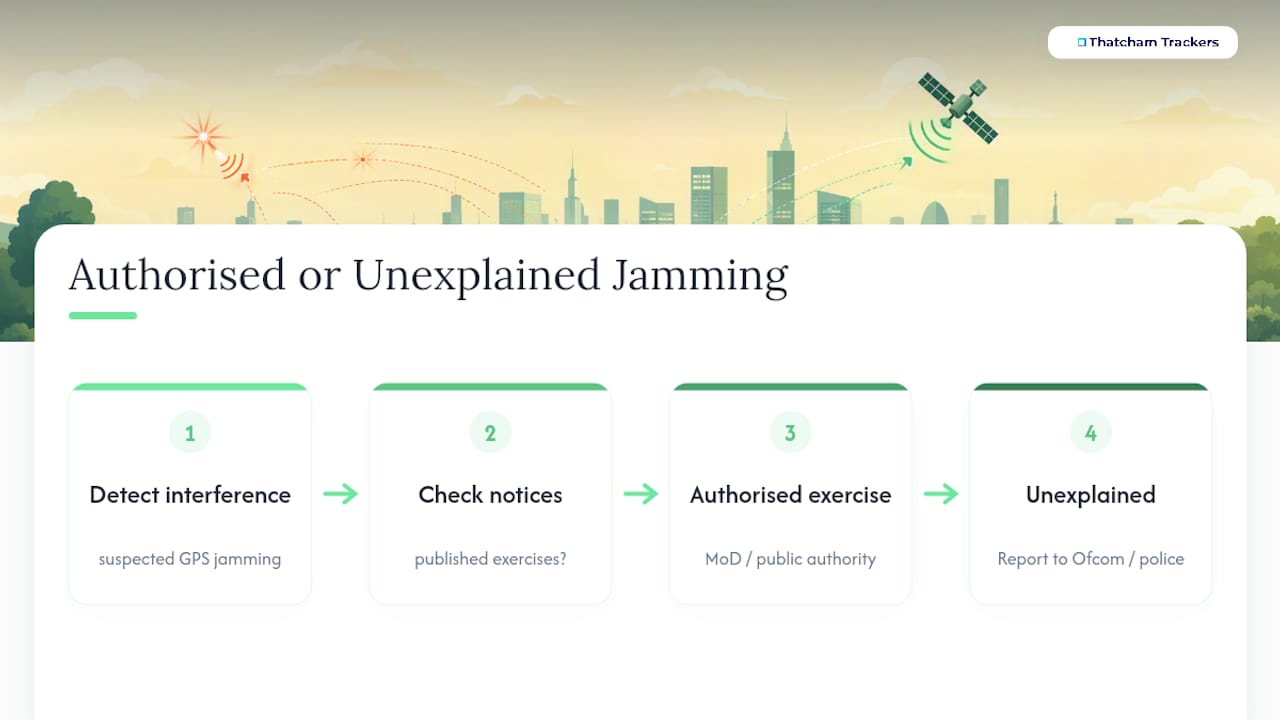
Some are. Police and other public authorities operate under specific exemptions for authorised operations, and the Ministry of Defence periodically runs scheduled GPS jamming exercises coordinated with aviation and emergency services. These are announced in advance through official channels rather than conducted covertly. If you suspect unexplained interference that is not linked to a published exercise, report it to Ofcom or the police rather than assuming it is authorised activity.
What should vehicle owners and businesses actually do?
Jamming defeats a tracker’s core purpose: if the signal is blocked during a theft, recovery becomes far harder and insurers may query the claim. That is precisely why Thatcham-approved devices build in tamper alerts and anti-jamming resilience rather than relying on a single unprotected signal path.
- Choose a Thatcham-approved tracker with genuine anti-jamming safeguards rather than a budget device with no resistance to interference. Our guide to anti-jamming tracker technology explains how these safeguards work.
- Preserve evidence the moment you suspect interference, noting the time, location, and any tracker or app alerts, then contact the police and Ofcom promptly.
- Understand how signal redundancy works before you buy, since some trackers switch between networks to resist a single point of failure, as detailed in our piece on how tracker signals evade interference.
- Verify accredited fitting, since a poorly installed tracker undermines even the best hardware. Fleet operators researching different systems may also find Nomora’s guide to vehicle tracking types useful background on where vulnerabilities typically sit.
Pro Tip: Ask any installer for the Thatcham digital certificate before you pay. Insurers increasingly ask for this document by name, and a missing certificate can delay or complicate a theft claim even if the tracker itself worked correctly.
Why certified anti-jamming technology matters
Working in vehicle tracking and recovery means seeing first-hand how often theft cases hinge on whether a signal held or failed at the critical moment. Jamming is not a theoretical risk; it is the specific weakness organised vehicle thieves exploit, which is exactly why insurers and Thatcham Research built certification standards around resilience rather than basic GPS functionality alone.
A Thatcham-approved device with a valid digital certificate does more than tick a box for your insurer. It gives you a documented, independently tested standard behind your recovery claim, which matters if a theft ever goes to dispute. Readers weighing up devices should treat certification as the baseline requirement, not an optional extra. For a fuller picture of why signal reliability underpins recovery outcomes, our guide on the role of GPS in theft recovery is worth reading before you buy.
— Thatcham Trackers
Get insurer-approved protection that resists interference
Thatcham Trackers is the direct route to certified, insurer-accepted protection, without the guesswork of checking compliance yourself.

Our range covers the Thatcham S7, the Thatcham S5, and the Thatcham S5 Plus, alongside the Casper Ghost-Like Immobiliser and Casper Pro for owners who want invisible, no-tag protection. A 4G Dashcam with remote live view is also available for cars, motorhomes, and fleets wanting an added layer of evidence. View the full Thatcham tracker collection or book accredited fitting today to get a compliant, certified device installed properly the first time.
This article is general information, not a substitute for advice from a qualified lawyer. Consult a qualified legal professional about your own circumstances before acting on anything here.
Sources
FAQ
Is signal jamming illegal in the UK?
Yes. Deliberately using a device to interfere with wireless telegraphy is an offence under section 68 of the Wireless Telegraphy Act 2006, carrying up to two years’ imprisonment and an unlimited fine on indictment.
Is tracking someone illegal in the UK?
Tracking a vehicle or asset you own or have legitimate authority over is lawful, but covertly tracking another person without consent or legal justification can breach data protection and harassment law. Legitimate tracker use, such as a Thatcham-approved device on your own vehicle, falls outside this concern entirely.
Is GPS jamming illegal?
Yes. Jamming a GPS signal falls squarely within the Wireless Telegraphy Act 2006’s definition of interfering with wireless telegraphy, regardless of whether the target is a vehicle tracker, a phone signal, or navigation equipment.
What is the punishment for using a GPS jammer?
Conviction on indictment can bring up to two years’ imprisonment and an unlimited fine, while government proposals tied to vehicle theft equipment cite maximum sentences of up to five years for possession or distribution offences once new laws take effect.
Does owning a Thatcham-approved tracker protect against jamming?
Thatcham-approved devices like the Thatcham S5 and S7 are built and certified with anti-jamming resilience and tamper alerts, which meaningfully reduces the risk that interference defeats recovery, though no device can guarantee immunity against every method criminals attempt.