

Yes, you must align your Thatcham-approved tracker subscription renewal with your motor insurance renewal. The single most important action is to confirm, in writing, that your monitoring subscription is active before your policy renews. A lapsed subscription, even by one day, can give your insurer grounds to decline a theft claim, regardless of whether the hardware is physically fitted to the vehicle.
Most claim disputes do not arise because the tracker was removed. They arise because the monitoring contract expired and nobody noticed. The Financial Ombudsman Service has confirmed this distinction matters: hardware fitted but subscription inactive is treated differently from a fully operational system.
Check these three things in the next 72 hours:
- Log into your tracker provider’s account portal and confirm your subscription status and next renewal date.
- Locate your insurance policy schedule and any endorsements that reference tracker requirements.
- Check whether your tracker subscription renewal date matches, or falls before, your insurance renewal date.
Table of Contents
- Why aligning tracker and insurance renewals matters
- What policy wording and documents should you check right now?
- How do you verify your tracker subscription and what proof do insurers accept?
- A practical timeline to align your tracker and insurance renewals
- What to do if your tracker subscription has lapsed
- What paperwork and records should you keep for renewals and claims?
- Which renewal model suits your situation?
- Why overlapping renewal dates is the right approach
- Thatcham Trackers: Thatcham-approved devices and renewal support
- Sources
- FAQ
Why aligning tracker and insurance renewals matters
UK motor insurers frequently attach endorsements to policies requiring a Thatcham-approved tracker to be “installed and in operation” with an active paid monitoring subscription. That phrase is not decorative. When a claim is made, insurers check whether the monitoring contract was live at the time of loss, not merely whether a device was bolted to the vehicle.
The Financial Ombudsman Service has confirmed that insurers acted fairly in declining theft claims where a required Thatcham-approved tracker subscription was not active at the time of loss. In a separate decision, the FOS upheld an insurer’s reliance on a policy endorsement requiring an anti-theft tracker with Pro-Active Automatic Driver Recognition to be fitted and subscribed, treating the policyholder’s breach as material to the loss:
The FOS has also confirmed that clear policy wording across the IPID, schedule, and endorsements is sufficient to place the obligation on the policyholder to maintain subscription continuity, per Decision Reference DRN-4141058. Insurers use Thatcham Research certification to assess theft risk and set cover conditions; when that certification’s monitoring component lapses, the risk reduction the insurer priced in disappears.
What policy wording and documents should you check right now?
Pull these documents before your next renewal:
- Policy schedule: Look for any condition referencing a tracker, security device, or named endorsement number.
- IPID (Insurance Product Information Document): Check the “What is not covered” section for tracker-related exclusions.
- Endorsements: Search for phrases such as “Tracker fitted,” “subscription in force,” “Category 5,” “S5,” “Cat 6,” or “S7.”
- Renewal notice: Insurers sometimes add or amend tracker conditions at renewal without highlighting the change.
The category labels matter. Older policies may reference “Cat 5” or “Cat 6,” which map directly to the current Thatcham S5 and S7 standards respectively. Thatcham-approved S5 devices include Automatic Driver Recognition (ADR), which some insurers require for higher-value vehicles. S7 devices represent the entry standard and are accepted by many insurers for standard-risk vehicles.
Pro Tip: Request written confirmation from your insurer of exactly which tracker category and subscription status they require. Keep that email alongside your installation certificate and monitoring invoices. If a claim is ever disputed, that written confirmation is your first line of defence.
How do you verify your tracker subscription and what proof do insurers accept?
- Log into your tracker provider’s online account or app and check the subscription status, expiry date, and last communication timestamp.
- Contact your monitoring centre directly and ask for written confirmation that your device is live and communicating.
- Request a copy of your installation certificate, which confirms the device was fitted by an accredited engineer. Insurers routinely request this at renewal and at the point of claim.
- Ask for monitoring logs or an activation timestamp showing continuous cover from installation to the present date.
- If your policy requires S5, confirm with your provider that ADR is active and that the monitoring centre can verify driver recognition events.
Documents insurers typically accept as proof include:
- Thatcham installation certificate (issued at point of fitting)
- Monitoring subscription invoice showing active dates
- Activation timestamp or monitoring log from the monitoring centre
- Account screenshot showing current subscription status
- Written confirmation email from the monitoring centre
Pro Tip: If you need retrospective proof quickly, contact your monitoring centre’s customer services team and request an account audit log. Most providers can produce a PDF showing every communication event and subscription payment. Ask them to include the phrase “subscription was active and device communicating” for the relevant dates. That specific wording tends to satisfy insurer claims handlers without further correspondence.
A practical timeline to align your tracker and insurance renewals
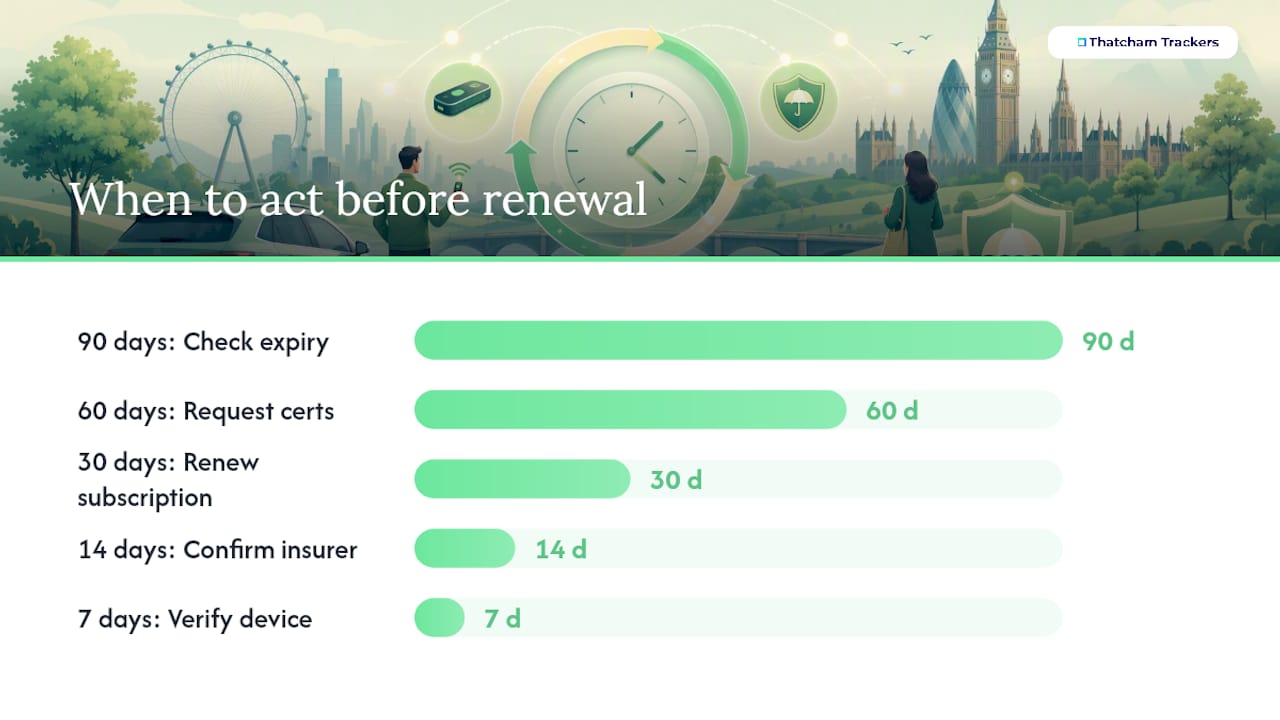
Follow this schedule before each insurance renewal:
- 90 days out: Check your tracker subscription expiry date against your insurance renewal date. If they differ by more than 30 days, contact your tracker provider to discuss aligning them.
- 60 days out: Request an updated installation certificate and monitoring log from your provider. Confirm your insurer’s current tracker requirements in writing.
- 30 days out: Renew your tracker subscription if it expires within the next 60 days. Overlap by at least a few days to avoid any technical processing gap causing an inadvertent lapse.
- 14 days out: Confirm with your insurer that your tracker documentation is on file. Send copies of your installation certificate and current subscription invoice proactively.
- 7 days out: Log into your tracker account and verify the device is communicating. Check for any alerts or errors.
- Renewal day: Confirm both the insurance policy and tracker subscription are active simultaneously before the old policy expires.
For fleets with staggered vehicle renewals, the insurance-approved tracker best practices guide recommends centralised renewal management with a dedicated fleet account manager to prevent multiple simultaneous lapses. Conduct a full tracker audit at each vehicle’s renewal and light-touch status checks at least quarterly between renewals.
For urgent mid-term renewals, contact your tracker provider the same day and request an expedited subscription reinstatement with a written confirmation timestamp.
What to do if your tracker subscription has lapsed
Act the same day you discover the lapse:
- Reinstate the subscription immediately and obtain written confirmation of the exact reactivation date and time.
- Preserve all payment receipts, account logs, and any monitoring centre correspondence from before and after the lapse.
- Inform your insurer in writing, attach the reactivation confirmation, and ask explicitly how they will treat the lapse period in the event of a claim.
- Request a monitoring log showing the gap period and the reinstatement timestamp.
If a claim has already been declined because of a lapsed subscription, gather this evidence before contacting the Financial Ombudsman Service:
- Payment history showing the lapse was brief and unintentional
- Reinstatement confirmation with timestamp
- Monitoring logs for the period before and after the lapse
- Any written communication from the insurer about the requirement
A short, unintentional lapse with prompt reinstatement and full documentation gives you the strongest possible position when presenting a complaint to the FOS.
What paperwork and records should you keep for renewals and claims?
Maintain a dedicated folder, physical or digital, containing:
- Thatcham installation certificate (original and any renewal versions)
- Monitoring subscription invoices for every renewal period
- Activation logs and communication timestamps from your monitoring centre
- Installer contact details and any engineer visit records
- Account screenshots taken at each renewal confirming active status
- Written insurer confirmation of tracker requirements at each policy renewal
When presenting evidence at renewal or in a claim, organise documents chronologically with timestamps highlighted. A short cover email to your insurer summarising the attached documents is more effective than sending files without context.
Sample email outline: Subject: Tracker compliance confirmation for policy [number]. Body: “Please find attached my Thatcham installation certificate (dated [X]), monitoring subscription invoice confirming active cover from [date] to [date], and written confirmation from [monitoring centre] that the device was communicating on [date]. Please confirm receipt and that these documents satisfy your tracker requirements.”
Pro Tip: Store your installation certificate and latest monitoring invoice in the same folder as your insurance documents. Reviewing them together at each annual tracker check takes under ten minutes and prevents the most common renewal oversight.
Which renewal model suits your situation?
Auto-renew is the lowest-risk option for most owners. The subscription continues without manual intervention, reducing the chance of an inadvertent lapse. The trade-off is that you may miss a price increase or a change in monitoring level unless you review the renewal notice carefully.
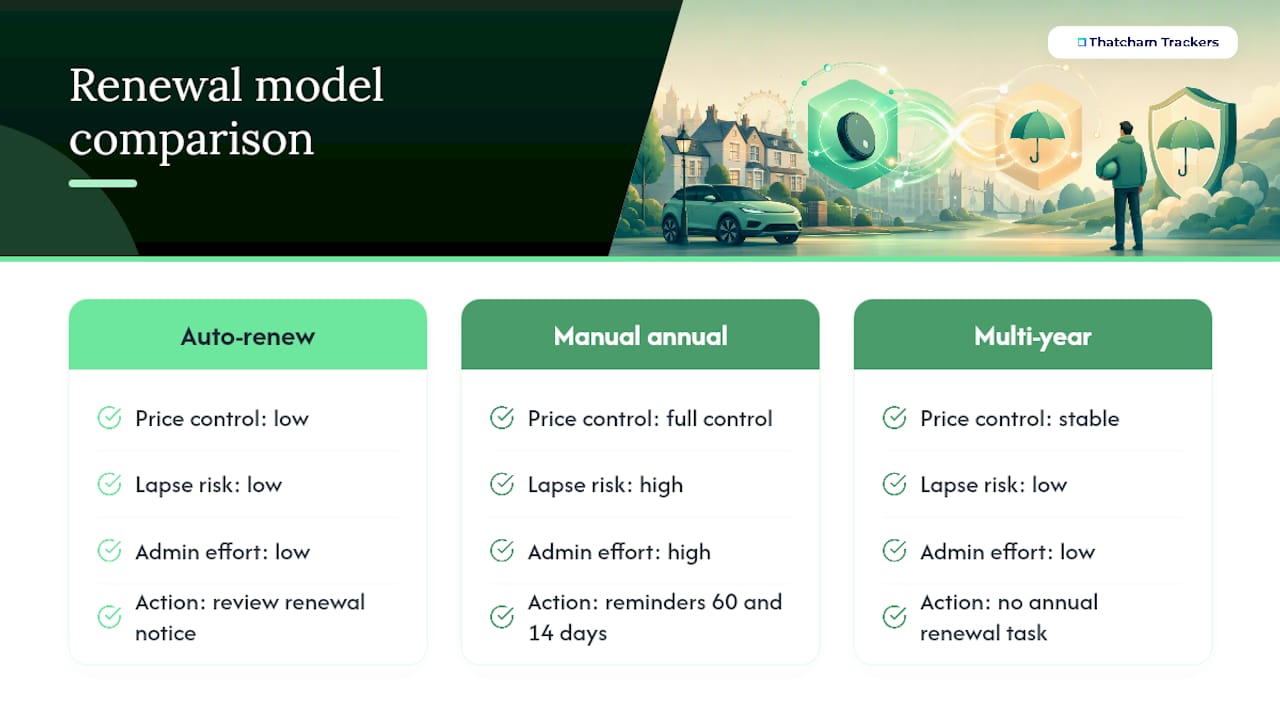
Manual annual renewal gives you full control over cost and provider choice. The risk is forgetting to renew, particularly if the tracker subscription date differs from your insurance renewal date. Set calendar reminders at 60 and 14 days before expiry.
Multi-year plans offer cost stability and remove the annual renewal task entirely. Confirm with your insurer that a multi-year subscription contract is acceptable and ask what proof they require at each insurance renewal within that period.
Cost factors to weigh include monitoring level (S5 monitoring typically costs more than S7 due to ADR functionality), fleet volume discounts for multiple vehicles, and any reinstallation fees if a device needs replacing. When changing insurer, always confirm the new insurer accepts your existing tracker category and subscription type before the policy starts.
Why overlapping renewal dates is the right approach
The most common cause of a declined theft claim is not fraud or negligence. It is a subscription that expired quietly while the owner assumed everything was in order. FOS decisions consistently show that insurers are not required to remind policyholders to maintain their tracker subscriptions; that obligation sits with the policyholder, as confirmed by Decision Reference DRN-4141058.
Overlapping tracker and insurance renewal dates by even a few days removes the single most common failure point. For fleets, staggering renewals across a managed calendar with a fleet account manager reduces administration and eliminates the risk of multiple vehicles lapsing simultaneously. Thatcham Trackers recommends treating the tracker subscription as part of the insurance renewal process, not a separate annual task.
Thatcham Trackers: Thatcham-approved devices and renewal support
Keeping your tracker subscription aligned with your insurance renewal is straightforward when you have the right device and the right support from the outset.
Thatcham Trackers supplies Thatcham-approved S7, S5, and S5+ devices with professional nationwide installation, a digital Thatcham certificate accepted by UK insurers, and renewal support designed to keep your cover compliant. Every installation comes with a certificate you can present to your insurer at renewal or in a claim. Fleet managers benefit from dedicated account support to manage staggered renewals across multiple vehicles without the administration overhead.
View the full range and start a renewal or installation order at Thatcham Trackers.
Sources
- Decision Reference DRN-5245609
FAQ
Can an insurer decline a claim if my tracker subscription lapsed?
Yes. The Financial Ombudsman Service has confirmed insurers can act fairly in declining theft claims where a required Thatcham-approved tracker subscription was not active at the time of loss, even when the hardware remained physically fitted.
What documents do I need to prove my tracker is active at renewal?
Your Thatcham installation certificate, a current monitoring subscription invoice, and written confirmation from your monitoring centre that the device was communicating are the documents most insurers request.
What is the difference between S5 and S7 for insurance purposes?
Thatcham-approved S5 includes Automatic Driver Recognition, which some insurers require for higher-value vehicles; S7 is the entry standard accepted by many insurers for standard-risk vehicles. Check your policy endorsement for the specific category required.
How far in advance should I renew my tracker subscription?
Renew at least 30 days before your insurance policy renews and overlap the subscription by a few days to eliminate any processing gap that could create an inadvertent lapse.
Does changing insurer affect my tracker requirements?
Yes. Confirm with your new insurer before the policy starts that they accept your existing tracker category and subscription type; requirements can differ between insurers, and a device acceptable to one may not satisfy another’s endorsement wording.