

Professional, monitored trackers substantially increase the chance of recovering a stolen vehicle in the UK.
The gap comes down to monitoring and police integration, not the tracker alone.
- Untracked vehicles: recovery depends on chance sightings, ANPR cameras, or the vehicle turning up abandoned.
- Tracked vehicles: a monitoring centre confirms theft, locates the vehicle, and liaises directly with police.
- Reported timelines: around half of recoveries within four hours, and 80% within 24 hours, according to industry recovery data.
Table of Contents
- What are the actual UK tracker recovery rate statistics?
- How do trackers work to boost recovery odds?
- What is the difference between Thatcham S7 and S5 approval?
- How do police and monitoring centres work together during a theft?
- How much do trackers cost and when do they pay for themselves?
- Where does this data actually come from?
- Which tracker setup actually makes sense for most owners?
- Get Thatcham-approved protection fitted across the UK
- Sources
- FAQ
What are the actual UK tracker recovery rate statistics?
The national recovery rate for stolen vehicles in the UK has hovered around 13% across 2022 to 2025, according to aggregated data reported by cinch. That figure covers every stolen vehicle recorded, tracked or not, and it means the majority of cars taken without dedicated protection are never seen again by their owners.
The Office for National Statistics publishes the underlying incident data through its Crime Survey for England and Wales, which tracks vehicle theft counts, locations and circumstances. It does not separately break out recovery outcomes for vehicles fitted with monitored trackers, which is why the two data sets, public and vendor, need reading side by side rather than as a single number.
Against that 13% baseline, industry reporting describes monitored tracking programmes recovering close to 95% of stolen vehicles, with 2025 alone seeing a record £41.3 million in recovered vehicle value according to the same SecurityBrief report. That is not a like-for-like comparison in a statistical sense, since the tracked figure comes from vehicles already fitted with active monitoring rather than a random sample. It does, however, show a consistent pattern across several years of reporting.
| Measure | Reported figure | Source |
|---|---|---|
| National recovery rate (all stolen vehicles) | ~13% (2022–2025) | ONS / Home Office aggregated data |
| Monitored tracker recovery rate | ~95% | Industry-reported (SecurityBrief) |
| Around half of recoveries | Around half of tracked recoveries | Industry-reported |
| Recovered within 24 hours | ~80% of tracked recoveries | Industry-reported |
A few points worth holding in mind when reading these figures:
- The 95% figure is a vendor-reported operational metric, not an independently audited national statistic.
- Recovery includes vehicles found damaged or stripped, not only those returned intact.
- Higher-value and newer vehicles are disproportionately represented in keyless and relay theft, which skews some regional figures.
How do trackers work to boost recovery odds?
Three technologies typically work together inside a monitored tracker, and each solves a different part of the recovery problem.
VHF (Very High Frequency) detection gives police a signal that keeps transmitting even when a vehicle is hidden in a garage, wrapped in foil, or moved into a shipping container, situations where GPS alone often fails. Most UK police patrol vehicles and all police helicopters carry detection equipment tuned to these signals, according to industry reporting, which is precisely why VHF remains the backbone of covert recovery operations.
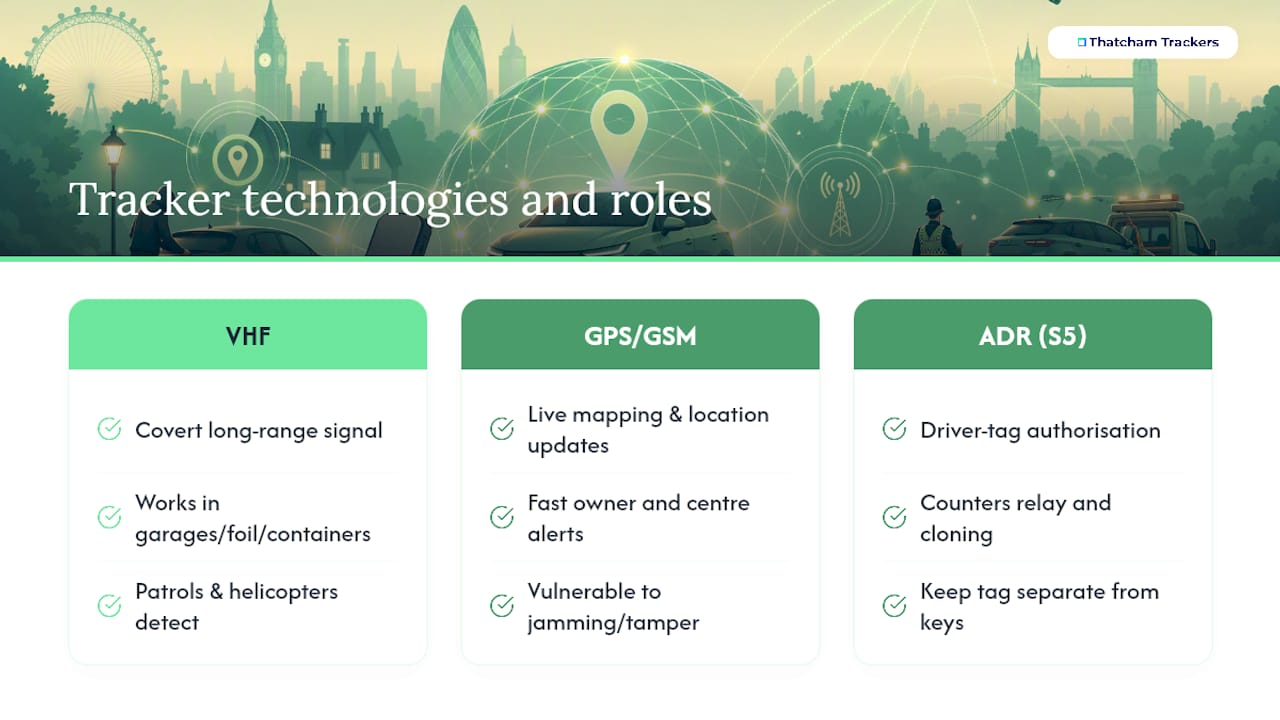
GPS and GSM telemetry provide the live mapping layer. The moment a monitoring centre flags unauthorised movement, GSM data sends the vehicle’s position to both the owner and the centre, allowing a police tasking request within minutes rather than hours. Read more detail on how this layer functions in Thatcham Trackers’ guide to GPS in theft recovery.
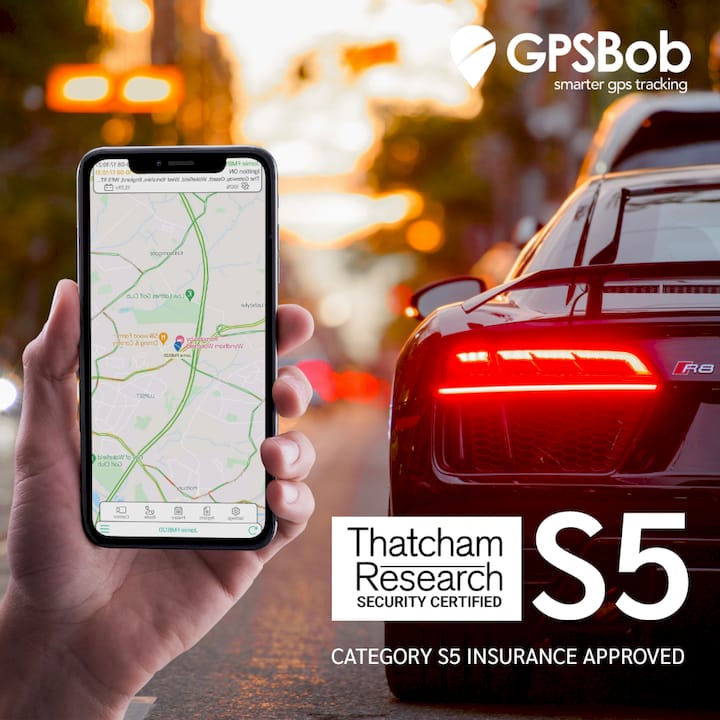
Automatic Driver Recognition (ADR), found in Thatcham’s S5 category, uses a driver tag to detect whether an authorised key or fob is present before the car moves. This directly counters relay and key-cloning theft, where criminals clone a signal without ever touching the physical key.
No system is immune to failure. Signal jamming, physical tampering, and vehicles hidden underground or in metal containers can all delay or block detection.
Pro Tip: Keep your tracker’s driver tag or fob somewhere separate from your car keys, ideally not in the same bag or drawer, so a stolen key doesn’t compromise your ADR protection too.
What is the difference between Thatcham S7 and S5 approval?
Thatcham Research is the UK’s independent body for testing and certifying vehicle security systems, and its approval categories are what insurers reference when setting premiums or mandating cover conditions. Two categories dominate the consumer market:
- S7 focuses purely on post-theft recovery: GPS/GSM/VHF tracking, 24/7 monitoring, and direct police liaison once a vehicle has already been taken.
- S5 builds on that with Automatic Driver Recognition, meaning the system can flag unauthorised use before the car even leaves the driveway, closing the gap that relay theft exploits.
- S5+ (used by some manufacturers and higher-value fleets) extends driver recognition further with additional tagging options.
Insurers increasingly reference these categories directly, according to Thatcham-approved tracker comparisons, and a higher-value or keyless-entry vehicle will often need S5 rather than S7 to satisfy policy conditions. If your insurer specifies a category on your policy schedule, that requirement isn’t negotiable. Fitting the wrong grade can invalidate cover rather than simply reduce a discount.
Browse the Thatcham-approved tracker range to see which category applies to your vehicle type before you buy.
How do police and monitoring centres work together during a theft?
A tracker’s real advantage shows up in the minutes after a theft is confirmed, not just in the hardware itself. Detection typically follows this pattern:
- The tracker’s GSM/GPS module detects unauthorised movement and alerts the monitoring centre automatically.
- The centre verifies the alert isn’t a false trigger, then contacts the vehicle owner directly for confirmation.
- Once confirmed, the centre passes live location data straight to the police, who can task patrol cars or helicopters fitted with VHF detection equipment.
- Police intercept the vehicle, often before it reaches a chop shop or is loaded for export.
This handoff between private monitoring and public policing is what separates tracked recovery from ordinary crime reporting, a point covered in more depth in Thatcham Trackers’ guide to how police use tracker recovery.
If your car is stolen, call 999 immediately, provide your tracker reference number if you have one, and never attempt to follow or confront the thieves yourself. Let the monitoring centre and police handle the tracking; your job is simply to report quickly and stay contactable.
How much do trackers cost and when do they pay for themselves?
Thatcham-approved trackers typically range from a few hundred pounds for an S7 unit up to a higher figure for S5 or S5+ systems with driver recognition, plus a professional fitting fee. Fitting matters because incorrect installation can affect both signal reliability and insurer acceptance.
Many insurers offer premium reductions for Thatcham-approved devices, and some mandate them outright for high-theft postcodes, imported performance models, or fleet policies. Keep your installation certificate and fitting invoice, insurers usually ask for proof before applying any discount or honouring a claim.
- High-theft areas: the reduced premium alone often covers the tracker’s cost within two or three years.
- High-value or keyless vehicles: S5’s ADR feature addresses relay theft risk directly, often a condition of cover rather than an optional extra.
- Fleet operators: bulk fitting spreads installation costs and simplifies compliance across multiple vehicles.
Pro Tip: Ask your insurer for their exact Thatcham category requirement in writing before you buy, some policies specify S5 for certain models even if the vehicle “looks” like a standard S7 candidate.
Where does this data actually come from?
Every figure in this article traces back to a specific source, and it’s worth being clear about what each one measures. The ONS runs the Crime Survey for England and Wales, the primary public dataset for vehicle-related theft, covering incident counts and circumstances but not tracker-specific recovery outcomes. The Home Office’s crime outcomes bulletin reports on police investigation closures, explaining part of why recovery without specialist intervention stays low.
The consistent theme across public and vendor data is the same: monitored, police-integrated tracking systems close the gap that patrol-based policing alone cannot. That doesn’t make the 13% baseline wrong, it makes it a measure of unprotected vehicles specifically.
Thatcham Trackers maintains its own UK recovery rate statistics update reconciling these public figures against industry claims year on year.
- Public baseline: ONS/Home Office, updated annually
- Vendor performance claims: industry-reported, updated as recoveries are logged
- Methodology gap: public data doesn’t isolate tracker-equipped vehicles, so direct comparison requires care
Which tracker setup actually makes sense for most owners?
Most UK owners overcomplicate this decision. If your car is a common target for opportunist theft, S7 with solid monitoring covers the core risk. If it’s keyless entry or sits on a manufacturer’s high-theft list, S5’s driver recognition earns its place, it’s addressing a specific attack method, not just adding a badge for insurers. Pair either with an immobiliser where your policy allows it, check your insurer’s exact wording before buying, and keep every fitting certificate. A tracker with a flat battery or an unregistered driver tag is a tracker doing nothing, so treat annual checks as part of ownership, not an afterthought.
Get Thatcham-approved protection fitted across the UK
That’s exactly what Thatcham Trackers supplies.
Thatcham Trackers stocks the full approved range, S7 for post-theft GPS recovery, S5 for vehicles facing relay theft risk, and S5 Plus for enhanced driver recognition, with professional mobile fitting available nationwide rather than a workshop appointment you have to arrange yourself. Every install comes with the digital certificate your insurer will ask to see, so there’s no chasing paperwork after the fact.
Before you buy, check your policy schedule for the exact category your insurer requires, then browse the Thatcham-approved tracker range to book fitting at a time and location that suits you.
Sources
- Nature of crime: vehicle-related theft (CSEW) — ONS
- Gov
- Tracker & UK police recover record £41.3m of stolen vehicles — SecurityBrief
- 342,000 cars stolen in four years - the UK’s vehicle theft crisis — cinch
FAQ
How many stolen cars are recovered in the UK?
Around 13% of stolen vehicles nationally are recovered, based on aggregated ONS and Home Office data from 2022 to 2025, compared with roughly 95% reported for monitored tracked vehicles.
What are the odds of recovering a stolen car without a tracker?
How much do car trackers cost in the UK?
Thatcham-approved trackers typically cost a few hundred pounds for S7 units, with S5 and S5+ systems priced higher due to added driver recognition features, plus a professional fitting fee.
How much does recovery cost the UK in stolen vehicle value?
Industry reporting put 2025’s recovered vehicle value at £41.3 million through monitored tracking programmes working alongside UK police, a record figure for that reporting period.
Do I need Thatcham S5 or S7 for my car?
It depends on your insurer’s policy wording and your vehicle’s theft risk. High-value or keyless-entry vehicles typically require S5 for its relay-theft protection, while S7 suits standard post-theft recovery needs.