

If your insurer requires a fitted, Thatcham-approved tracker for your hybrid, book an approved hardwired install now. S5 is usually required for higher-value hybrids, and S7 covers lower-risk vehicles. Check your policy wording first, then arrange installation with an accredited fitter who issues a proper certificate.
TL;DR:
- An insurer requiring a Thatcham S5 tracker demands installation by an accredited professional and certification that confirms proper wiring and placement.
- Hybrid owners should confirm their policy’s required Thatcham category before purchasing, with high-value vehicles often needing S5, while lower-risk models may be satisfied with S7.
- A hardwired tracker with tamper detection and registered ADR tags provides better theft protection and is more likely to satisfy insurer requirements than plug-in or self-installed devices.
- Choosing an approved fitter, obtaining a proper certification, and maintaining active monitoring are crucial steps for optimal security and insurance compliance.
Table of Contents
- What ‘Thatcham-approved’ means: S5, S5 Plus and S7 explained for hybrid cars
- Installation options: professional hardwired fitting, immobiliser integration and what installers do
- Costs and ongoing fees: what UK hybrid owners should budget
- How to choose an approved fitter and the questions to ask before booking
- Aftercare: registering the device, keeping subscriptions active and how insurers check status
- Why Thatcham Research certification matters and how it underpins insurer requirements
- Practical recommendation: pick the category your insurer specifies, prioritise approved fitment
- How we can help: products, nationwide fitting and booking
- FAQ
- Sources
- Authoritative links: Thatcham Research, GOV.UK and industry cost guide
What ‘Thatcham-approved’ means: S5, S5 Plus and S7 explained for hybrid cars
Insurers do not accept every GPS tracker as proof of security. They look for a specific classification from Thatcham Research, the UK body that tests and certifies vehicle security devices. Two categories matter most for hybrid owners.
Thatcham S7 is an asset location system. It tracks the vehicle’s position but does not include 24/7 monitored response as a core requirement, and it sits at the entry level of the certification scale.
Thatcham S5 is a vehicle tracking system built around round-the-clock monitoring and ADR, short for automatic driver recognition. Thatcham Research’s certification defines S5 systems as including 24/7 monitored response, motion detection and driver identification features that S7 does not require.
ADR matters because hybrid models, like many modern cars with keyless entry, are frequent targets for relay attacks and key cloning. ADR links the tracker to a registered driver tag, so the monitoring centre can tell the difference between the registered owner driving away and an unrecognised person starting the car. That distinction is what allows a monitoring centre to flag a theft in progress rather than simply logging a location after the fact.
S5 Plus builds on the standard S5 specification with additional features, though the exact bundle varies by provider. The technical checklist behind S5 certification includes monitoring to BS 8591 remote centre standards, a roaming SIM for signal continuity, bi-directional transmission, and battery back-up so the device keeps reporting even if someone disconnects the vehicle’s power supply.
Which category you need is not your choice to make in isolation:
- Your insurance policy wording specifies the Thatcham category it requires, often tied to the vehicle’s value or theft risk profile.
- High-value hybrids are commonly asked for S5 because of the monitored response and ADR protection.
- Lower-risk vehicles or lower premium brackets may be satisfied with S7.
- Some insurers accept either category but offer better terms for S5.
Read your policy document or call your insurer before buying anything. A device that is technically excellent but the wrong category will not satisfy your cover, and choosing the right tracker for your specific policy terms avoids that mistake entirely.
Installation options: professional hardwired fitting, immobiliser integration and what installers do
A tracker only counts for insurance purposes if it is fitted the way insurers expect. That means professional, hardwired, concealed installation, not a plug-in device you fit yourself in the car park.
Plug-in OBD trackers are cheap and easy to buy online, but they clip into the diagnostic port and are visible and removable in seconds. Insurers generally will not accept these as meeting a Thatcham S5 or S7 requirement, because anyone who steals the car can simply unplug the device before driving off. A hardwired fit is wired directly into the vehicle’s electrics and hidden in the bodywork, which is why insurers treat it differently.
Many hybrid owners also pair their tracker with an immobiliser, such as a Casper Ghost-like device, and often consider ceramic coatings to protect their vehicle’s finish during installation and daily use (ceramic coating cost UK). These are “no-tag, no-start” systems: the engine will not run unless a registered tag or code is presented, which closes the gap that keyless relay attacks exploit. An immobiliser does not replace a tracker for insurance purposes, but combining the two gives both prevention and recovery.
A typical professional installation follows a consistent sequence:
- The installer assesses the vehicle and confirms wiring points suited to the hybrid’s electrical system, since hybrid drivetrains route power differently from petrol or diesel-only models.
- The tracker is wired into a concealed location, away from obvious access points, so it cannot be found and removed quickly.
- ADR tags are paired with the system, so the monitoring centre can distinguish the registered driver from an unauthorised one.
- Tamper detection is activated and tested, so any attempt to disconnect or interfere with the device triggers an alert.
- Battery back-up is fitted or checked, keeping the tracker reporting even if the main power supply is cut.
- The installer registers the device with the monitoring centre and issues a fitting certificate confirming the work.
That certificate matters as much as the hardware. It should record the device’s unique ID, the installer’s name or company, and the date of fitting, because this is the document your insurer will ask to see.
Pro Tip: Keep a digital copy of your fitting certificate alongside your insurance documents, not just in an email folder you might lose access to.
Our own guidance on S7 installation for 2026 covers the hardwiring and concealment steps in more detail for owners weighing up the entry-level category against S5.
Costs and ongoing fees: what UK hybrid owners should budget
Fitted prices for Thatcham-approved trackers in the UK typically fall between £169 and £400 for S7 systems, and roughly £300 to £700 or more for S5, according to industry cost reporting for 2026. Monitoring subscriptions on top of that typically run between about £7.99 and £10.99 a month, or £100 to £150 a year, per the same 2026 cost guide, and that ongoing fee is what keeps your tracker insurer-recognised, not a one-off purchase.
Several factors push the final bill up or down:
- Vehicle access and wiring complexity: hybrids with more densely packed engine bays can take longer to fit than a simple petrol model.
- Bundling an immobiliser with your tracker raises the upfront cost but can reduce the number of separate installation visits.
- Model-specific wiring looms sometimes require extra parts or labour, particularly on newer hybrid platforms.
- Choosing S5 Plus over standard S5 adds to the device cost, though the feature set also expands.
The functional gap between S5 and S7 is not really about GPS accuracy. As the same cost guide explains, the difference is operational: S5’s monitored response and ADR mean a theft can be flagged and acted on faster, while S7 simply reports location without that monitored layer.
When comparing quotes, ask installers to itemise the device cost, the fitting fee and the monitoring subscription separately. A single bundled figure makes it hard to see whether you are paying a fair rate for each part, or whether a cheaper quote is cutting corners on fitting quality. Our price breakdown for S7, S5 and monthly monitoring sets out typical figures so you have something to measure quotes against.

How to choose an approved fitter and the questions to ask before booking
Not every installer who advertises “car tracker fitting” works to the standard your insurer expects. A short checklist before you book saves you from discovering the problem after a claim.
- Ask to see proof that the fitter installs Thatcham-recognised, insurer-approved devices, not generic consumer trackers.
- Confirm the exact Thatcham category on offer (S5, S5 Plus or S7) and whether immobiliser bundles are available alongside it.
- Ask who registers the device with the monitoring centre, and when that registration takes effect.
- Request the fitting certificate in advance so you know what information it will contain: device ID, installer details and fitting date.
- Check how tamper alerts and battery back-up are tested before the installer signs off the job.
Watch for a few warning signs. A fitter who cannot produce a certificate, who offers only a plug-in device when you have asked for a hardwired fit, or who is vague about which monitoring centre the device reports to, is not someone whose installation your insurer is likely to accept without question. If any of those come up, ask directly before paying a deposit rather than after the work is done.
Aftercare: registering the device, keeping subscriptions active and how insurers check status
Fitting the tracker is only the start. Thatcham Research’s own guidance is clear that an active monitoring subscription matters as much as the hardware itself, and insurers often ask for evidence of active monitoring when a theft claim is made.
A few habits keep that cover intact:
- Register the device with the monitoring centre as soon as it is fitted, and keep confirmation of that registration with your other car documents.
- Renew the monitoring subscription before it lapses: a gap in cover can leave an insurer treating the tracker as though it were never fitted at all.
- Test tamper alerts periodically, and replace lost or damaged ADR tags promptly rather than leaving the system running without one.
- Keep your fitting certificate and monitoring proof together, since you may need both at once if you ever make a claim.
The Crime and Policing Act 2026 gives police targeted powers to enter premises and recover stolen goods where electronic tracking data meets certain thresholds, which raises the practical value of a properly monitored tracker. A device that reports live, verified location data to an active monitoring centre is far more useful to the police under these powers than one with a lapsed subscription or no monitoring at all.
Pro Tip: If your car is stolen, note the exact time you noticed it missing and contact your monitoring centre immediately, since a fast report gives the tracked data the best chance of supporting a timely police response.
Why Thatcham Research certification matters and how it underpins insurer requirements
Thatcham Research exists to test vehicle security products against a consistent standard, rather than leaving every manufacturer to make its own claims about theft resistance. Its certification categories, from S5 through to S7, set out specific technical requirements: monitored response, ADR, tamper resistance, bi-directional communication and battery back-up, depending on the category.
Insurers rely on this testing because it gives them a consistent benchmark across different manufacturers and installers. Rather than assessing every tracker brand individually, an insurer can simply specify “S5 required” in a policy and know what that means in practice. That is why the fitting certificate your installer issues after an approved installation matters so much: it is the documentary link between the certified product, the professional fit, and the cover your insurer has agreed to provide.
For owners who want to understand the technical detail behind a category before booking, Thatcham’s own vehicle security product definitions set out the full checklist each category must meet, which is worth a look if your insurer’s wording is unclear.
Practical recommendation: pick the category your insurer specifies, prioritise approved fitment
The single most useful thing a hybrid owner can do before buying anything is call the insurer and get the required Thatcham category in writing. Guessing wastes money, either on a device that is more than your policy demands or, worse, one that falls short of it.
S5 tends to be the requirement for higher-value hybrids, largely because of the monitored response and ADR protection against relay theft. If your insurer accepts S7 for your specific vehicle, the decision becomes a trade-off between lower cost and the slower, unmonitored response that S7 alone provides. Adding a Ghost-like immobiliser to an S7 setup is a reasonable way to close some of that gap.
What we would push back on is treating this as a brand or gadget comparison. The debate that matters is not which tracker has the flashiest app. It is whether the device is the correct Thatcham category, fitted by an accredited installer, with a certificate your insurer will actually accept, and backed by a monitoring subscription that stays active. Get those four things right and the rest is detail.
— Thatcham Trackers
How we can help: products, nationwide fitting and booking
We supply tracking and immobilisation hardware with installation built around the requirements set out above: the right category, a professional hardwired fit, and documentation your insurer will accept.
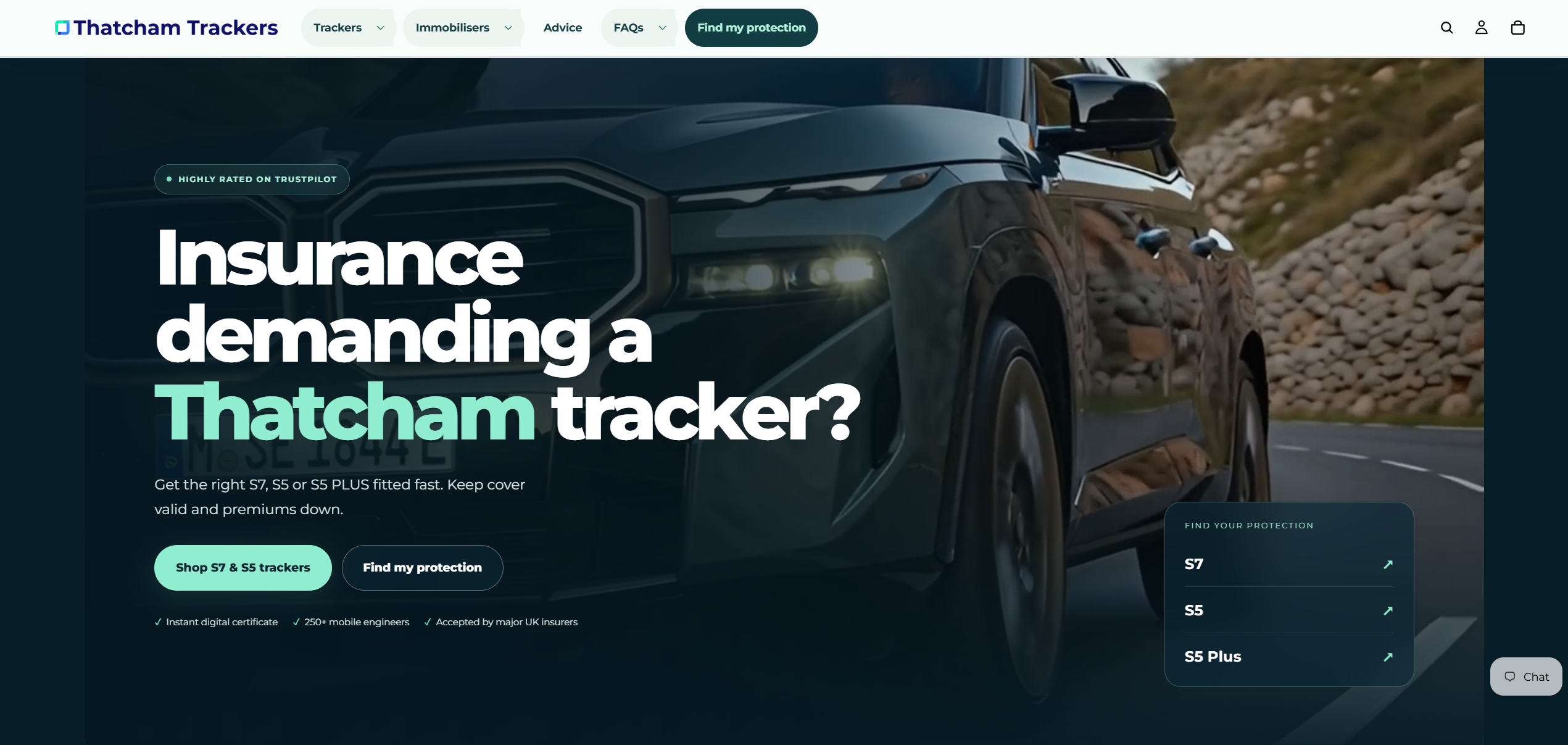
Our product range covers Thatcham S7 at £169 one-off, Thatcham S5 at £349 one-off, and Thatcham S5 Plus at £449 one-off, alongside immobiliser options including the Casper Ghost-like immobiliser at £399.00 one-off and Casper Pro at £499.00 one-off for owners who want a no-tag, no-start layer on top of tracking.
Every order includes:
- The certified device itself, matched to the required category.
- Nationwide mobile fitting from qualified engineers, so the installation happens at a location that suits you.
- A fitting certificate recording the device ID, installer details and fitting date.
- Monitoring registration completed at the point of fitting, activating your cover.
If you already know which category your insurer specifies, you can browse our S5 range or the S7 collection directly and book a fitting date that works around your diary.
FAQ
How much does it cost to fit a tracker to a car in the UK?
Fitted costs for a Thatcham-approved tracker typically range from £169 to £400 for S7 and roughly £300 to £700 or more for S5, according to current UK cost reporting. Monitoring then adds a separate ongoing subscription on top of that one-off fitting cost.
Is it illegal to put a tracker on a vehicle in the UK?
Fitting a tracker to a vehicle you own is not illegal, and insurers often require one for cover on higher-risk or higher-value cars. The legal and insurance questions usually concern how the device is fitted and monitored, not whether fitting one is permitted in the first place.
How much does it cost to install a tracker on a vehicle?
Installation is usually quoted as part of the fitted price rather than separately, with S7 around £169 to £400 and S5 around £300 to £700 or more in the UK, per industry cost figures for 2026. A monitoring subscription of roughly £7.99 to £10.99 a month is then charged on top to keep the device insurer-recognised.
What is the best car tracking device in the UK?
The right choice depends entirely on what your insurer’s policy specifies rather than any single “best” product. We supply Thatcham S5, S5 Plus and S7 devices built to meet Thatcham Research’s certification standards, fitted with the accreditation and certificate insurers look for.
Does a lapsed monitoring subscription affect my insurance?
Yes. Thatcham Research’s guidance notes that insurers often require proof of active monitoring to validate a theft claim, so a lapsed subscription can leave your tracker unrecognised for insurance purposes even though the hardware is still fitted.
Sources
- Thatcham Security Certification - Thatcham Research
- Vehicle Tracker Cost UK 2026 | Thatcham S5 & S7 Fitted Prices
- Gov
Authoritative links: Thatcham Research, GOV.UK and industry cost guide
For further reading beyond this guide, Thatcham Research’s certification page sets out the S5 and S7 definitions in full, while its security guidance and product definitions document cover the technical detail. GOV.UK’s Crime and Policing Act 2026 factsheet explains the new police powers around electronically tracked stolen goods, and the 2026 vehicle tracker cost guide was used for the pricing figures throughout this article.