

Motorhome low battery alerts are notifications from a Thatcham-certified, monitored tracker warning that its backup power, the vehicle’s battery voltage, or its wiring connection has dropped below a safe threshold. They reach the owner, any nominated contacts, and the monitoring centre simultaneously. The moment one arrives, do not approach the motorhome if tampering is indicated. Contact the monitoring centre, follow their instructions, and screenshot or log the alert for your records.
TL;DR:
- A low-battery alert can indicate the tracker’s backup power fading, the motorhome’s electrical supply dropping below normal, or a tamper attempt involving wiring cuts or disconnection.
- Insurer-grade trackers poll voltage periodically and escalate alerts only when dips persist, reducing false alarms caused by normal electrical fluctuations during vehicle use.
- When an alert arrives, verify its type, avoid approaching if tampering is suspected, log and screenshot the event, and promptly notify your monitoring centre and insurer if needed.
- Regular maintenance, including annual checks and testing after battery replacements or storage periods, is essential to prevent unnoticed backup drain leading to false or missed alerts.
- Properly documented, monitored alerts reinforce your insurance claim by proving continuous system activity and timely responses, especially when alerts are paired with tamper flags or repeated low-battery warnings.
Table of Contents
- What low-battery alerts actually mean on a Thatcham-certified tracker
- How insurer-accepted monitoring systems detect and notify low-battery conditions
- What a Thatcham-certified alert tells you, and how it interacts with insurers
- Step-by-step: what to do the moment an alert arrives
- Installation, backup batteries and maintenance that keep alerts accurate
- How low-battery alerts affect your insurance cover and claims
- Common causes of motorhome battery depletion behind these alerts
- Preventative measures to avoid low battery situations
- Do all tracker brands handle low-battery alerts the same way?
- How temperature and usage patterns shape battery life
- Reading alert severity and timing to stay ahead of problems
- Publisher perspective: why monitored alerts earn their place in your insurance strategy
- Get insurer-accepted monitoring built into your motorhome from day one
- FAQ
What low-battery alerts actually mean on a Thatcham-certified tracker
Not every low-battery alert means the same thing, and confusing one type with another leads owners to either panic unnecessarily or ignore something serious.
A tracker internal battery alert flags the device’s own backup cell, separate from the motorhome’s supply, running low. This backup exists so the tracker keeps reporting even if someone disconnects the vehicle battery. When it drops, the unit is warning that its independent power reserve is fading, not that your leisure systems are affected.
A vehicle or auxiliary voltage alert fires when the tracker monitors the motorhome’s own electrical supply and detects a drop below the working range. This usually points to a starter battery issue, a failing alternator, or a parasitic drain somewhere on the vehicle circuit.
A tamper or disconnection alert is different again. It triggers when wiring is cut, the CAN-bus connection is interfered with, or the unit is physically removed. Insurers treat this category with particular seriousness because it can indicate an attempted theft rather than a maintenance issue.
- Internal backup battery low: the tracker’s own reserve power is fading
- Vehicle voltage low: the motorhome’s supply has dropped below normal range
- Tamper/disconnection: wiring cut, CAN-bus interfered with, or unit removed
How insurer-accepted monitoring systems detect and notify low-battery conditions
Insurer-grade trackers work by polling voltage and connection status at regular intervals rather than waiting for a single failure event. A device that checks in every few minutes builds a pattern; when a reading dips below a set threshold and stays there across successive checks, the system escalates it from a minor fluctuation to a genuine alert. This filtering matters because vehicle electrics naturally dip during ignition or heavy accessory use, and a tracker that screamed at every wobble would be useless.
The backup battery inside the unit is what keeps monitoring alive when the main supply is cut or fails. A “low” reading typically means the backup still has enough charge to report but is running down; a “dead” or unresponsive unit means it has lost the ability to communicate altogether, which is itself treated as a red flag by monitoring services. Choosing the right backup cell affects how long that warning window lasts, something covered in detail in Thatcham Trackers’ guidance on backup battery selection.
Notification typically follows a chain:
- An SMS or app push reaches the registered owner within moments of the threshold being crossed
- The monitoring control room receives the same alert and begins its own verification process
- If tampering or unexplained movement accompanies the low-battery signal, the control room can escalate to police
Owners who pair alerts with a nominated secondary contact see faster resolution, because someone is nearly always reachable to confirm whether an event is genuine or a false trigger.
What a Thatcham-certified alert tells you, and how it interacts with insurers
An alert from a certified system is not a vague ping. It carries specific data points designed to be useful both to you and to anyone assessing an insurance claim later.
- Timestamp — the exact moment the threshold was crossed
- Last-known location — GPS coordinates or nearest recognisable landmark
- Voltage or charge state — the reading that triggered the alert
- Tamper flag — whether disconnection or interference was detected alongside the voltage drop
- Device ID — the unique identifier tied to your Thatcham digital certificate
Monitoring centres log every one of these events against your account, creating a time-stamped record that exists independently of your own phone or memory. That record matters more than most owners realise. When a claim is disputed, insurers want evidence that the certified device was active, monitored, and reporting correctly at the time in question. A digital certificate confirms the installation met Thatcham’s standard; the event log confirms the system was doing its job on the day something went wrong.
Reporting an alert promptly, and keeping your own copy of the notification alongside the monitoring centre’s log, gives you a paper trail that is far harder to dispute than a verbal account given weeks after the fact.
Step-by-step: what to do the moment an alert arrives
- Check the alert type first. A tamper or movement flag needs a different response to a simple low backup battery warning.
- If tampering is indicated, do not approach the vehicle. Contact the monitoring centre immediately and let them verify the situation; if it looks like an active theft, they can involve police directly.
- If it is purely a low backup battery reading, arrange remote diagnostics. Most certified providers can check the unit’s status without you doing anything to the vehicle.
- Book an engineer visit if the diagnostics confirm a failing backup cell. Waiting risks the tracker going fully dark, which removes your protection entirely.
- Screenshot the alert and keep a written log of every call and reference number. Insurers and monitoring centres both work faster when you can produce a clean, time-stamped record.
- Notify your insurer if your policy terms require it. Some policies specify a reporting window after any security-related event.
Pro Tip: Keep your nominated emergency contact’s phone number updated with the monitoring provider every time you change it. An alert sent to a disconnected number is an alert nobody sees.
Installation, backup batteries and maintenance that keep alerts accurate
Hard-wired, CAN-bus integrated installation gives the most reliable low-battery reporting available for a motorhome tracker. It reduces the false disconnection readings that plague superficial “sleeper” installs, and it preserves more of the vehicle’s own telemetry, which monitoring centres use to verify events rather than guessing from GPS position alone.
Backup batteries inside these trackers generally fall into two camps: sealed lead acid cells, which are inexpensive but bulkier and slower to recharge, and lithium variants, which hold charge longer and recover faster after a drain event. Neither lasts indefinitely, and both degrade faster in extreme temperatures.
- Have the installation checked annually, ideally alongside your motorhome’s own service schedule
- Test the tracker’s alert function after any battery replacement, on the vehicle or inside the unit itself
- Run a manual check after long storage periods, since an idle motorhome is exactly when a slow backup drain goes unnoticed
Skipping these routine checks is the single most common reason owners get caught out by a “sudden” low-battery alert that had, in reality, been building for weeks.
How low-battery alerts affect your insurance cover and claims
Insurers who require a Thatcham-certified tracker as a condition of cover expect that device to be active and reporting. An alert history, even one showing nothing more dramatic than routine backup battery warnings, demonstrates the system was working as intended. That record can actually strengthen your position during a claim, because it proves continuous monitoring rather than a device fitted once and forgotten.
Where alerts matter most is in the aftermath of a theft or attempted theft. Insurers assessing a claim will often ask for the monitoring centre’s event log covering the period leading up to the incident. If your tracker had been sending unresolved low-battery warnings for weeks beforehand and nothing was done, that gap can complicate the claim, since the insurer may argue the security condition attached to your policy was not being properly maintained.
Conversely, a clean log showing prompt engineer follow-up after any low-battery warning supports your case that reasonable care was taken. This is one reason the digital certificate issued at installation matters beyond the initial paperwork; it establishes the baseline the insurer expects you to keep meeting throughout the policy term, not just on the day of fitting. Keep every alert notification and every response you made to it. If a claim ever needs supporting evidence, that trail of timestamped messages is worth far more than a memory of “I think I got a text about the battery.”
Common causes of motorhome battery depletion behind these alerts
Most low-battery alerts trace back to a small handful of recurring causes; recognising which one applies to you saves a great deal of guesswork.
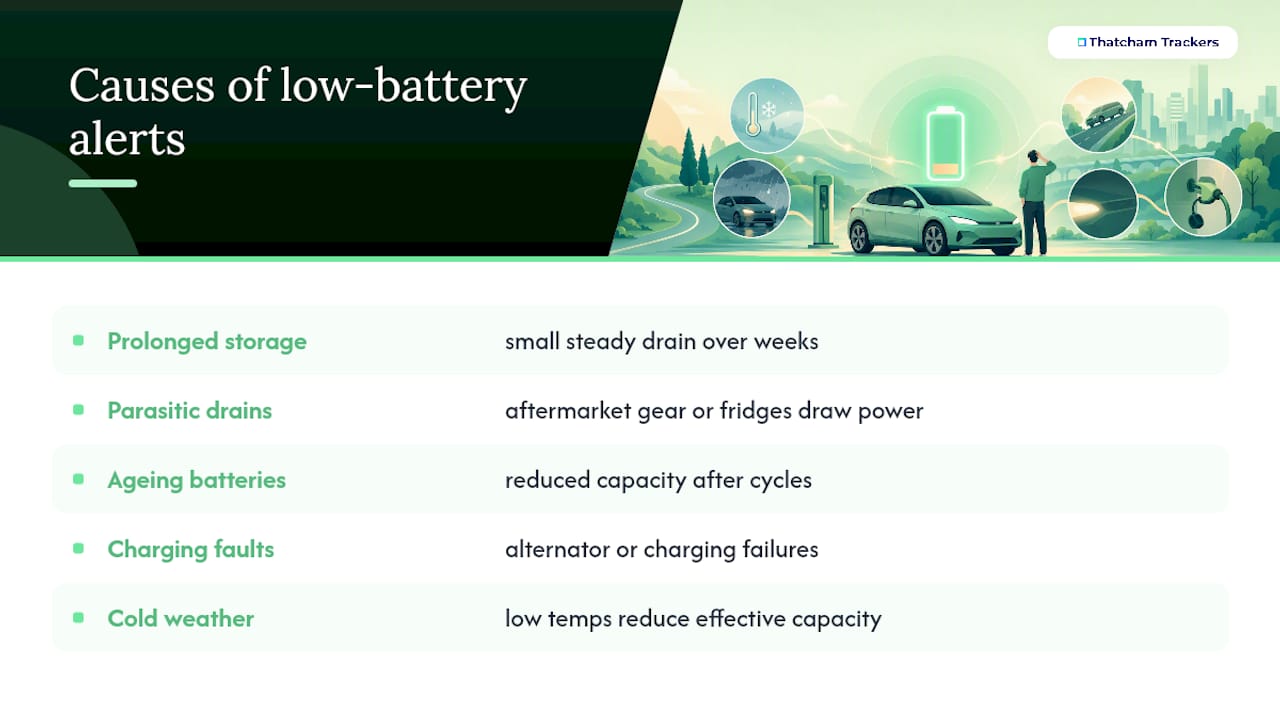
Prolonged storage without use is the most frequent culprit. A motorhome left idle for weeks draws small amounts of current from alarm systems, trackers, and other always-on electrics, and without regular charging that steady drain eventually crosses the alert threshold.
Parasitic drains from aftermarket accessories, fridges left on 12V mode, or faulty relays can pull power even when the vehicle appears switched off entirely.
Ageing or degraded batteries hold less charge with every cycle, so a battery that coped fine last year may simply no longer have the reserve to survive a fortnight of storage.
Alternator or charging faults stop the battery topping back up properly during drives, so it looks fine after a long trip but fails the moment the motorhome sits still again.
Cold weather accelerates all of the above, since low temperatures reduce a lead acid battery’s effective capacity at exactly the time parasitic drains are working hardest.
Understanding which cause applies to your situation is the first real step toward preventing the alert from happening again, rather than just reacting to it each time.
Preventative measures to avoid low battery situations
A handful of habits do most of the work in keeping your motorhome’s electrical system, and your tracker’s backup power, out of alert territory altogether.
Fit a solar trickle charger if your motorhome spends long periods parked, since it offsets the small constant drain from alarms and trackers without you needing to intervene. A smart battery isolator switch lets you cut power to non-essential circuits during storage while keeping the tracker itself active. Scheduling a periodic drive, even a short one, helps the alternator top the battery back up and gives you a natural opportunity to check dashboard warnings.
Regular voltage checks with a simple multimeter, done monthly during storage, catch a slow decline long before it becomes a crisis alert. For deeper cleaning and protective maintenance around the vehicle, guidance from Diamondbrite on motorhome storage care covers routines that reduce the kind of prolonged idle exposure that contributes to battery strain in the first place.
None of these measures are dramatic, but consistency matters more than any single fix. A motorhome checked every few weeks rarely surprises its owner with a dead battery; one left entirely alone for months almost always does.
Do all tracker brands handle low-battery alerts the same way?
They do not, and the differences matter more than most owners assume when comparing options. Some units report only a binary “low” or “normal” state, giving you no sense of how urgent the situation actually is. Others provide a graded voltage reading, letting you see a battery declining over days rather than being surprised by a sudden cutoff notification.
Polling frequency varies too. A tracker checking status every few minutes catches problems far earlier than one that reports once or twice a day, though more frequent polling also draws more power from the very backup battery it is trying to protect, a balance that certified manufacturers tune carefully.
Integration method affects reliability as well. Devices that connect through the vehicle’s CAN-bus, rather than a simple plug-in sleeper unit, generally deliver steadier data because they are drawing readings from the vehicle’s own systems rather than an isolated add-on. This is one reason Thatcham-approved product lines such as the Thatcham S7 and Thatcham S5 are built around proper hard-wired fitting rather than a basic clip-in design.

Escalation behaviour is the final differentiator. Some systems simply notify the owner and stop there; insurer-accepted, monitored options pass the same alert to a control room capable of independent verification, which is the feature that actually matters when a genuine security event is unfolding rather than a routine power dip.
How temperature and usage patterns shape battery life
Cold weather is the biggest single environmental factor behind winter alert spikes. Lead acid batteries lose a meaningful share of their effective capacity as temperatures drop, so a battery that seemed perfectly healthy in summer can trigger a low-voltage alert on the first proper cold snap, even without any new fault developing.
Heat causes a different problem. High temperatures accelerate the chemical breakdown inside a battery over time, shortening its overall working life even if it does not cause an immediate alert.
Usage pattern matters just as much as climate. A motorhome used every weekend keeps its battery cycling and topped up naturally. One left stationary for months at a time, particularly through a cold winter, faces the worst combination possible: reduced capacity from temperature and no charging input from driving. This is exactly the scenario where preventative measures such as trickle charging earn their cost back many times over, and it’s why storage duration deserves as much attention as the vehicle’s age or battery brand when you’re troubleshooting recurring alerts.
Reading alert severity and timing to stay ahead of problems
Not every alert deserves the same urgency, and learning to read the pattern rather than reacting to each notification individually is what separates proactive owners from those constantly firefighting.
A single low-battery alert that clears itself after a drive or a short charge is usually just the system doing its job, flagging a dip and confirming recovery. Treat it as information, not emergency.
Repeated alerts over a short window, particularly ones that recur despite charging, point to a genuine fault rather than a one-off fluctuation. This pattern is your signal to book a diagnostic check before the battery fails completely rather than after.
An alert that arrives paired with a tamper flag, regardless of how minor the voltage drop looks, should always be treated as high severity. The combination of the two readings is what insurers and monitoring centres pay closest attention to, because it distinguishes ordinary battery ageing from a potential security event.
Timing also carries information. Alerts clustering overnight or during long storage periods usually point to parasitic drain or cold-weather capacity loss. Alerts appearing shortly after a drive suggest a charging system fault rather than the battery itself. Reading that context before calling an engineer often saves a wasted callout.
Publisher perspective: why monitored alerts earn their place in your insurance strategy
Thatcham certification paired with a monitored control room does more than satisfy a policy condition on paper. It gives you a running record that speaks for itself when an insurer starts asking questions, and it turns a vague “the tracker went quiet” story into a documented sequence of events with timestamps attached.
For motorhomes that spend long stretches in storage, that continuous low-battery monitoring becomes a genuine deterrent as much as a diagnostic tool. Someone tampering with wiring generates a record the moment they touch it. Keep your insurer and your nominated contacts current with the monitoring provider. An alert that reaches nobody achieves nothing, no matter how good the underlying hardware is.
— Thatcham Trackers
Get insurer-accepted monitoring built into your motorhome from day one
Your digital certificate is issued immediately once installation and commissioning are complete. Nationwide mobile fitting is subject to coverage, compatibility and appointment availability. Confirm that the exact device and monitoring service meet your insurer’s requirements.
Our S7 provides monitored location tracking and recovery support. S5 adds Automatic Driver Recognition using a driver tag; recognition alone does not prevent starting. Our standard S5 Plus adds tag-operated No Tag, No Start immobilisation. S5 Plus is a package description, not a separate Thatcham certification category. Confirm the exact device and installation requirements with your insurer.
Browse the current collections and book your fitting directly through the Thatcham Trackers product pages to get certified, monitored protection installed before your next trip.
FAQ
What counts as a low-battery alert on a Thatcham-certified tracker?
It is a notification that the tracker’s backup power, the vehicle’s voltage, or its wiring connection has fallen below the monitored threshold. Insurer-accepted systems send this to the owner, nominated contacts, and the monitoring centre at the same time.
Does a low-battery alert mean my motorhome has been tampered with?
Not necessarily. Most low-battery alerts relate to normal backup cell depletion or a vehicle voltage dip, but if the alert also carries a tamper flag, treat it as high priority and contact the monitoring centre rather than approaching the vehicle yourself.
How much does a Thatcham-approved tracker with monitored alerts cost?
Our standard wired packages cost £169 for S7, £349 for S5 and £449 for S5 Plus, including professional fitting, plus £10.99/month monitoring. First-year totals are £300.88, £480.88 and £580.88 respectively, excluding optional extras and counting the first monitoring month once. Prices checked on 30 September 2026; fitting is subject to compatibility, coverage and appointment confirmation. See our current cost comparison.
Will a low-battery alert affect my insurance claim?
A well-documented alert history generally supports a claim by showing the certified system was active and monitored throughout the policy period. Unresolved warnings left ignored for weeks can complicate a claim if an insurer argues the security condition wasn’t properly maintained.
How often should I test my tracker’s backup battery?
Test it annually alongside routine vehicle servicing, and always after replacing either the vehicle battery or the tracker’s internal backup cell. Owners storing their motorhome for extended periods should also run a manual check before and after long lay-ups.