

Yes. Data from a Thatcham-approved tracker can support and speed up a motor insurance claim. It provides location, timestamps, ignition and tamper alerts, and dashcam footage where fitted, all of which help reconstruct what happened, corroborate other evidence, and support theft recovery or fraud checks. It rarely stands alone, though. Insurers still expect it alongside witness statements, CCTV, or police reports.
TL;DR:
- Thatcham-approved tracker data includes GPS coordinates, timestamps, journey logs, ignition and immobilisation records, tamper alerts, and dashcam clips, depending on the device category.
- Data exports from these devices must be unaltered, signed, and provided in formats like CSV with metadata to be considered strong evidence for claims.
- Insurers use tracker logs to build detailed timelines, verify claims, assist in theft recovery, and detect fraud, often speeding up claim approvals significantly.
- The legality of tracker data use relies on contractual consent and legitimate interest under UK GDPR, emphasizing the importance of proper permissions and timely data access.
- Properly fitted and owner-prepared devices enable quick, credible exports, which are crucial for avoiding delays and disputes during the claims process.
Table of Contents
- What does tracker data for claims actually contain?
- How do insurers use tracker data to handle claims?
- How do you request and export tracker data for a claim?
- Is it legal for insurers to use your tracker data?
- Why tracker data alone doesn’t always settle a claim
- What should you submit with a claim to make tracker evidence insurer-ready?
- What we’ve learned fitting Thatcham S5 and S7 devices across the UK
- Get insurer-ready evidence before you ever need to claim
- Sources
- FAQ
What does tracker data for claims actually contain?
Tracker data is not one thing. It’s a bundle of separate signals, and which ones you have depends on the device fitted and the Thatcham category it falls under.
A typical export from a Thatcham-approved unit includes:
- GPS coordinates logged at set intervals, showing exact vehicle position over time
- Timestamps for every recorded event, down to the second
- Journey logs showing routes, speed, and stop patterns
- Ignition on/off records
- Immobilisation events, showing when and how the vehicle was disabled
- Tamper alerts, flagging attempts to disconnect or interfere with the device
- Dashcam clips with embedded metadata, where a camera is fitted alongside the tracker
Our S7 provides monitored location tracking and recovery support. S5 adds Automatic Driver Recognition using a driver tag; recognition alone does not prevent starting. Our standard S5 Plus adds tag-operated No Tag, No Start immobilisation. S5 Plus is a package description, not a separate Thatcham certification category. Confirm the exact device and installation requirements with your insurer.
Certification confirms the device performs to a tested standard. It does not automatically mean every insurer treats the output the same way. Thatcham Security Certification is an engineering benchmark. Whether your insurer discounts your premium or fast-tracks your claim on the strength of it is still a commercial decision they make separately.
How do insurers use tracker data to handle claims?
Claims handlers use tracker logs the way a detective uses phone records: to build a timeline, then check whether everything else lines up with it.
The first job is reconstruction. GPS pings and ignition events let an investigator sequence exactly what happened before, during, and after an incident, often down to the minute. That timeline then gets checked against witness statements, CCTV, and vehicle ECU or mileage records. If a driver claims they were parked all evening but the tracker shows the ignition firing at 2am, that discrepancy matters.
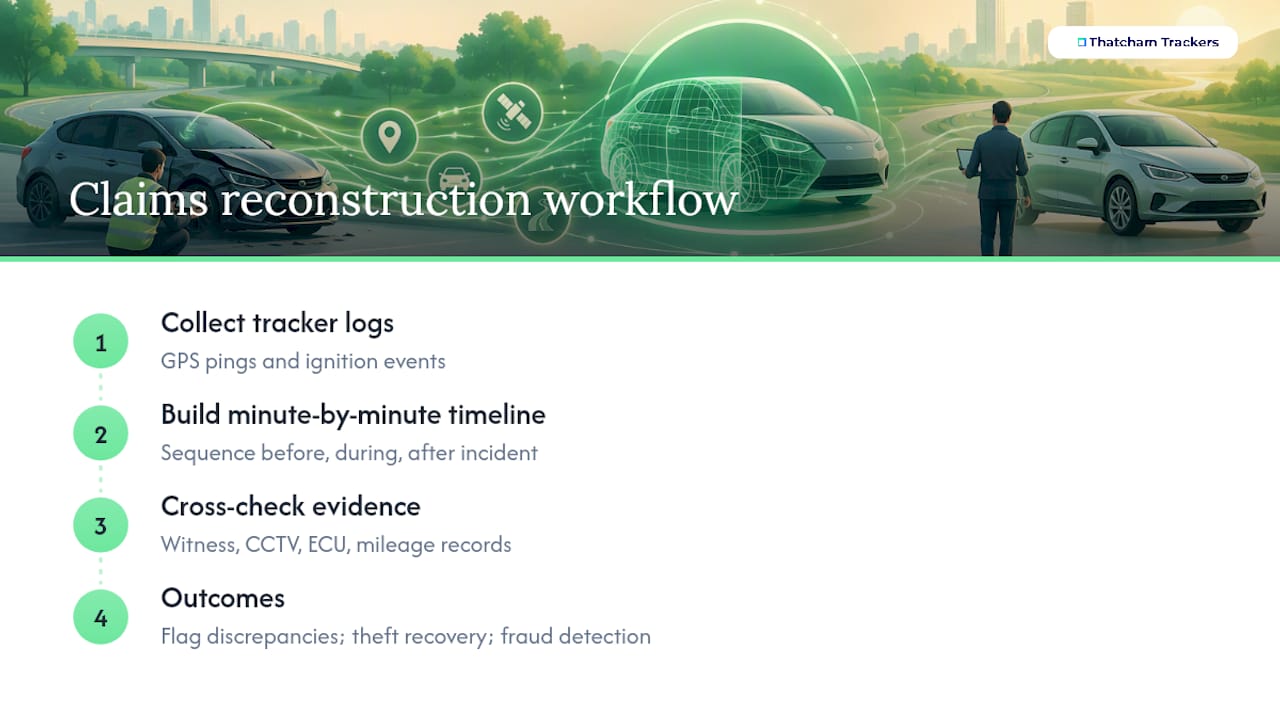
Statistic callout: Industry commentary suggests that vehicle-to-insurer data sharing can substantially reduce claim approval times when connected data is available, according to analysis on data sharing in UK motor claims.
Tracker data also drives theft recovery directly. Live location feeds let monitoring centres liaise with police in real time, sometimes recovering a stolen vehicle before the claim paperwork is even finished. One tracking firm reported helping recover £41.3 million worth of stolen vehicles in 2025, a scale that shows how much insurers now lean on this kind of live data rather than waiting on police resources alone.
Fraud detection is the other side of the coin. Structured telematics has been used to disprove staged accidents in documented cases, cutting both investigation time and payout risk. When the data is clean and consistent, it tends to shorten disputes rather than lengthen them.
How do you request and export tracker data for a claim?
Speed and format both matter here. A screenshot of a phone app is far weaker evidence than a signed, timestamped export.
- Preserve first, act second. Don’t reset the app, remove the device, or let the battery die before data is pulled. Anything that interrupts logging weakens your case.
- Export from your own app if possible. Most Thatcham-approved trackers, including Thatcham S5 devices, let owners pull a journey history directly from the companion app.
- Contact the monitoring provider. They can issue raw logs with device identifiers and a signed statement of authenticity, which carries far more weight than a screenshot.
- Ask your insurer what format they need. Some want CSV exports, others want a formal incident report from the monitoring company.
- If police are involved, request their data separately. Police-retrieved evidence follows its own chain-of-custody process and usually needs a formal request or subject access request to release.
Response times vary. A monitoring provider might turn around a signed export within a day or two; police data requests routinely take weeks.
Pro Tip: Ask the monitoring provider for GPS logs with epoch timestamps and device IDs, plus their signed statement of authenticity. Insurers and police accept that combination far more readily than a phone screenshot, based on Thatcham’s own product definitions guidance.
Is it legal for insurers to use your tracker data?
Location and dashcam data count as personal data under UK GDPR, so there has to be a lawful basis before anyone processes it during a claim.
For most policies, that basis is written into the contract you signed when you took out the policy or activated the tracker. Consent isn’t usually the mechanism insurers rely on. It’s “performance of a contract” or “legitimate interest” in investigating a claim you’ve raised yourself.
A few practical points worth acting on before you ever need to make a claim:
- Check your tracker app’s permission settings now, not after an incident, so location history isn’t accidentally capped or deleted.
- Read the data-sharing clause in your policy wording. It usually specifies what the insurer can request and from whom.
- Keep your monitoring provider’s contact details somewhere accessible. You’ll need them fast if a claim is opened.
- If an insurer refuses to release data that relates to your own vehicle, or a provider won’t cooperate, that’s when to involve a solicitor or escalate.
If access is unfairly blocked and the dispute drags on, the Financial Ombudsman Service has ruled on cases in which vehicle electronic data, including ECU and key logs, was decisive. It’s a real route, not a last resort to be embarrassed about using.
Why tracker data alone doesn’t always settle a claim
No tracker is immune to interference, and claims handlers know it. GPS signals can be jammed. Some devices can be spoofed. A unit can be disconnected before a theft, or transmission can lag long enough to create gaps in the timeline.
That’s exactly why the old fraud checklist is outdated. Absence of forced entry used to be treated as a red flag for a staged claim. With keyless theft, relay attacks, and app takeovers now common, a clean lock with no forced entry proves almost nothing on its own.
Statistic callout: Investigators increasingly treat “no forced entry” as a neutral finding rather than suspicious, precisely because modern theft techniques rarely leave physical traces.
Handlers corroborate tracker data with:
- ECU and mileage records, to check whether the vehicle’s own systems match the tracker’s story
- CCTV or doorbell footage from the area, where available
- Witness accounts and police incident numbers
- Cross-checking multiple sensors on the same device (ignition, movement, tamper alert) rather than trusting one signal in isolation
What should you submit with a claim to make tracker evidence insurer-ready?
Getting this right the first time avoids weeks of back-and-forth requests from your insurer.
- Raw GPS logs, ideally as CSV files with timestamps, not a screenshot of a map.
- Dashcam footage, saved in its original file format with metadata intact, not re-recorded or cropped.
- A signed statement from your monitoring provider, confirming the data’s authenticity and how it was extracted.
- Your police reference number, if one was issued.
- Photos of the vehicle and scene, dated and, where possible, geotagged.
- A short chain-of-custody note, stating who accessed the data, when, and how it was stored.
Name files clearly (date, vehicle registration, data type) and send copies to both your insurer and broker. Always keep the originals yourself.
What we’ve learned fitting Thatcham S5 and S7 devices across the UK
Certification from Thatcham Research is the anchor point every insurer recognises, but a certified device only earns its value when it’s fitted correctly and the owner knows how to pull an export fast. We see far too many owners who have the right tracker but no idea how to get a signed log out of it when a claim actually lands. The gap isn’t the technology. It’s preparation.
— Thatcham Trackers
Get insurer-ready evidence before you ever need to claim
Thatcham Trackers sells and fits the exact certified devices your insurer expects to see, so the evidence question is settled before an incident happens, not scrambled together afterwards.
For our standard wired trackers, professional fitting is included subject to coverage and availability. Your digital certificate is issued immediately once installation and commissioning are complete. Confirm the exact device, monitoring service and evidence with your insurer. Certification does not guarantee acceptance or a claim outcome.
This article is general information, not a substitute for advice from a qualified financial advisor. Consult a qualified financial professional about your own circumstances before acting on anything here.
Sources
- Vehicle security product definitions and guidelines (Thatcham Research)
- Three motor claims that prove telematics is a must | Insurance Business
- The claims intelligence gap - DLB Investigations
- Financial Ombudsman decision involving vehicle electronic evidence
FAQ
Can Tracker Data Prove I Wasn’t Driving When My Car Was Stolen?
Yes, tracker data showing ignition events, movement, and immobilisation logs can support your account of when and where the vehicle was taken. Insurers usually want this alongside a police reference and, where fitted, dashcam footage for a fuller picture.
What’s the Difference Between Thatcham S5 and S7 for Claims?
S7 provides monitored location tracking and S5 adds Automatic Driver Recognition. Both can supply relevant location and event records, depending on the system. The usefulness of evidence depends on the recorded events and the insurer’s requirements, not simply the category.
How Long Does It Take to Get Tracker Data for a Claim?
A monitoring provider can often issue a signed data export within a day or two of a request. Police-retrieved data usually takes longer, sometimes several weeks, because it follows a formal chain-of-custody process.
Does Thatcham Certification Guarantee My Insurer Will Accept the Data?
Certification confirms the device meets a tested performance standard, but insurer acceptance of the data is a separate commercial matter, according to Thatcham’s own certification guidance. Most major UK insurers do recognise Thatcham-approved devices, which is why fitting one from a range like Thatcham S5 makes the evidence question far simpler from the outset.